

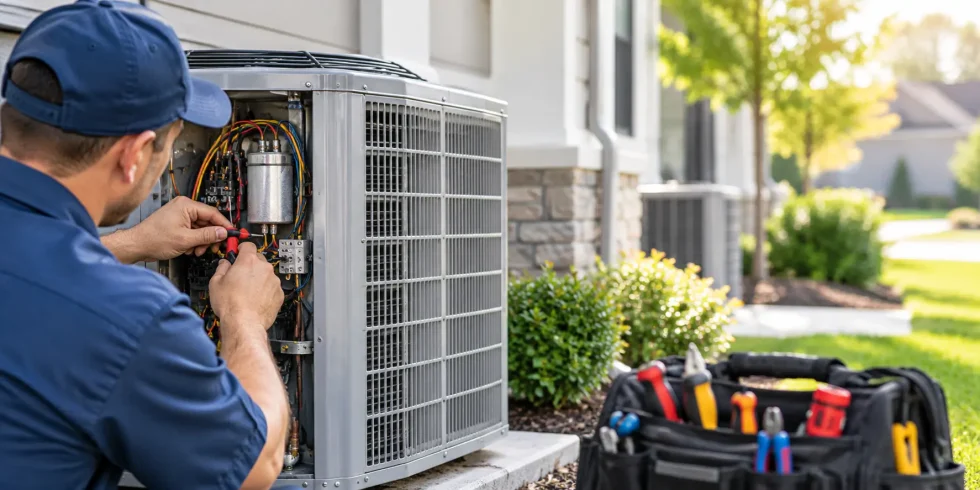
Hot, sticky summers and quick temperature swings make comfort in Louisville more complicated than setting a thermostat. Cooling systems must remove heat and moisture, ductwork must move enough air without excess resistance, and controls must encourage longer, gentler run times when humidity spikes. When any of those three pieces is off, you get rooms that feel clammy, uneven temperatures, or equipment that runs hard but never quite catches up. This guide explains how humidity, airflow, and sizing interact, along with clear steps homeowners can take to diagnose common problems and hold smarter conversations during service visits.
-
How Humidity Changes the Cooling Job
Air conditioners and heat pumps remove sensible heat and latent heat. Sensible heat is the temperature you read on a thermostat. Latent heat is moisture in the air that condenses on the evaporator coil. High humidity loads in July can push systems that are technically large enough on paper but do not run long enough to wring out moisture. That is why an oversized unit can make a home feel cool yet damp: short cycles drop the air temperature quickly, then the system shuts off before the coil has time to drain significant moisture.
If your living room reaches the setpoint but still feels clammy, you may be dealing with short cycling. Two-stage or variable-speed equipment and thermostats with humidity control encourage longer, lower-speed cycles that boost moisture removal. A thermostatic expansion valve (TXV) can help maintain proper refrigerant flow under varied conditions, improving latent capacity. If you need help with calculations or pressure readings, a local HVAC contractor can check runtime trends, coil temperatures, and setup to confirm whether equipment behavior, charge, or controls are limiting dehumidification.
-
Airflow and Ductwork: The Hidden Performance Cap
Even a perfectly sized system cannot perform if airflow is choked. Most systems need around 350 to 400 cubic feet per minute (CFM) per ton of cooling. Excessive static pressure across a restrictive 1-inch high-MERV filter, a dirty evaporator coil, or undersized return ducts will starve the blower. Symptoms include noisy vents, weak airflow in distant rooms, coil icing, and wide temperature differences between floors. An easy win is switching to a deeper 4-inch media filter that provides similar filtration with much lower resistance. That trade-off often delivers cleaner air and better airflow at the same time.
Duct leakage is another stealth problem. Leaky return ducts pull hot, dusty attic or crawlspace air into the system, raising the cooling and filtration load. Leaky supply ducts waste conditioned air into unconditioned spaces, which is essentially cooling the attic. Closing supply registers to “force” air elsewhere can backfire by raising static pressure and increasing leakage. A better approach is a balancing check and minor duct corrections, like adding a return in a starved room or adjusting manual dampers near the air handler to even out flows.
-
Thermostats and Staging: Controlling Runtime More Than Temperature
Controls shape how long and how hard an HVAC system runs. Single-stage units operate at full capacity or not at all, which can lead to temperature overshoot and short cycles in milder weather. Two-stage or variable-speed systems start low, allowing the evaporator coil to stay cooler longer for improved dehumidification. If you are pairing new controls with an existing system, ask whether your blower motor is ECM (electronically commutated) or PSC. ECM motors can modulate and hold airflow targets better, making advanced thermostat features more effective.
Thermostat fan settings matter on sticky days. “Fan on” can lift water off the evaporator coil between cooling cycles and re-evaporate it into the air, increasing indoor humidity. Leave the fan on “auto” unless a technician recommends a low continuous speed for a specific reason. Large setback strategies also have a humidity cost: pulling a house down from a big afternoon rise may demand long high-stage run times right when outdoor dew points are highest. Modest set-backs combined with longer low-stage cooling often feel better and can be more efficient in humid climates.
-
Maintenance That Protects Cooling and Heating Capacity
A clean system moves more air and transfers heat more easily. Outside, keep the condenser coil and fins free of cottonwood, grass clippings, and lint. Restricted outdoor airflow raises head pressure, which reduces capacity and strains the compressor. Inside, check that the evaporator coil is not matted with dust downstream of the filter. If you see dirt on the coil face, airflow has been bypassing the filter or the filter has been collapsing under high static pressure. That is a sign to address filter quality and duct resistance, not just to clean the coil.
The condensate drain deserves attention every cooling season. Algae and debris can clog the trap, causing water to back up and trip a float switch or, worse, overflow a secondary pan. A quick example: an attic air handler with a clogged drain can stain a bedroom ceiling overnight after a series of long humid runs. Flushing the trap, confirming the safety switch works, and ensuring the drain line has a proper slope can prevent this. During tune-ups, a technician should verify refrigerant charge using superheat and subcooling, inspect electrical connections, and measure total external static pressure across the filter and coil to catch airflow issues early.
When to Call a Pro and What to Ask
Some signs call for a trained eye: refrigerant lines frosting up, frequent short cycling without thermostat changes, a musty smell from supply vents, water near the furnace or air handler, or rooms that never reach target temperatures even after long run times. Before the visit, note the thermostat setting, how the system cycled, and any recent filter or control changes. That timeline helps a technician isolate whether the problem is charge, airflow, or control related.
Ask for data, not just a fix. A proper evaluation can include a Manual J load calculation for sizing, a duct inspection, static pressure measurements, and a check of blower settings or dip-switches. If improvements are needed, discuss trade-offs. Sealing and slightly resizing return ducts might cost less and improve comfort more than jumping straight to a larger condenser. Likewise, upgrading from a 1-inch restrictive filter to a 4-inch media cabinet can lower static pressure and extend blower life while maintaining filtration. If equipment replacement is on the table, consider a two-stage or variable-speed unit paired with a thermostat that offers dehumidification control for long, efficient runtimes in sticky weather.
Getting comfort right in a humid climate comes down to three levers that influence each other: equipment sizing and staging, ductwork and airflow, and controls that manage runtime and moisture. Focus on steady airflow, clean coils and drains, and thermostat strategies that encourage longer low-stage cycles. Paired with a filter that captures particles without choking the system and ducts that do not leak away your investment, these steps prevent the classic cool-but-clammy complaint and keep your system running efficiently through Louisville’s swings in weather.
