

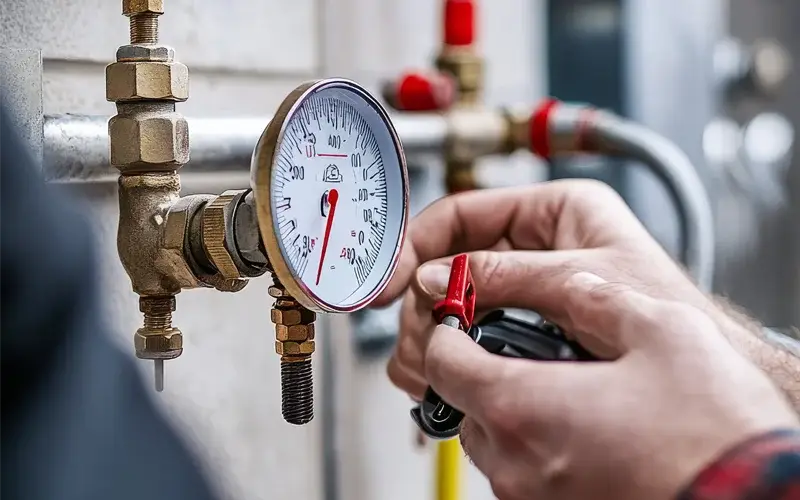
Sudden low flow at a faucet, banging pipes, or a shower that swings from strong to weak can all feel like “pressure” problems. In plumbing, though, true pressure and usable flow are related but not the same. A quick, safe diagnostic at home can tell you whether you are dealing with a clogged fixture, a partially closed valve, a high-pressure condition, or a supply issue coming from outside your house. The steps below use basic tools, including a towel, small wrench, bucket, and an inexpensive pressure gauge, and help you decide what to fix now and what to document for a licensed plumber. Before you begin, locate your main shutoff so you can stop water quickly if a fitting loosens.
-
Pressure vs. Flow: What Your Symptoms Actually Signal
Start by noting where the problem appears. If one faucet is weak but others are normal, you are probably looking at a restriction at the fixture, such as a clogged aerator or a stuck cartridge. If every fixture is affected, the cause is more likely at the main shutoff, the pressure reducing valve (PRV), a whole-house filter, or the municipal supply. If only the hot side is slow, that points you toward your water heater path and its valves rather than the cold supply. If you prefer to compare common approaches before touching anything, service pages from local Crofton, MD plumbers outline how professionals separate fixture problems from supply problems.
-
Start at the Fixture: Aerators, Angle Stops, and Supply Lines
Fixture checks are fast and often fix the issue. Under the sink, make sure the angle stop valves for both hot and cold are fully open. A valve opened only one quarter of the way can restrict water flow to a faucet. Inspect braided supply lines for kinks, especially where they loop to the faucet. At the spout, unscrew the aerator, tap out grit, rinse the screen, and test flow with the aerator removed. If flow improves sharply, the screen was the restriction point. For faucets with a single handle, debris can lodge in the cartridge. After shutting off the angle stops, cleaning or replacing the cartridge according to the manufacturer’s instructions can resolve restrictions introduced after recent plumbing work.
A common mistake is overtightening compression fittings when reattaching lines. That can deform the ferrule and create a slow leak. Tightening connections according to the manufacturer’s specifications is important. Another mistake is confusing flow with temperature. Replacing a thermostat will not cure a weak hot water stream at one sink. In one typical scenario, a kitchen faucet dribbles while the nearby laundry sink produces strong water flow. Cleaning the aerator or replacing a clogged supply line usually resolves the kitchen problem without adjusting the home’s water pressure.
-
Test the Whole House: Main Valve, PRV, and a Hose Bib Gauge
If multiple fixtures suffer, verify that your main shutoff valve is fully open. Gate valves can fail halfway, and ball valve handles should align parallel to the pipe when open. Next, measure static pressure. Screw a pressure gauge onto a hose bib or laundry tap, then open the valve. Residential static pressure commonly falls in the 50 to 60 psi range, although acceptable operating pressure varies by property and local requirements. Readings above 80 psi are generally considered excessive and may exceed plumbing code limits because that stress can shorten the life of supply lines, toilet fill valves, and washing machine hoses.
If pressure is high, look for a bell-shaped PRV near where water enters the building. Many homes also have an expansion tank near the water heater to absorb thermal expansion in a closed system. A waterlogged expansion tank can contribute to pressure spikes even if the average pressure looks fine on the gauge. Adjusting or replacing a PRV is not simply a matter of turning a screw. Incorrect adjustment can create pressure problems and increase wear on plumbing components. There is also a tradeoff to consider: lowering pressure to protect fixtures can reduce irrigation performance and the strength of showers. Measuring pressure while a fixture runs, known as a dynamic pressure test, can reveal a large pressure drop, which points to a restriction rather than simply an incorrectly adjusted regulator.
-
Hot Water Only Problems: Follow the Heater’s Valves and Outlets
When only the hot side is weak, follow the hot water path rather than the thermostat. Confirm that the water heater’s cold inlet and hot outlet valves are fully open. On tank models, heat trap nipples or the outlet fitting can accumulate mineral scale and debris that restrict hot water flow, especially after sediment is disturbed. Flushing the water heater can reduce future buildup, but a flush alone will not clear a clogged outlet fitting. On tankless units, scale at the heat exchanger is a frequent cause of poor hot water flow. Descaling with a pump and an approved cleaning solution is a standard professional remedy.
Some homes include a tempering or mixing valve that blends hot and cold water to a set output temperature. If that valve is failing or partially closed, it can mimic low-pressure symptoms on the hot side. Expansion tanks matter here too. In closed systems, thermal expansion raises pressure when the heater runs. If the expansion tank has lost its air charge, the resulting pressure spikes can trigger the water heater’s temperature and pressure relief (TPR) valve to seep and can aggravate water hammer. Checking the expansion tank’s air pressure with a tire gauge, after safely relieving water pressure according to the manufacturer’s instructions, is a useful follow-up task for an experienced homeowner or licensed plumber.
When Symptoms Point Upstream: Meters, Filters, and Buried Lines
If pressure is low throughout the home and the gauge never rises into a normal range, the issue can be upstream of your fixtures. Whole-house filters and softeners are common restriction points. Try the softener’s bypass lever and recheck flow. A clogged filter cartridge can reduce pressure dramatically. If pressure recovers when you bypass the filter housing using its designated bypass arrangement, you have identified a likely restriction. Irrigation backflow preventers can also trap debris and restrict outdoor hose bibs fed from the same supply connection.
If filtration equipment is not installed or bypassing it changes nothing, you may be dealing with a failing PRV, debris lodged at the water meter’s internal screen, or a partially collapsed or corroded service line. Static pressure that looks fine but drops sharply when multiple fixtures run suggests a restriction in the supply piping. Avoid opening municipal valves or meter boxes yourself because these components are often sealed and maintained by the water utility. In a realistic example, a home shows 55 psi static pressure at a hose bib, but the shower and dishwasher running together cause water flow to drop to a trickle. A plumber’s flow test and inspection of the service line, PRV, and meter strainer can pinpoint the restriction without guesswork.
A few preventive habits reduce repeated pressure complaints. Once a year, clean faucet aerators, carefully operate seldom-used angle stops if they are in good condition, and record a fresh pressure gauge reading at a hose bib. If your gauge rises above 80 psi or you hear regular banging when fixtures close, arrange a PRV and expansion tank inspection. After any plumbing work that involves shutting off the main, remove aerators and flush lines briefly to clear disturbed debris before it becomes lodged in cartridges. If your tests reveal pressure outside the normal range, visible corrosion, or unexplained drops throughout the house, documenting those readings will help a licensed plumber move efficiently from diagnosis to repair.
