

A commercial gym’s weight area can look impressive on opening day and still become frustrating within a few months. The problem usually isn’t a lack of equipment. It’s buying the wrong mix, creating awkward traffic patterns, or failing to account for how people actually train.
A better approach is to plan the strength floor around usage. Think about which stations will attract queues, where people need room to lift safely, and how quickly members can find and return equipment. Those details have a bigger impact on the daily gym experience than simply squeezing another machine into the room.
Start With the People Who Will Use the Gym
Before ordering a rack of dumbbells or stacks of plates, consider your membership.
A general fitness club may need a broad weight range because its members include beginners, experienced lifters, older adults, and people returning to exercise. A strength-focused facility will probably need more heavy plates, barbells, racks, and lifting platforms. A hotel or workplace gym may benefit from a smaller, simpler selection.
This matters because commercial equipment takes up valuable floor space. Buying equipment that rarely gets touched isn’t just a purchasing mistake. It’s space that could have been used for something members need every day.
Watch existing member behaviour if you’re upgrading an established facility. Which dumbbells disappear during peak hours? Are members waiting for barbells? Do people carry plates halfway across the gym because storage isn’t close enough?
Those observations tell you far more than a catalogue does.
Build the Free-Weight Foundation First
Most commercial strength areas need a dependable core of free weights.
Dumbbells
Dumbbells are among the most flexible pieces of equipment you can put on a gym floor. Members can use them for presses, rows, squats, lunges, curls, raises, and dozens of other movements.
The challenge in a commercial facility is choosing the right range and quantity.
One pair at each weight may sound sufficient on paper, but popular weights can quickly become a bottleneck during busy periods. If three people want the same pair at 6 p.m., somebody is waiting.
It can make sense to duplicate frequently used weights rather than spending that budget on unusual equipment that serves fewer members.
Barbells
A good barbell area gives experienced members room to train while remaining approachable for newer lifters.
Standard Olympic-style bars will cover many exercises, including squats, bench presses, deadlifts, rows, and overhead presses. Depending on your audience, you may also want lighter training bars and specialised options.
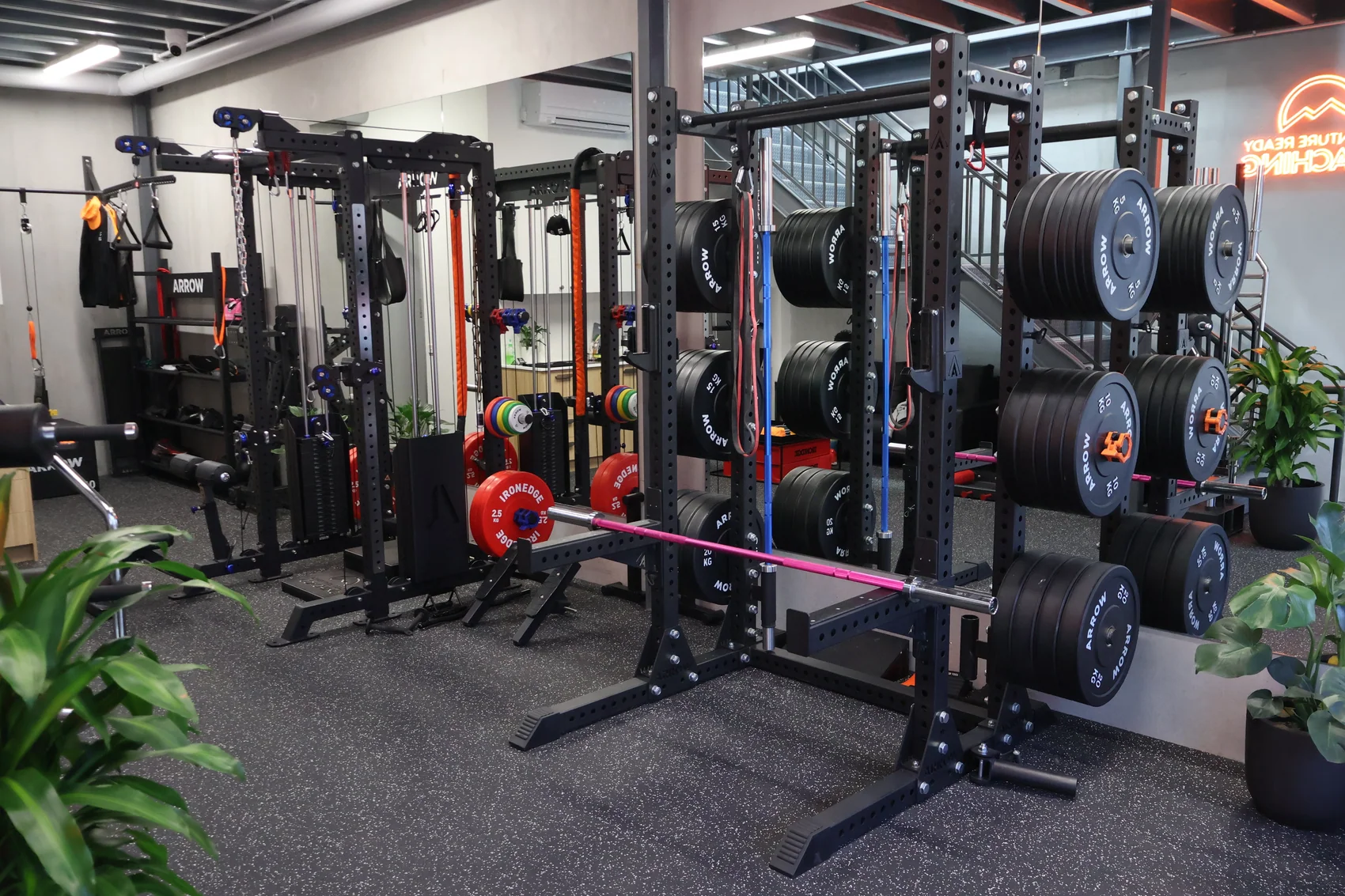
When comparing weights equipment for commercial gyms, think in terms of the entire training area rather than individual pieces. Barbells need plates, collars, racks, benches, and sensible storage nearby.
That turns a collection of products into a usable lifting station.
Don’t Underestimate Weight Plates
Plates are easy to underestimate because they’re scattered around a gym rather than occupying a single obvious station.
Consider a busy period where several racks are being used simultaneously. One person is squatting, another is deadlifting, two people are bench pressing, and someone else needs plates for a plate-loaded machine.
Suddenly, a large plate inventory doesn’t feel so large.
Your plate selection should reflect the number of stations that can use them simultaneously. Smaller change plates can also be useful because they allow members to increase resistance gradually instead of making unnecessarily large jumps.
Durability matters here too. Commercial weights are repeatedly loaded, unloaded, moved, and occasionally dropped. Equipment intended for frequent use should be selected with that workload in mind.
Storage Is Part of the Equipment Plan
Storage often gets treated as something to figure out after the main equipment arrives. That’s backwards.
Imagine walking through a weight area where plates are leaning against walls, dumbbells are sitting beside benches, and unused barbells are resting on the floor. Even if every individual piece of equipment is excellent, the room feels disorganised.
More importantly, poor storage can interfere with movement.
Plan storage at the same time as the weights themselves. Dumbbell racks should be positioned where users can access them without blocking people who are exercising. Plate storage should be reasonably close to racks and plate-loaded stations. Barbell storage needs to keep unused bars accessible without putting them in walkways.
A simple rule helps: make the correct place to return equipment the easiest place to return it.
If members have to walk across the room to put a plate away, don’t be surprised when plates accumulate beside racks.
Give Lifters Enough Room
Trying to maximise equipment count can backfire.
A floor packed with equipment might photograph well, but commercial gyms need circulation space. Members carry dumbbells between racks and benches. People load plates from either side of a bar. Trainers move around clients to check technique.
Deadlift and squat areas require particularly careful planning. You don’t want somebody walking directly behind a lifter because the aisle was squeezed between two stations.
Start with the movements that require the most space and build outward. Once racks, platforms, benches, and major traffic routes are established, smaller pieces can fill suitable gaps.
This approach may leave a little more open floor than expected. That’s usually a good thing.
Choose Benches Based on Demand
A large dumbbell collection isn’t particularly useful when every bench is occupied.
Flat and adjustable benches allow members to perform a wide variety of exercises, and adjustable models can cover flat, incline, and sometimes decline positions. The right balance depends on the type of training your members prefer.
Placement matters as much as quantity.
Leave enough distance between benches for people to lift and lower dumbbells without interfering with the person beside them. Members also need a clear route back to the dumbbell rack.
If people constantly drag benches across the gym to find room, that’s a sign the original layout isn’t matching actual behaviour.
Think About Peak Hour, Not Quiet Hour
Visit almost any gym during a quiet afternoon and the equipment selection can seem perfectly adequate.
Peak hour tells the real story.
Plan for the period when the largest number of members will be training at once. Ask what happens when every rack is occupied. Are there alternative stations? Are enough plates available? Can people still move through the room safely?
This doesn’t mean buying two of everything. It means identifying the equipment most likely to create queues.
Sometimes the smarter investment is another adjustable bench or duplicate set of popular dumbbells rather than an additional specialised machine.
Leave Room for the Gym to Change
Member preferences aren’t fixed.
A gym might open with a particular training style in mind and discover a year later that members are using the facility differently. Strength classes may become popular. More members might start barbell training. Personal trainers may need additional open space.
Avoid designing a floor so tightly that nothing can move.
Modular storage, movable benches, freestanding racks, and flexible open areas can make future changes much easier. Even when equipment itself is heavy, the overall layout shouldn’t feel permanently locked.
A Good Weight Area Feels Simple
The best commercial strength floors often feel obvious to use. Members can find the weight they need, locate an available training station, complete their exercise, return the equipment, and move on without weaving through a maze.
Achieving that simplicity takes planning.
Choose equipment according to member demand rather than filling space for the sake of variety. Provide enough weights for simultaneous users, position storage where people naturally need it, and give each lifting station adequate room.
When those fundamentals are right, the weight area doesn’t need gimmicks. It simply works.
