

Key Takeaways
- Art Deco is best understood as a citywide design language, not a style limited to one famous tower.
- A rewarding route combines skyline views with close looks at doors, stonework, metalwork, and entrances.
- Keeping the walk within one neighborhood reduces backtracking and leaves time for breaks and discoveries.
- Private lobbies and interiors may have changing access rules, so the sidewalk should remain the core of the plan.
- Comfortable shoes, weather awareness, and a flexible indoor stop make the walk more enjoyable in every season.
Table of Contents
- Why Art Deco Still Matters In New York City
- What To Look For On The Walk
- How To Plan The Route
- A Sample Midtown Route
- How To Read An Art Deco Building
- Photography Tips For Architecture Walks
- Practical Planning
- Preservation, Change, And City Memory
- Common Questions
New York City, New York, rewards people who look above the storefronts. On a self-guided Art Deco walk, a familiar Midtown block can become a sequence of setbacks, polished metal, stone reliefs, glowing lobby lights, and patterns designed to suggest speed, confidence, and a modern future.
The Empire State Building is an easy visual anchor for this kind of exploration, especially for visitors beginning near 34th Street. Before choosing whether to add its observatory or exhibits to the day, learn more. Then build the rest of the route around public sidewalks, nearby facades, and details that do not require a packed attraction schedule.
Why Art Deco Still Matters In New York City
Art Deco uses crisp geometry, symmetry, rich materials, and imagery associated with industry, travel, nature, and progress. In New York, it appears at several scales: monumental office towers, apartment-house entrances, theaters, transit-related spaces, and modest commercial facades. The style flourished during the 1920s and 1930s, but its visual energy still fits a city built around movement and reinvention.
For useful context before setting out, the history of Art Deco architecture in New York City shows how broadly the style shaped the city. The important lesson for walkers is simple: do not save your attention only for the skyline. Some of the best moments are at eye level.
What To Look For On The Walk
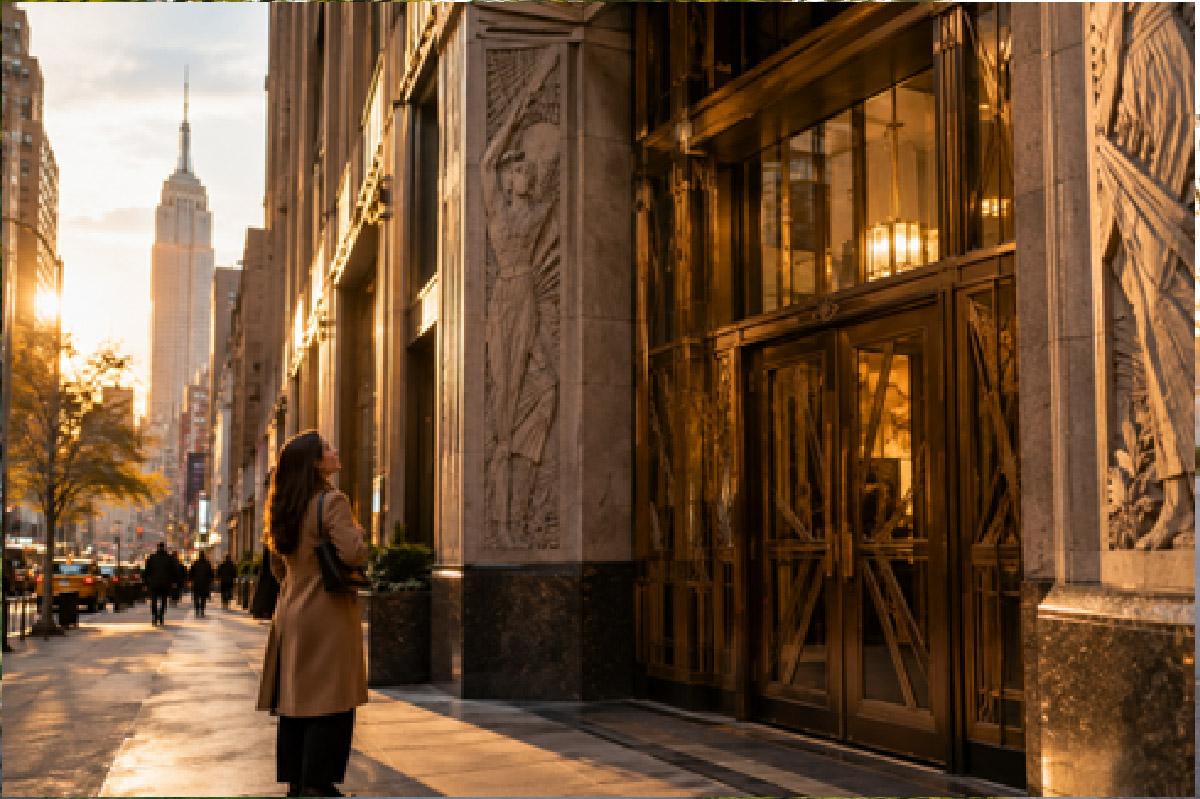
Use a short visual checklist. First, notice vertical emphasis: narrow windows, piers, and stepped upper stories that lead the eye toward the roof. Then look for sunbursts, chevrons, zigzags, fans, repeated lines, and stylized flowers or animals. These motifs may appear in stone, terra cotta, tile, glass, or bronze-colored metal.
Entranceways deserve extra time. Study the doors, handles, transoms, light fixtures, mailboxes, and elevator surrounds when they are visible from a public area. Contrasts often create the drama: pale stone beside dark metal, smooth glass beside carved reliefs, or brick walls broken by colorful decorative panels. Look up, too. Ornament is frequently placed well above the first floor.
How To Plan The Route
- Choose one compact area, such as Midtown, rather than trying to cross Manhattan repeatedly.
- Select three to five primary stops that can be appreciated from the street.
- Leave room for two flexible discoveries, such as an apartment entrance or an unusual storefront.
- Use transit for longer gaps, and allow extra time for traffic lights, photographs, and restrooms.
- Choose an indoor break that suits the weather, especially during summer heat, winter wind, or rain.
A focused route makes it easier to slow down. Instead of treating buildings as boxes to check off, compare how each architect used proportion, material, and decoration to make a corner, doorway, or roofline feel distinctive.
A Sample Midtown Route
Start near Herald Square or Penn Station, where transit connections make arrival straightforward. Walk toward the Empire State Building and spend time viewing its massing from several blocks away, then move along nearby streets where older office buildings and apartment entrances can reward a slower pace. Continue toward Fifth Avenue or east toward Grand Central-area streets, depending on your energy and interests.
For a 60- to 90-minute version, choose one major tower, two nearby facades, and a café or public indoor pause. For a half-day outing, add time for a museum, library, or neighborhood meal, then continue to another cluster of buildings. Avoid zigzagging across town just to collect landmarks. The best route has a clear rhythm.
How To Read An Art Deco Building
- Begin at street level. Identify the materials and examine the entrance composition.
- Follow the facade upward. Watch for changes in window pattern, setbacks, and ornament.
- Find repetition. Repeated shapes reveal the building’s organizing idea.
- Consider original purpose. A bank, office building, residence, or theater may express Art Deco differently.
- Compare the surroundings. Nearby newer buildings can make historic proportions and craftsmanship stand out.
Photography Tips For Architecture Walks
Photograph both the full building and the small evidence of design skill. Step across the street when it is safe to capture a facade, then move closer for a grille, carved panel, or lobby-facing detail. Morning and late afternoon can create stronger shadows, but overcast light can also help reveal stone texture. Keep entrances clear, respect posted rules, and ask before photographing in private interiors.
Practical Planning
Wear supportive shoes, bring water and a charged phone, and check the weather before leaving. New York sidewalks can be crowded, uneven, wet, or icy depending on the season, so route length should match the group’s pace. Building access, security practices, and photography rules can change, which is another reason to treat exterior viewing as the dependable experience.
Preservation, Change, And City Memory
Historic buildings need ongoing care to keep ornamental metal, stone, windows, and interiors legible over time. At the same time, older structures must adapt to present-day needs involving safety, accessibility, energy use, and new tenants. The work of the city’s Landmarks Preservation Commission reflects the public importance of protecting significant places while allowing a living city to keep changing.
Common Questions
How long should an Art Deco walk take?
A short neighborhood route can take one to two hours. A half-day walk provides more room for indoor stops, meals, photography, and unplanned detours.
Can the walk be done in winter?
Yes. Keep outdoor segments shorter, schedule warm breaks, and take extra care on wet or icy sidewalks.
Is a guide necessary?
No. A map, a few selected stops, and curiosity are enough for a satisfying self-guided walk. A guide can be valuable for people seeking deeper architectural history.
Can families enjoy the route?
Yes. Turn it into a scavenger hunt for sunbursts, zigzags, animals, unusual doors, and repeated geometric shapes.
New York City’s Art Deco heritage becomes more memorable when the pace is unhurried. Choose a practical route, leave space for a warm drink or a skyline pause, and let the details between destinations become part of the experience.
Read More: 7 Best Sober Companion Services for Private Recovery Support
