

For much of the past several decades, static stretching was the default recommendation for adults looking to maintain or recover range of motion. Physical therapists prescribed it. Coaches built warm-up routines around it. Most adults over 40 who noticed stiffness in the morning, tightness in the hips, or difficulty bending were told to hold a stretch for thirty seconds and repeat it daily.
The research has shifted significantly since then. Not dramatically, and not overnight, but steadily and clearly enough that practitioners working in rehabilitation, sports medicine, and movement health have begun rethinking what actually drives lasting flexibility in aging adults. Static stretching still has a place, but the assumptions behind it as a standalone practice — particularly for people over 40 whose connective tissue, nervous systems, and recovery capacity have changed — don’t fully hold up under scrutiny.
This article draws on that research to explain why a structured, movement-integrated approach to flexibility produces better outcomes than passive stretching alone, especially for adults navigating the physiological realities of midlife and beyond.
1. Flexibility in Aging Adults Is a Neurological Issue, Not Just a Tissue Issue
When most people think about tight muscles, they assume the problem is physical — shortened tissue that needs to be pulled longer. This is partially true, but it misses a more fundamental mechanism. Much of what we experience as stiffness is the nervous system applying a protective brake. The body sets a range-of-motion limit based on what it perceives as safe, and when you hold a static stretch, you’re pushing against that limit without giving the nervous system any reason to recalibrate it.
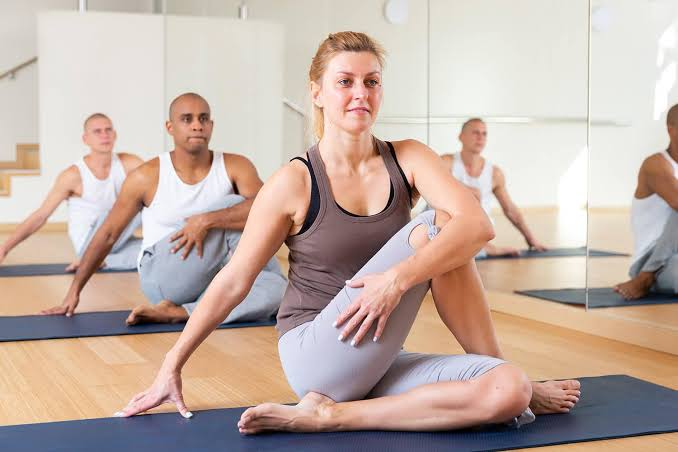
yoga flexibility classes address this differently. The combination of breath control, postural awareness, progressive loading, and movement sequencing gives the nervous system information — signals that the range being explored is stable, supported, and repeatable. Over time, the nervous system adjusts its protective threshold. Range of motion improves not just because tissue has lengthened, but because the body has learned to permit more movement.
This neurological dimension is one reason why adults who commit to yoga-based flexibility training often report changes that feel qualitatively different from what they experienced with isolated stretching. The shift is deeper and more durable because it operates at a different level of the body’s control system.
Why Static Stretching Doesn’t Fully Retrain the Nervous System
Static stretching, held passively, doesn’t require the nervous system to do much. The muscle is elongated under external pressure — gravity, body weight, or manual assistance — but there’s no active neuromuscular engagement. The nervous system isn’t learning to control movement through that range; it’s simply tolerating a temporary position. When the stretch is released, the body often returns to its habitual pattern within minutes. The protective limit hasn’t shifted; it’s been briefly bypassed.
2. Connective Tissue in Adults Over 40 Responds Better to Load Than to Passive Tension
After roughly the age of 35 to 40, the body’s connective tissue — tendons, ligaments, fascia — becomes less hydrated, less elastic, and slower to respond to mechanical stress. This doesn’t mean it can’t adapt. It means the conditions under which it adapts most efficiently change. Research on connective tissue remodeling, including work cited through the National Center for Biotechnology Information, consistently shows that collagen synthesis and tissue reorganization are stimulated by controlled, progressive mechanical loading — not by prolonged passive tension.
Yoga-based flexibility training applies load through movement. Transitioning between poses, holding positions that require active muscular engagement, and working through functional ranges all place the connective tissue under the kind of stimulus it needs to remodel. Static stretching, by contrast, applies tension without significant load variation, which is less effective at triggering the adaptive response in aging tissue.
The Practical Consequence for Recovery and Injury Risk
Adults over 40 who rely primarily on static stretching for flexibility maintenance often find that their range of motion improves slowly, if at all, while their connective tissue remains vulnerable to strain during more demanding activities. The tissue hasn’t been trained to handle load through extended ranges — it’s only been held there passively. This gap between passive and active range is where injuries frequently occur: a sudden reach, a misstep, a lift that demands more than the tissue has been prepared for.
3. Breath Integration Changes How the Body Responds to Stretch Sensation
One of the most consistent and underappreciated elements of yoga-based flexibility training is the role of structured breathing. When the body enters a position that approaches its range-of-motion limit, the natural reflex is to brace — shallow breath, increased muscle tension, elevated stress response. This reflex is protective, but it also prevents deeper adaptation.
Coordinated breathing, as taught in yoga flexibility classes, directly counteracts this pattern. Slow, controlled exhalation during a stretch activates the parasympathetic nervous system, which reduces the threat response and allows the muscles surrounding the joint to release more completely. The result is access to a greater range of motion within the same session — and over repeated sessions, a recalibration of the body’s default tension level.
Why This Matters More After 40
Adults over 40 typically carry higher baseline muscle tension than younger adults, driven by cumulative postural habits, chronic stress, and reduced sleep quality. This elevated baseline makes it harder to achieve meaningful stretch depth through static methods alone. Without the breath-based nervous system regulation that structured yoga practice provides, many adults plateau quickly and see diminishing returns from continued static stretching.
4. Movement Sequencing Builds Flexibility Within Functional Contexts
Static stretching is inherently isolated. A hamstring stretch addresses the hamstrings. A hip flexor stretch addresses the hip flexors. Each position is removed from the movement patterns the body actually uses during daily activity. This isolation has some value, but it doesn’t build what practitioners sometimes call functional flexibility — the ability to access range of motion while the body is moving, loaded, and coordinating multiple muscle groups simultaneously.
Yoga practice develops flexibility within sequences. Transitioning from a standing position to a forward fold to a lunge to a balance pose requires the hamstrings, hip flexors, glutes, and stabilizing muscles of the core to work in coordination. Flexibility gained in this context transfers more readily to real-world activity because it was developed within movement, not apart from it.
The Transfer Problem with Isolated Stretching
Many adults who stretch consistently report that their measured flexibility — what they can achieve in a specific stretch position — doesn’t reflect in how they feel or move during daily life. They can touch their toes on a mat but still feel stiff walking up stairs or lifting objects from low shelves. This is the transfer problem. Flexibility developed in isolation doesn’t automatically migrate to dynamic, integrated movement. Yoga’s sequential structure reduces this gap considerably.
5. Consistency Is Structurally Built Into Class-Based Practice
One of the most reliable predictors of flexibility improvement over time is consistency of practice. This sounds obvious, but it has a specific structural implication: the format of training matters because it determines how reliably people actually do it. Static stretching, as a self-directed practice, has a very high dropout rate. Adults over 40 often begin a stretching routine after an injury or a period of noticeable stiffness, maintain it for a few weeks, and then abandon it as the immediate discomfort fades.
Scheduled group yoga classes create an external accountability structure. The class happens at a set time. There is a teacher. There are other people. These elements are not incidental — they are the primary reason class-based flexibility training produces better long-term outcomes than equivalent self-directed work. The practice gets done more often, more consistently, and with more attention.
How Consistency Compounds Neurological Adaptation
The neurological adaptations described earlier — the nervous system’s gradual willingness to permit greater range of motion — require consistent repetition to consolidate. A single session creates a small, temporary shift. Regular sessions build on each other, reinforcing the new movement patterns and gradually making them the body’s default. Inconsistent practice, common with self-directed static stretching, interrupts this compounding process and forces the body to begin the adaptation cycle repeatedly from a baseline that hasn’t advanced.
6. Postural Awareness in Yoga Addresses the Root Causes of Age-Related Stiffness
Much of the stiffness adults over 40 experience is not a simple consequence of aging — it’s the accumulated result of sustained postures held over years of desk work, driving, and repetitive movement patterns. Forward head position, rounded shoulders, anterior pelvic tilt, and compressed hip flexors are common structural adaptations to modern sedentary activity. Static stretching can temporarily relieve some of the symptoms, but it doesn’t address the underlying postural patterns that recreate the problem continuously.
Yoga practice develops postural awareness as a core competency. Learning to position the pelvis, stack the joints, and engage the stabilizing muscles in the correct sequence teaches the body how to hold itself differently — not just during practice, but progressively throughout daily activity. This is a different kind of intervention than stretching. It works on the source rather than the symptom.
The Long-Term Structural Benefit
Adults who develop genuine postural awareness through structured yoga practice often find that the stiffness they attributed to aging decreases substantially over months of consistent work. This happens not because their age-related tissue changes reverse — they don’t — but because the habitual postural patterns that were compressing and shortening their tissues are gradually corrected. The underlying physiology is the same; the mechanical environment the body is operating in has improved.
7. Mental Engagement During Practice Enhances Proprioceptive Sensitivity
Proprioception — the body’s sense of where its parts are in space and how they’re moving — declines with age. This is a significant contributor to the stiffness and movement hesitation many adults over 40 experience. When proprioceptive sensitivity decreases, the body becomes less accurate in its movement, which triggers more conservative protective responses from the nervous system. Range of motion contracts partly as a precaution against falls and strains that the body is less confident it can control.
Yoga practice directly trains proprioception by demanding continuous mental attention to alignment, balance, and position. Unlike static stretching, which can be performed while watching television or thinking about something else entirely, yoga requires ongoing internal focus. This attentional demand is not a secondary feature — it’s part of the mechanism by which flexibility and movement confidence improve.
Why Mindless Stretching Produces Limited Results
When a stretch is performed without conscious attention to the body’s position and response, the proprioceptive system is not being trained. The person is in the position, but they are not developing the sensory awareness that would allow them to control and use that position in more demanding contexts. Yoga’s requirement for focused attention integrates flexibility work with proprioceptive training, producing a more complete and durable result.
Closing Perspective
The case against static stretching is not absolute. It remains useful for certain recovery applications, and it causes no harm when practiced correctly. The case being made here is more specific: for adults over 40 who want meaningful, lasting improvement in flexibility and movement quality, static stretching as a primary or sole method is insufficient. The physiology of aging connective tissue, the neurological nature of range-of-motion limits, and the structural realities of what makes people actually practice consistently all point in the same direction.
Structured yoga-based flexibility training addresses the problem at multiple levels simultaneously — neurological, connective tissue, postural, proprioceptive, and behavioral. That combination is why the outcomes differ, and why the research supporting movement-integrated flexibility work continues to grow while the evidence base for isolated static stretching has remained largely unchanged for decades.
For adults over 40 who have stretched faithfully and seen limited results, the honest conclusion is not that their body has stopped responding. It’s that the method they’ve been using wasn’t designed for what they actually need.
