

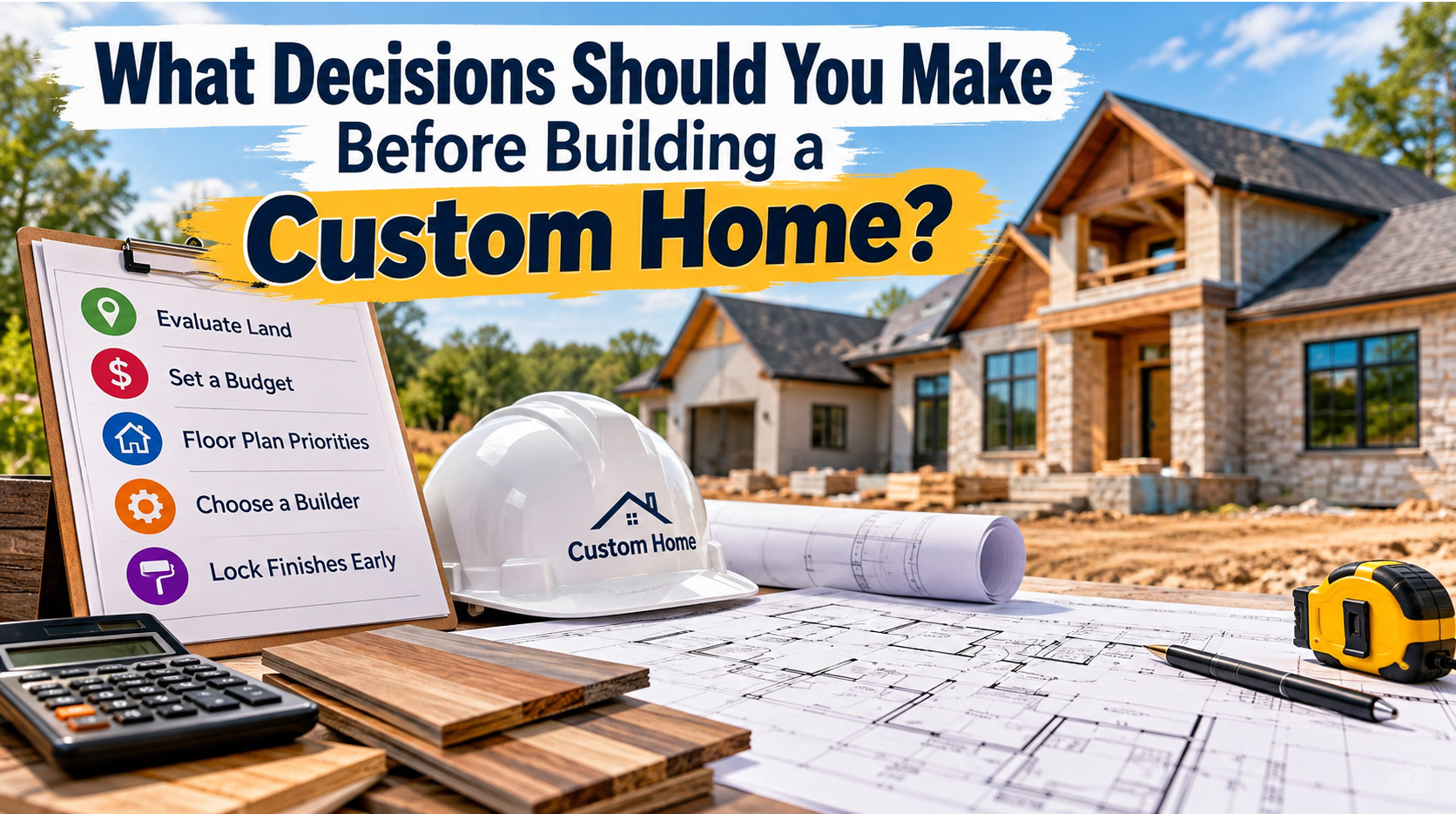
If you are planning a custom home, it’s easy to end up with cost overruns. The reason most cost overruns occur on custom homes is because most decisions were deferred too late in the process. In most cases by the time you begin excavation, you have spent most of your influence with respect to price, schedule and quality of design. The following are questions that are best answered prior to the time that they become very expensive to answer.
Set a budget that separates hard costs from everything else
A single number does not constitute a budget. A good budget includes the costs of hard construction versus land acquisition and site work, versus design and engineering, versus permits and impact fees, versus the interest incurred during the period that the money is tied up during construction, versus the costs of the finishes (furnishings) to be put into the completed house.
This way you can work from a fixed total price for the construction of your new house and deduct from this the non-construction items such as the purchase of the land and associated site works, and the cost of design and engineering. The remainder will then define the scope of your dream house, and stop you from allowing design to proceed against an ‘aspirational’ figure only to have to value-engineer down later when all the permits are in place.
Contingency and allowance discipline
8-12% contingency on new construction is standard, but on unknown sites, steep sites, etc., this can increase dramatically. Allowances on items such as plumbing fixtures also need to be scrutinized as these can often end up being higher than a builder’s ‘allowance’ set to keep their initial bid price competitive and end up as change orders.
Evaluate land for what it will cost to build on, not what it looks like
The price of the lot and the cost of the lot are two different numbers. In addition to soil conditions (e.g., rock, poor soil), there are water table issues, severe slope, difficult access for construction equipment, unusual utility placement, and the costs to develop septic or sewer for the property. All of these items can add up to six figures of unexpected cost to what appeared to be an economical piece of property.
- Geotechnical report and percolation testing where septic is required
- Survey with topography, easements, and setbacks confirmed
- Zoning and overlay district review, including height and lot coverage limits
- Utility availability letters and the actual cost to extend service to the building envelope
- Any HOA or architectural review committee standards that constrain massing or materials
Match the lot to the intended house
A single-story house with a wide footprint is often a bad bet for a narrow or sloping site. How the general form of your new home will relate to its site should be worked out before you buy the land, or at least you should be clear on what you are prepared to compromise on the site and what not.
Resolve floor plan priorities before drawings begin
Measuring design time as hours is another thing that disappears very quickly. It is best to lock down the non-negotiables for your custom home early on in the design process and list them out in full written detail. For example, a single-level primary suite, 10-foot ceilings, 12-foot garage, a kitchen that seats 8 people. The rest of the home’s square footage is merely additional ‘flexible’ space that can be stripped of non-essential items as necessary.
To understand the trade-offs between square footage and shape, the client must recognize that every complex roof line, long wall, exterior corner and special detail (no matter how seemingly minor) adds cost without adding square footage. Thus, the way a house relates to its lot is fundamentally a cost issue and the client who can understand this will be far better at making trade-offs between rooms than the client who can only think in terms of square footage. If you intend to build a custom home in Medina County, it is worth walking through these form-versus-footprint decisions with a builder who already knows the local lots and soil conditions.
Lock finishes early and understand where lead times live
Most delays, and cost overruns on a custom home, arise from finish selections made after the framing of your new home is complete. Items such as windows, custom cabinetry, specialty tile, as well as specialized mechanical items have very long lead times. It is crucial to select these items well before the commencement of framing your home and to have selected them in substantial completeness prior to the permitting of your home.
| Decision | Best timing | Cost of deferring |
| Site due diligence | Before land closing | Unbudgeted site work, or an unbuildable lot |
| Budget allocation by category | Before schematic design | Redesign fees and lost permit time |
| Structural and plan decisions | Before construction documents | Re-engineering, revised permit review |
| Windows, cabinetry, appliances | Before permit submission | Framing delays, substitution at higher cost |
| Tile, paint, hardware | Before rough-in inspection | Trade resequencing and crew downtime |
Choose the builder on process, not price
Be sure to compare bids line by line, make sure they all have the same scope and contain the same allowances. Also be sure that they all assume the same site work. The lowest bid will usually be the least complete.
What to ask before signing
- How are change orders priced, approved, and documented
- Who holds responsibility for schedule, and what triggers an extension
- How many projects will the assigned superintendent run concurrently
- What is covered by warranty, for how long, and who performs the work
- How are subcontractor payments and lien waivers handled
Don’t confuse the style of a custom home with the process of building it. This process is the coordination of budget, site limitations, the prioritization of your needs and the hiring of a builder to complete the project. Completing a custom home within the funds you started with is easy, just complete the necessary steps in the correct order.
You May Also Read: Beyond the Blue Water: What to Consider Before Building a Backyard Pool
