

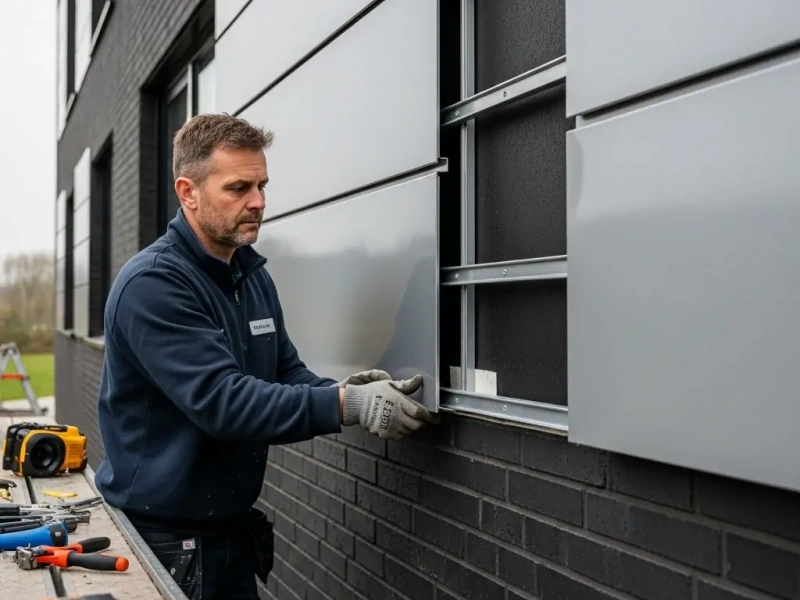
When a building owner or project manager starts evaluating exterior cladding options, the decision often begins with material cost. That’s a reasonable starting point, but it rarely tells the full story. The real financial picture only becomes clear when you account for how a cladding system performs over time — how it holds up against weather, how much ongoing maintenance it requires, and how well it preserves the integrity of the structure beneath it.
Both metal and composite cladding have earned their place in commercial and industrial construction. Neither is universally superior. What separates them — in terms of long-term value — comes down to the specific conditions of a project: the building type, the climate, the maintenance capacity of the owner, and how long the structure needs to perform without intervention. This article breaks down both options across those dimensions so that decision-makers can form a clear, evidence-based view before committing to one direction.
Understanding the Role of Cladding in Long-Term Building Performance
Cladding is not purely aesthetic. It functions as a building’s primary barrier against moisture infiltration, wind pressure, thermal cycling, and UV degradation. When cladding fails — whether through delamination, corrosion, joint failure, or surface breakdown — the costs extend well beyond replacing the panels themselves. Water intrusion behind a failed cladding system can compromise insulation, structural framing, and interior finishes, turning what might have been a manageable surface repair into a significant remediation project.
This is why selecting the right cladding solutions from the outset matters as much as any other structural decision. Professionals who have evaluated projects across different climates and building types consistently find that the ten-year cost of a cladding system is shaped more by its failure rate and maintenance demands than by its initial installation price. A material that costs less upfront but requires repainting every three years, or that begins showing surface oxidation in coastal environments, often ends up more expensive in the long run than a higher-cost system that holds its performance without intervention.
According to the Designing Buildings knowledge base, cladding systems must balance thermal performance, structural load requirements, and durability against environmental exposure — factors that vary significantly depending on the location and building use.
Why the Ten-Year Window Matters for Cost Comparison
Most building owners and facilities managers think about capital expenditures in cycles that align with financing terms, lease renewals, or operational planning horizons. Ten years is a meaningful benchmark because it captures the first full maintenance cycle for most cladding materials, while stopping short of the longer lifespan projections that are difficult to validate without controlled conditions.
Within a ten-year window, you can realistically measure repainting or recoating frequency, joint sealant replacement needs, panel replacement rates due to impact or weather damage, and labor costs associated with routine inspections. These costs, compounded across the life of a cladding system, often shift the financial advantage from one material category to another in ways that aren’t obvious from a line-item quote.
Metal Cladding: Strengths, Limitations, and Real-World Performance
Metal cladding — most commonly aluminum, steel, or zinc — is widely used across commercial, industrial, and institutional buildings. Its appeal is well-founded. Metal panels are dimensionally stable, fire-resistant, and capable of spanning large surface areas with minimal joint interruptions. When properly installed with appropriate coatings, metal cladding can perform for decades with limited surface degradation.
The durability of metal cladding is closely tied to the quality of its coating system. Powder-coated or PVDF-finished aluminum panels, for example, resist UV fading and surface chalking far better than painted steel. In moderate climates with limited salt air exposure, a well-coated aluminum system can go ten or more years without requiring surface refinishing. This characteristic makes metal a strong candidate for projects where long intervals between interventions are a priority.
Where Metal Cladding Carries Hidden Costs
Metal cladding performs less predictably in specific environmental conditions. In coastal or industrial environments where salt air, chemical exposure, or high humidity are persistent factors, even well-coated metal panels can show surface corrosion, particularly at cut edges, fastener points, and panel joints. These are the locations where protective coatings are thinnest or where moisture can accumulate.
Thermal expansion is another operational consideration. Metal expands and contracts significantly with temperature changes, which places ongoing stress on joint sealants and fastener systems. Over a ten-year period, this movement can lead to sealant failure at panel joints, which, if left unaddressed, creates pathways for moisture infiltration. Buildings in climates with wide seasonal temperature swings — cold winters and hot summers — tend to see this problem emerge earlier and more frequently than buildings in stable climates.
The labor cost of inspecting and resealing metal cladding joints is often underestimated at the procurement stage. It is not a dramatic expense in any single year, but it is consistent and recurring, and it requires access equipment and skilled trades to execute properly.
Composite Cladding: What It Offers and Where It Falls Short
Composite cladding systems are typically manufactured from a combination of materials — most commonly a polymer core bonded between metal facings, or a fiber-reinforced polymer panel with a wood or mineral filler. The composition varies by manufacturer and application, but the common thread is that composite panels are engineered to balance the aesthetic qualities of natural materials with the durability benefits of synthetic construction.
One of the practical advantages of composite cladding is resistance to the thermal expansion problems that affect solid metal systems. The layered construction absorbs some movement internally, reducing the stress on joint systems over time. Composite panels also tend to be lighter than equivalent metal assemblies, which can reduce structural load requirements and simplify installation logistics on certain building types.
Surface Performance and Long-Term Durability Considerations
Composite cladding systems vary considerably in their long-term surface performance, and this is where specification decisions have the most impact. Lower-grade composite panels — particularly those with thin polymer skins — can show surface fading, micro-cracking, or delamination under prolonged UV exposure or freeze-thaw cycling. When this occurs, the repair path is more complex than with metal, because composite panels often cannot be refinished in place and instead require full panel replacement.
Higher-quality composite systems, particularly those used in commercial and institutional applications, are engineered to resist these failure modes and carry performance warranties that reflect their expected lifespan. The gap in ten-year performance between lower-grade and higher-grade composite products is significant enough that composite cannot be treated as a uniform category when making cost comparisons.
Maintenance Demands Over a Decade
When composite cladding is specified correctly for the application and climate, its maintenance profile over ten years tends to be straightforward. Most systems require periodic cleaning to prevent biological growth — moss, algae, and mold can establish on textured composite surfaces in humid climates — and occasional inspection of mechanical fasteners and perimeter sealants. Unlike metal systems, composite panels in appropriate grades rarely require recoating or refinishing within a ten-year window, which reduces the skilled labor component of ongoing maintenance costs.
This characteristic makes composite cladding particularly practical for building owners or operators who lack a dedicated facilities maintenance team and prefer a system that performs predictably with minimal intervention between major inspection cycles.
Direct Cost Comparison: What the Numbers Actually Reflect
Any direct cost comparison between metal and composite cladding must account for installation complexity, regional labor rates, and the specific product grades being compared. That said, certain cost patterns appear consistently across project types.
Metal cladding systems — particularly steel — tend to carry lower material costs at the point of purchase, but installation labor can be higher due to the weight of panels and the precision required at joints. Composite panels are often faster to install, which can partially offset higher material costs in labor-intensive markets.
Over a ten-year window, the maintenance cost differential between the two systems depends heavily on the environment:
- In moderate, inland climates, both metal and composite systems tend to perform reliably with similar maintenance intervals, making the ten-year cost difference relatively modest.
- In coastal or chemically aggressive environments, metal systems often require more frequent sealant replacement and surface inspection, increasing cumulative labor costs compared to composite alternatives.
- In climates with severe seasonal temperature variation, the joint performance of metal cladding requires more consistent monitoring, while well-specified composite systems tend to maintain joint integrity more reliably across temperature cycles.
- For buildings with complex geometry or high-profile facades, composite panels often offer more fabrication flexibility, reducing waste and installation time in ways that affect overall project cost.
- For large, straightforward industrial facades, metal cladding solutions frequently deliver better value per square meter installed, particularly when long spans and simple profiles reduce joint complexity.
Making the Decision: What Should Actually Drive the Choice
Neither metal nor composite cladding is the right answer for every project. The decision that genuinely reduces ten-year costs is the one that aligns material performance with the specific operational conditions of the building — not the one that simply minimizes the initial line item on a specification sheet.
Building owners who prioritize minimal maintenance intervention, operate in challenging climates, or manage properties without dedicated facilities staff tend to find that high-grade composite cladding delivers better long-term value despite higher upfront costs. Building owners managing large industrial or commercial portfolios with structured maintenance programs and moderate climate exposure tend to find that metal cladding — properly coated and maintained — holds its value reliably across a ten-year horizon.
The most consistent mistake in this decision is treating cladding as a commodity purchase rather than a performance system. When the selection process focuses exclusively on material cost without modeling maintenance frequency, labor access costs, and replacement risk, the ten-year savings calculation almost always understates the true cost of the less durable option.
Conclusion
The comparison between metal and composite cladding is ultimately a question of operational fit, not material superiority. Both systems have legitimate strengths, and both carry real risks when specified outside their appropriate conditions. A ten-year cost analysis that accounts for maintenance labor, sealant replacement cycles, environmental exposure, and panel replacement rates will almost always reveal a clearer picture than purchase price alone.
The buildings that age best are not those built with the cheapest materials — they are those where the cladding system was selected with a clear understanding of what the building would face over time. Investing that analytical effort at the specification stage, rather than addressing the consequences of a mismatched system years later, is where the real savings are found.
