

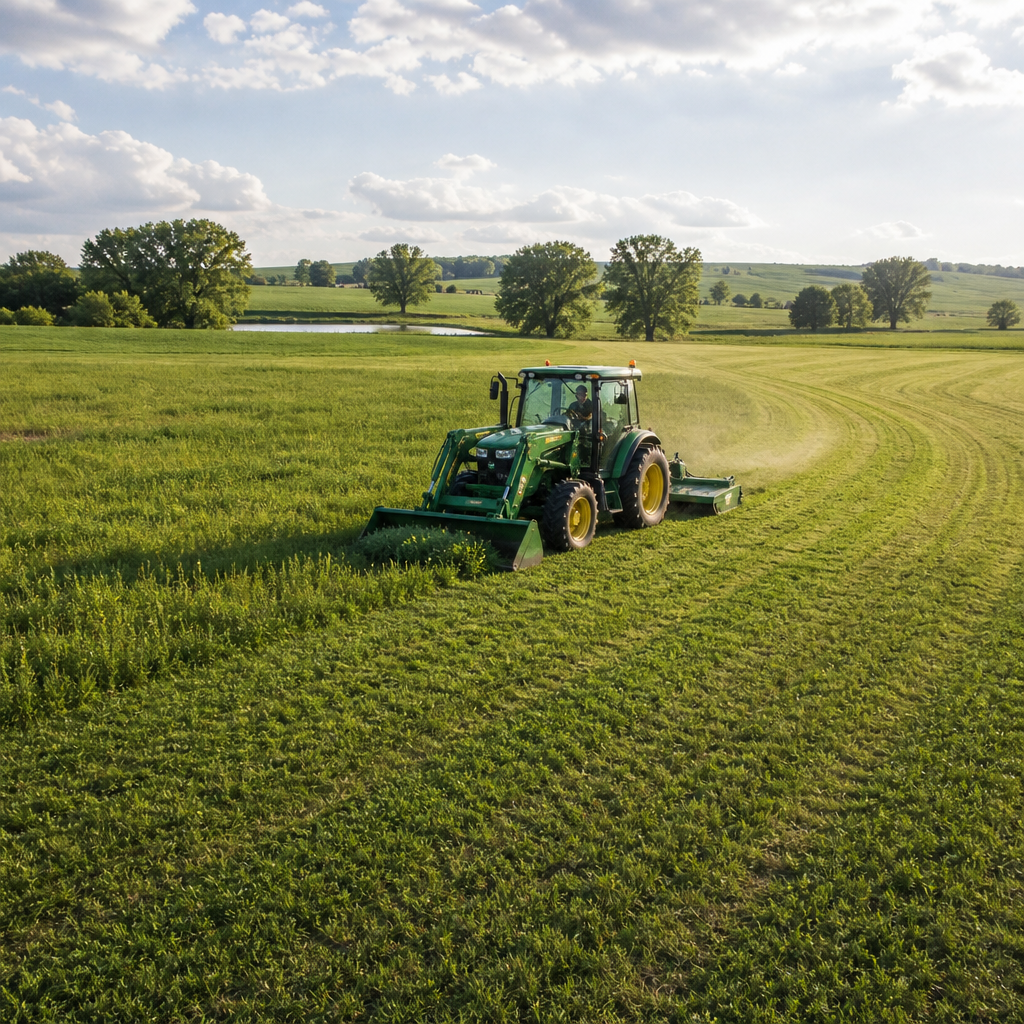
Most people buy their first tractor twice. The first one is chosen in a hurry — usually too small, occasionally far too big — and the second one is chosen after a season of learning what the property actually demands. You can skip that expensive education with a weekend of honest measuring and a short list of the jobs you genuinely repeat every year.
This is a guide to sizing a compact or utility tractor, matching implements to it, and keeping the machine healthy once it is parked in your shed. It assumes you own somewhere between two and eighty acres, you are not running a commercial row-crop operation, and you would rather spend your Saturdays using the machine than fixing it.
Start with the tasks, not the horsepower
Horsepower is the number everyone quotes and the number that misleads most often. Write down your real workload instead, in order of frequency:
- Mowing — how many acres, how tall does the grass get, how often?
- Loader work — gravel, mulch, manure, firewood, fence posts, snow?
- Ground engagement — box blade, rotary tiller, subsoiler, post hole digger?
- Hay — mowing, raking and baling, or just buying it in?
- Towing — a trailer, a sprayer, a chipper, a stock tank?
Now pick the heaviest and most frequent task and size for that. If brush hogging a six-foot cutter through thick summer growth is your weekly reality, you need the engine and the weight for a six-foot cutter — not for the twice-yearly box blade pass. Everything else the tractor does becomes easy by default.
Rough brackets that hold up in the field
As a general guide, sub-compacts in the low-to-mid twenties of horsepower suit manicured acreage, finish mowing and light loader chores. Compacts in the mid-twenties to around forty horsepower handle five-foot and six-foot implements, serious loader work and heavier rotary cutting. Utility tractors from roughly forty-five horsepower upward are where hay equipment, larger tillage and loaded trailers stop feeling like a strain. Gaps exist for a reason, and salespeople who work the brackets daily can tell you where your workload lands. A useful second opinion is the classic homesteader’s walkthrough on how to select the best tractor for a small farm, which argues the same point from a slightly different angle: buy for the hardest job you will repeat.
The specs that matter more than engine power
Four numbers deserve more attention than they usually get.
Loader lift capacity at full height, measured at the pins. Brochure figures sometimes quote capacity at the pivot, which flatters the machine. Ask what it lifts at the bucket edge, fully raised, because that is where a pallet of seed or a round bale actually sits.
Three-point hitch lift capacity. A seven-foot rear blade or a heavy rotary cutter can outweigh what a small hitch will raise. Hitch category matters too: Category 1 pins fit most compact implements, Category 2 appears on larger utility machines, and mixing them means bushings and adapters.
Weight and wheelbase. Tractor weight is traction. A heavy machine with modest power will pull a disc through dry ground better than a light machine with a bigger engine spinning its tires. Weight also stabilises loader work, though it comes at the cost of turf compaction and tighter clearance in orchards and barn alleys.
Hydraulic flow and remote valves. If you ever plan to run a grapple, hydraulic top link, or an angle snow blade, specify the remotes at purchase. Adding them later costs more and rarely looks as tidy.
Packages versus piecing it together
A tractor without implements is a very expensive way to drive around your property. Bundled packages — tractor, loader, cutter, box blade, trailer — exist because those four pieces cover roughly ninety percent of rural chores, and because matched components spare you the guesswork about whether an implement overloads the hitch.
Build your own combination when your work is unusual: steep slopes, heavy clay, orchard rows, or a hay operation where the baler dictates the tractor rather than the other way around. Buy a package when your list looks like everyone else’s list, because a dealer who has assembled the same combination hundreds of times has already solved the compatibility questions you have not thought of yet.
Used equipment, sensibly
Used compacts hold value well, which cuts both ways — they rarely sell cheap, but they also rarely lose much more. Inspect the loader mounting points for cracks and amateur welds, check the hour meter against the condition of the seat and pedals, look for hydraulic weeping at the cylinder rods, and pull the dipstick to see whether the oil has been changed in this decade. A used machine with service records beats a lower-hour machine with none.
Where a dealer relationship earns its keep
The purchase is the short part of ownership. What matters over ten years is whether someone within reasonable driving distance stocks the filters, knows which hydraulic fitting your model uses, and can get a mower deck spindle on the shelf during the week you actually need it. Across Kentucky, Tennessee and Indiana, H&R Agri Power operates as an authorized Kubota tractor dealership handling new and used tractors and implements, pre-built and custom Kubota tractor packages, genuine Kubota parts alongside general tractor, mower and baler parts, and repair work at its locations — including lawn mower service out of Owensboro, Kentucky. That combination of parts counter and service bay is the practical reason to buy locally rather than from the cheapest listing three states away.
Genuine parts: when they are worth it
Not every component needs to come in a branded box, but some do. Fuel filters and hydraulic filters on modern diesels are built to specific micron ratings and bypass pressures; a cheap substitute that passes debris or collapses under cold-start pressure can cost you an injection pump. The same logic applies to drive belts, seals and emissions-related components. Wear items with simple geometry — cutter blades, tines, shear bolts, pins — are far more forgiving, and that is where aftermarket parts make obvious sense.
A seasonal checklist you will actually follow
Manufacturer schedules run on hours. Most rural owners do better with a calendar, because the tractor sits idle for weeks at a time and idle machines develop their own problems.
- Early spring: change engine oil and filter, inspect air filter, grease every zerk on loader and three-point, check tire pressures including the fronts, test the battery before the first long day.
- Late spring: sharpen and balance mower blades, check deck spindles and belt tension, inspect the rotary cutter gearbox oil and driveline shields.
- Midsummer: clean radiator and oil cooler screens — chaff and seed heads cause more overheating than coolant problems ever do. Re-grease anything working daily.
- Autumn: change hydraulic and transmission fluid on schedule, inspect hoses for chafing, check coolant strength, and look over hay equipment before storing it rather than after.
- Winter: treat fuel and keep the tank full to limit condensation, store on a maintainer if the machine sleeps for weeks, and grease cylinder rods you are leaving extended.
Keep a cheap notebook in the toolbox and log hours with every service. It takes thirty seconds, settles arguments about when the oil was last changed, and adds real money to the resale conversation years later.
Buy for the property you have
The best tractor for your land is usually one size up from what you first imagined and one size down from what the brochure tempts you toward. Measure your gate widths, walk your steepest slope, count how many times a year you really move gravel, and let those answers pick the machine. Then spend what you saved on the implements and the storage, because a tractor that has to live outdoors ages faster than one that does not.
Equipment is only part of what makes a few acres enjoyable, of course. Once the fence lines are clear and the drive is graded, the same practical instinct applies to the areas closest to the house — plenty of owners find that turning the backyard into a family cooking space is what finally makes all that mowing feel worthwhile.
