

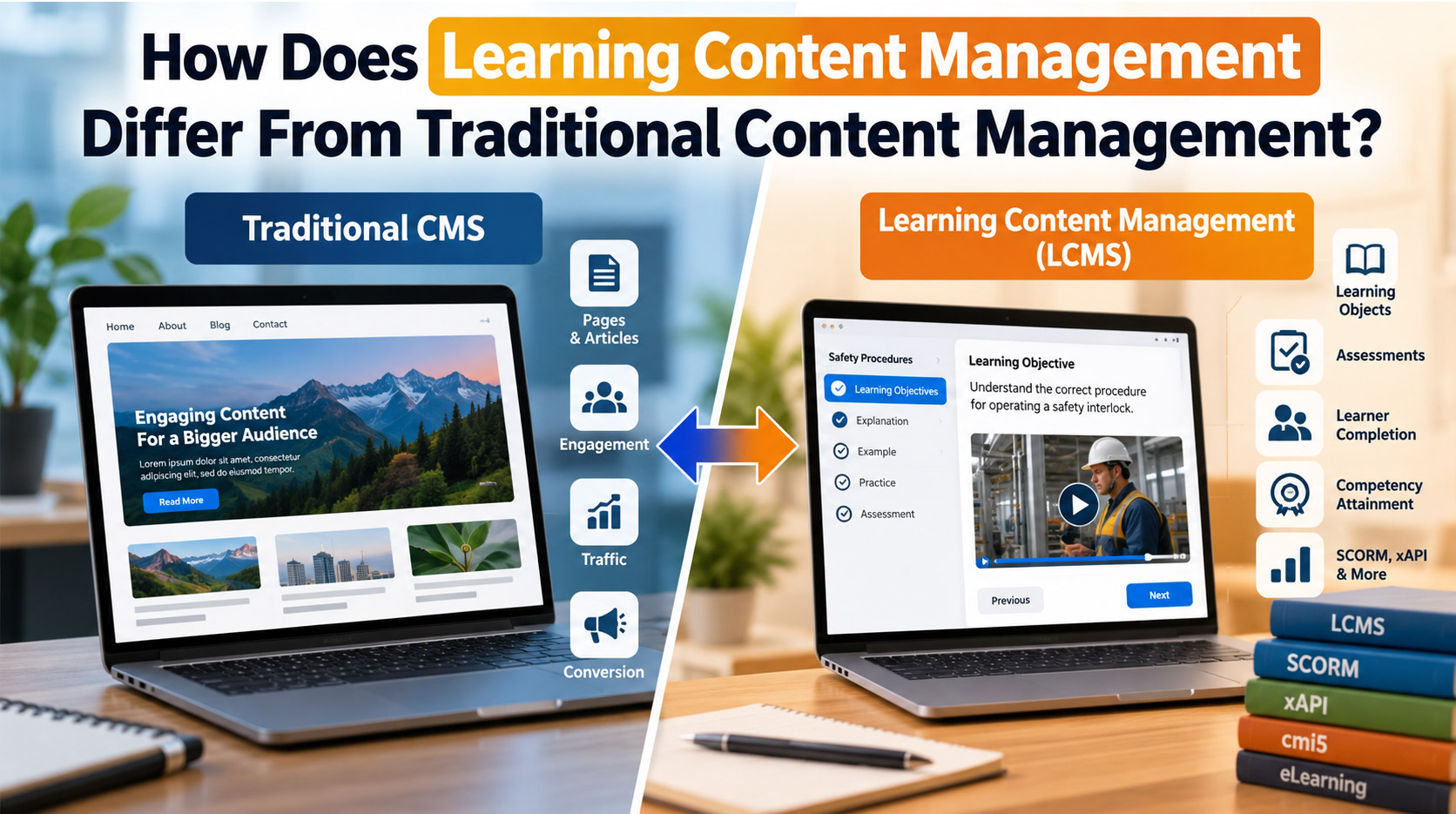
Both a web CMS and a learning content management system (LCMS) basically do the following, store content assets, manage the workflow to publish content in channels, etc. However, the moment you publish content, it has a different function. Marketing content needs to be found, read, and lead to action. Learning content needs to be offered in a sequence of learning objects, assessed, and connected to learners who have completed the content.
However, the differences between marketing content and learning content to be published on the Web greatly exceed these similarities. The main differences relate to data models, to authoring processes and to economic benefits of reuse. The following sections describe differences in practice and what to look out for to determine whether a general purpose CMS can also be used for learning programs.
The unit of content is smaller and more constrained
For a CMS used on the web, the atomic unit for storing content is typically a page or article. The corresponding CMS fields are mostly tuned for presentation on the website. This is different from learning content, where the storage of learning objects (e.g. 3 min long explanation of a safety interlock for a specific type of equipment) with objective, prerequisites, estimated learning time and the corresponding assessments is the norm. A single learning object can be tagged with certain competencies.
However, once constrained by the above parameters, content objects can be written by authors new to learning production in a short space of time (in addition to marketing content). Once set up, a series of authored objects can be combined (‘assembled’) in different ways to present different views of similar content. This needs to be a discipline in itself.
What structured authoring actually requires
- A content model that separates objective, explanation, example, practice, and assessment into distinct typed components
- Rules preventing context-dependent language such as “as discussed above” inside reusable objects
- Metadata for audience, role, jurisdiction, language, and regulatory reference applied at the object level, not the course level
- A single source for each fact, with transclusion rather than copy and paste
Reuse is the business case, not a convenience
Web teams reuse presentation components to maintain their web site’s look and feel. Learning teams reuse content to help manage the huge maintenance load of many learning objects. A regulated manufacturer of products (e.g. Industrial equipment) with many locations world-wide might have forty learning objects for six different roles delivered to nine different sites. Many of the learning objects for different roles would cover similar procedures for different products.
This compounding also affects translation costs as every duplicate paragraph is translated again. While the cost of a license of an LCMS may look different from that of a CMS, it is worth reading learning content management explained and then modelling the saving of single-sourcing for your specific case, number of shared objects times number of courses times number of locales per course.
Where reuse breaks down
While objects can be written at just about any granularity, in practice most tend to be around the size of a single learning objective and 3-8 minutes long. Then, for example, variants can be created for different sites or for different roles within a single site. To reuse, reuse at the right level of granularity.
Publishing targets behave differently
Structured publishing on the web typically refers to rendering the same content in different screen sizes and distributing it through various syndication channels. Structured learning content, on the other hand, is rendered in different output formats and may have behavior associated with it, such as opening in a new window. A SCORM or xAPI package may, for example, negotiate with an LMS, report completion, resume from the exact point where the learner left off and report scores.
| Dimension | Traditional CMS | Learning content management |
| Atomic unit | Page or entry | Objective-aligned learning object |
| Primary metric | Traffic, engagement, conversion | Completion, assessment performance, competency attainment |
| Output format | HTML, feeds, app payloads | SCORM, xAPI, cmi5, PDF job aids, instructor packs |
| Versioning driver | Editorial refresh | Regulatory change, procedure change, audit cycle |
| Review participants | Editor, legal, brand | SME, instructional designer, compliance, works council |
| Retention need | Current version | Every version a learner was assigned, with dates |
Governance is evidentiary, not editorial
While a simple web CMS might keep a history of versions of a given piece of content so that an editor can go back to a previous version, a learning system will keep a history of versions for audit purposes. So, for example, a simple typo fix may need to be treated differently from a substantive change to content that has been proven, sequenced for learners and reproduced for use in other locales. All of this must be kept under version control.
Practical controls worth enforcing
- Distinguish editorial revisions from material revisions, and only force reassignment on the latter
- Lock published packages so the source can evolve without altering what past learners saw
- Route SME sign-off at the object level so one expert approval propagates to every course using it
- Record the regulatory citation on the object, so a change in the regulation produces an immediate impact list
Choosing where the boundary sits
You probably don’t need to replace your current web CMS, as most already do a great job at managing your public facing content. It’s more a case of having your non-public, assessed, assigned and audited learning content managed in a system specifically designed for managing structured learning content. Such a system will cost more in manual reconciliation with your CMS than the license fee for the learning management system.
You May Also Read: Beyond the Blue Water: What to Consider Before Building a Backyard Pool
