

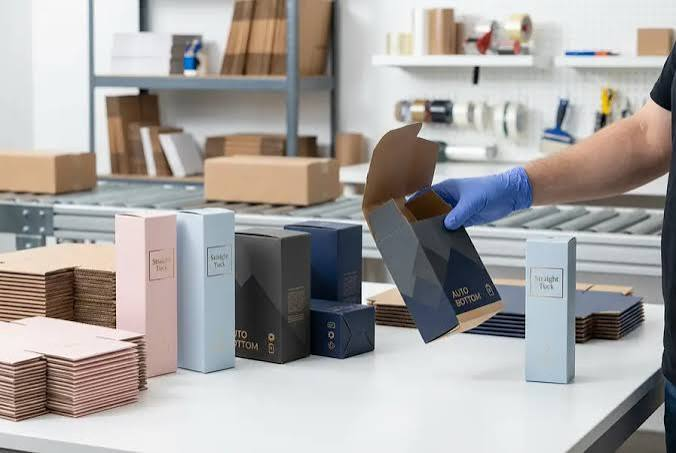
When packaging buyers sit down to finalize box structures for a new product line, the decision often comes down to three formats that look deceptively similar on paper: auto-lock, straight tuck, and reverse tuck. Each has a different closure mechanism, a different assembly behavior, and a different relationship with your production environment. Choosing the wrong one does not just create a cosmetic problem—it creates friction at the fill line, increases damage rates during transit, and complicates reorder cycles when specifications get locked into a format that was never quite right.
The challenge is that these three formats are often presented as interchangeable options when they are not. They serve different operational realities. Understanding what separates them—structurally and functionally—helps buyers make decisions that hold up across production runs, not just on the sample table.
What a Tuck Box Is and Why the Closure Style Matters
A tuck box is a folding carton format where the top and bottom of the box are closed by tuck flaps that fold inward and lock into the body of the structure. Unlike a glued bottom or a crash-lock base, the tuck closure is assembled without additional adhesive at the point of use—it relies entirely on the die-cut geometry and the material’s fold properties to create a secure enclosure. This makes the format widely used across retail, pharmaceutical, food, and consumer goods packaging because it is fast to assemble and relatively economical to produce.
What determines how well that closure performs is the specific type of tuck used. The orientation of the top flap relative to the bottom flap, and whether those flaps tuck in the same or opposite directions, changes how the box behaves under load, how it opens for the end user, and how reliably it can be filled on automated equipment. Packaging specifiers who treat this as a minor detail often encounter problems that are difficult to reverse once tooling has been cut and materials have been ordered. For buyers working through a structured quoting process with a tuck box manufacturer, understanding these differences before tooling is finalized saves both time and money.
How Closure Direction Affects Structural Performance
The direction a tuck flap folds in relation to the box panels is not arbitrary. It controls where stress concentrates when the box is filled, stacked, or opened. A flap that tucks in the same direction as the primary display panel will behave differently under shelf pressure than one tucked from the opposite side. This matters most in automated filling environments where boxes move through machinery at speed. A closure that does not seat consistently—or one that springs open under light compression—creates stoppages and product loss that compound quickly across a full production shift.
Straight Tuck: When Simplicity Serves the Format
In a straight tuck configuration, both the top and bottom flaps tuck in the same direction—typically toward the back panel of the box. This makes the carton blank easier to print consistently because the front panel faces the same direction on both the top and bottom sections. For products where branding needs to wrap cleanly across the top closure and the primary display face, straight tuck provides a reliable alignment that reverse tuck does not.
This format is common in cosmetics, pharmaceuticals, and smaller retail products where the box is displayed upright and the top closure is visible to the consumer. Assembly tends to be straightforward, and the format works well with both manual packing and semi-automated fill lines where operators load from the top and close in a single motion.
Where Straight Tuck Has Limitations
The primary operational limitation of straight tuck is structural. Because both closures tuck toward the back, the bottom flap is more likely to open under the weight of the product if the box is carried or jostled with moderate force. This is not a problem for lightweight products or those sold in retail environments where the box remains upright and undisturbed. However, for heavier items or products that are regularly removed and reinserted by the end user, the bottom closure on a straight tuck carton can become unreliable over time.
Buyers should also consider how this format interacts with display fixtures. If a straight tuck carton is inserted into a shelf slot or pegboard display from the front, the back-tucking bottom flap can catch or deform during loading, leading to visible damage on the retail floor.
Reverse Tuck: Added Security at the Cost of Some Consistency
Reverse tuck cartons close with the top flap tucking toward the back panel and the bottom flap tucking toward the front. This opposing direction creates a more balanced structure under load because the two closures are working against each other when pressure is applied from above. The result is a bottom closure that is more resistant to accidental opening during handling, which makes reverse tuck a practical choice for heavier consumer products, hardware items, and anything shipped loose in a larger outer carton.
The trade-off is on the print side. Because the top and bottom tuck in opposite directions, the carton blank is oriented differently at each end, which can create challenges when printing full-coverage designs that need to read cleanly at both the top and bottom of the box. For many products, this is a non-issue. For others—particularly in premium retail or branded gifting—the asymmetry requires additional attention during design to avoid a result that looks inconsistent at the point of sale.
Reverse Tuck in Automated Packing Lines
In high-volume automated environments, reverse tuck cartons can present minor setup challenges because the opposing closure directions require the fill station to manage two different fold orientations. Most modern cartoning equipment handles this without issue, but older machinery or equipment configured specifically for straight tuck may require adjustment. Buyers sourcing large volumes for automated lines should confirm compatibility with their equipment supplier before committing to a reverse tuck specification.
Despite this, reverse tuck remains the more common format across general consumer goods packaging globally, largely because the structural balance it provides reduces damage rates during distribution—a concern that often outweighs the marginal complexity in setup.
Auto-Lock: A Different Approach to the Bottom Closure
Auto-lock, sometimes called crash-lock bottom, takes a fundamentally different approach to the base of the carton. Rather than using a tuck flap that folds inward, the auto-lock bottom is pre-glued at the manufacturing stage and collapses flat for shipping. When the box is opened by the packer, the bottom snaps into a locked position automatically—no additional folding, tucking, or manual closure required.
The top of an auto-lock carton typically uses a standard tuck closure, which means the box retains the ease of top opening that buyers and consumers expect. The difference is entirely at the base. This structure, as noted in general packaging engineering literature including resources documented through bodies like the International Organization for Standardization, is designed to improve fill-line efficiency and reduce the risk of bottom-closure failure under product weight.
Where Auto-Lock Adds Real Operational Value
The practical advantage of auto-lock becomes clear in high-speed packing environments. Because the bottom requires no assembly—it locks automatically when the flat carton is opened—packers do not need to complete a folding step before loading. This reduces packing time per unit and virtually eliminates the category of errors that come from incorrectly assembled tuck bottoms, including partially inserted flaps and cross-locked closures that look correct but fail under weight.
Auto-lock cartons are well suited for:
- Products with meaningful weight that would stress a standard tuck bottom during transit or retail handling
- High-volume fill operations where bottom-assembly time creates a meaningful bottleneck
- Items sold through e-commerce channels where boxes are packed, sealed, and shipped without a retail display phase
- Categories where bottom-closure failure would result in product damage or a customer-facing defect
Cost Considerations with Auto-Lock
The gluing step required to create an auto-lock bottom adds cost relative to a straight or reverse tuck carton. The carton blank is also typically more complex, which affects die-cut tooling costs and may limit sourcing flexibility if a buyer needs to move between suppliers. For products where the structural benefit justifies the added investment, this is straightforward to evaluate. For lightweight products or those sold in low-handling environments, the additional cost may not be warranted, and a standard tuck format will perform reliably at a lower unit cost.
Matching the Format to the Product and the Operation
The right carton format is determined by a combination of product weight, fill-line configuration, retail environment, and end-user behavior. None of the three formats is universally superior. Each addresses a specific set of conditions, and the decision becomes clearer when buyers work through those conditions systematically rather than defaulting to the format they have used before.
A lightweight cosmetic sold through specialty retail where the top closure is part of the brand presentation suits a straight tuck format. A moderately heavy consumer product sold through mass retail and shipped in mixed outer cases suits a reverse tuck. A heavier item filled at volume on an automated line and shipped direct to consumer suits an auto-lock bottom. These are generalizations, but they reflect the core logic that experienced packaging specifiers apply when making format recommendations.
Where buyers get into difficulty is when format decisions are made late in the product development cycle—after design assets are locked, after tooling discussions have begun, or after a contract packer has already configured their line for a different structure. Bringing format questions forward, alongside material selection and print specification, reduces the cost and delay of corrections later.
Closing Considerations for Packaging Buyers
The distinction between auto-lock, straight tuck, and reverse tuck is not a technical detail that can be left to the printer or converter to resolve. It is a structural decision that affects how reliably a box performs across the full chain from filling to consumer. Buyers who understand the functional logic of each format are better positioned to ask the right questions during the quoting process, catch specification mismatches before tooling is finalized, and avoid the downstream costs that come from a format that was never quite suited to the product it was meant to protect.
The goal is not to choose the most sophisticated option—it is to choose the one that performs consistently under the actual conditions the box will face. That requires a clear-eyed look at the product, the operation, and the environment before a format is locked in.
