

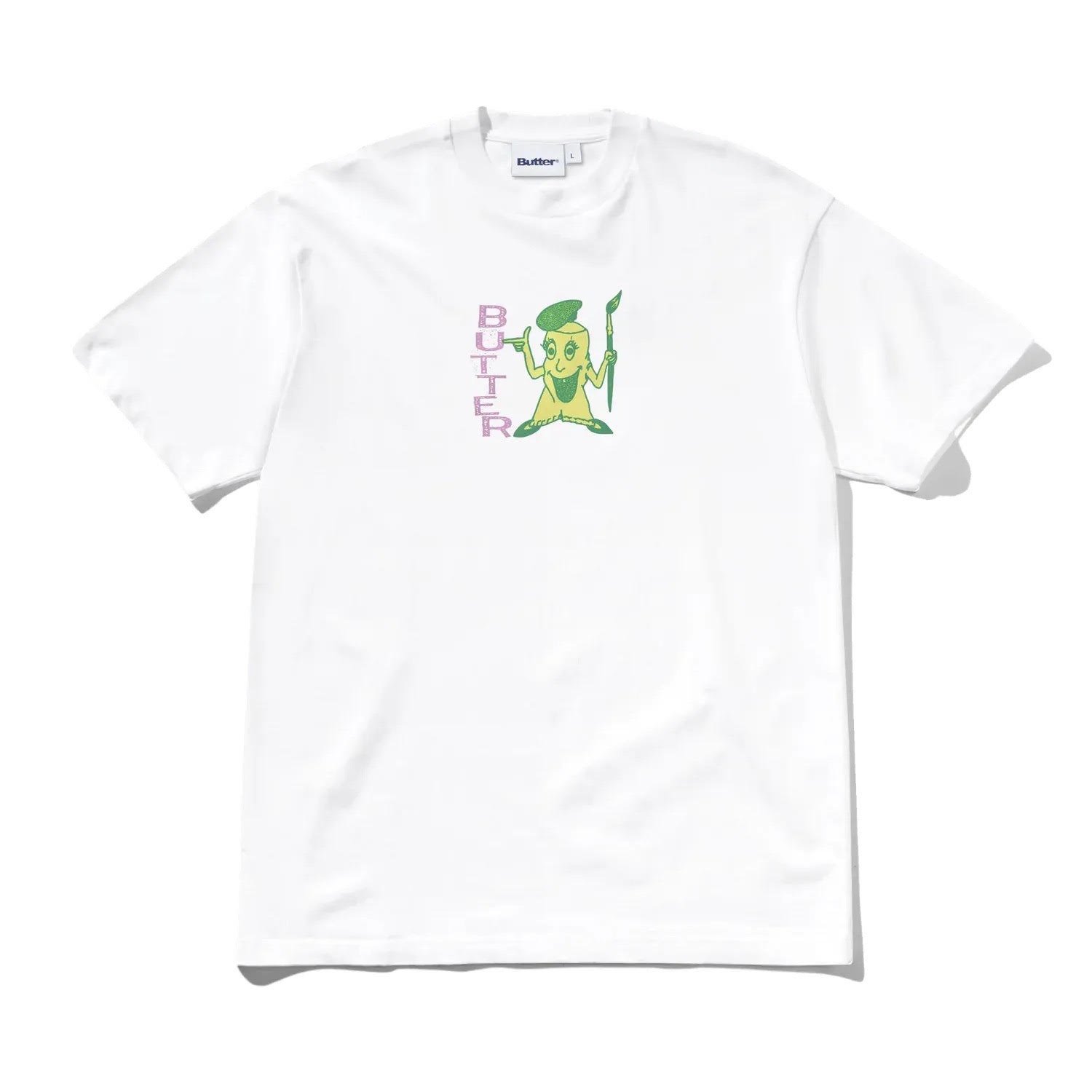
Late January in Brisbane. Around 30 °C, and the air is close to saturated, so there’s nowhere for more moisture to go. You walk four blocks from the car park and your shirt has quietly decided where it’s going to stick for the afternoon. That’s a different complaint from a dry 35 °C somewhere inland, and it changes what you want a cotton tee to do — which is why the tee pages at Butter Goods read differently in February than they do in June.
That’s the Paint Tee in White up there. White is doing something fairly specific in this climate that Black simply isn’t, and I’ll get to it. Humidity first, though, because basically everything else follows from it.
Humid thirty is not dry thirty
The whole cooling trick your body pulls off depends on sweat evaporating, and in dry air it does that so fast you barely clock it happening. Brisbane in January, though — the air’s already carrying about all the water it can hold, so your sweat sort of queues up with nowhere to go. You stay hot and you get visibly wet. Worst of both.
Which means the thing worth chasing isn’t some fabric that feels cold in your hand on the shop floor (that feeling lasts ninety seconds anyway). It’s movement. You need a gap between cloth and skin for air to cross, and no gap means the air has nothing to work with, so cut ends up mattering more than fibre once it’s humid.
A boxy tee moves air. A slim one just sits there.
A boxy fit keeps the body of the shirt standing away from your ribs and lower back. Walk in one, and you get a small chimney going — air in at the hem, warm air out at the collar. It isn’t dramatic. Just enough that you notice it on the way back from lunch.
A drop shoulder helps too, for a reason people don’t expect. The seam lands out on your upper arm rather than on the bone, so the sleeve hangs loose instead of gripping the armpit, which is where damp cotton pins itself first. The skate-rooted cut Butter Goods uses on the tees — wider through the body, a shorter body length — wasn’t designed for humidity, but it suits it anyway. A slim tee does the reverse: pinned flat, venting nothing.
Caught between two sizes in a humid week
Sizing runs S to 4XL, so there’s room to move either way. In summer, I’d take the larger of two without much agonising, since those extra centimetres through the chest are the air gap you’re after. For December, lean roomy.
White in open sun, and why thin isn’t automatically cooler
A white tee reflects most of the sunlight landing on it. A black one absorbs it and the surface genuinely heats up — you feel that waiting at a crossing with no shade, nothing moving. Step under an awning and the gap mostly disappears. Which is the catch, because white also shows every bit of damp you produce.
- White reflects the most and hides the least — good in open sun, awkward over a long lunch.
- Black looks identical all day however wet you get, but it cooks on a treeless footpath.
- Ash and Washed Black sit between the two, which is probably why they get worn the most.
- Chestnut, Army and Eggplant take a sweat mark better than White without going fully dark.
Then there’s weight, and this one trips people up. Really thin cotton jersey goes a bit see-through and clings the moment it’s damp — and once it’s clinging, there goes your air gap. Something fractionally heavier holds its own shape instead, so it stays standing off your back while you sweat through it. Sounds backwards. Isn’t. Most of the Butter Goods T Shirt options sit around A$80 to A$90 at the moment, down from A$135 to A$190, so there’s little reason to hunt for the flimsiest thing going.
A screen print doesn’t breathe either — it’s ink sitting on top of the cotton. A modest chest print changes nothing you’d notice; a full back print on a still 32 °C day, you will.
| Pro Tip: Don’t leave a sweated tee bunched in the laundry basket overnight in a Brisbane summer. Damp cotton folded up in that air picks up a smell one wash won’t fully shift. Hang it over a chair back to air dry in the shade first, then wash it. |
Aircon at nine, dinner at seven
Here’s the part nobody plans for. You arrive somewhere damp, the aircon is set to about 21 °C, and the shirt that was your friend outside turns clammy against your spine inside ten minutes. Trains and shopping centres are the worst for it. What you want over the top is something thin you can carry in a bag — a waffle long-sleeve or a light crewneck. Heavyweight fleece in a Brisbane summer is pointless. This layering isn’t a southern cold change where you add warmth; you’re adding a dry surface between you and the vent.
And keep one tee back for the evening. Not the one you’ve been in since seven that morning — a second one, darker, flatter print, still folded. Brisbane evenings stay warm enough that the tee is the whole outfit, so it’s doing all the work. Which raises the rotation question, and the honest answer is more than you think:
- Two or three pale ones for days you’re actually outdoors in the sun.
- Three or four mid-to-dark ones for office, aircon and anything indoors.
- One kept clean for evenings, swapped out and washed the next morning.
- Room to change twice on the stickiest days, which in January is most of them.
That lands near seven or eight tees if you want a week without an emergency wash on Wednesday night. Butter Goods delivery runs about 7 to 10 business days, so November is the month to sort it rather than the first hot Saturday in December.
Frequently Asked Questions
Is a heavier tee really cooler in humidity?
Often, yes. Thin cotton collapses onto wet skin and seals the gap shut; something with a bit more body stays off you and keeps air moving. In dry inland heat the thin one wins — two climates, two shirts.
Does a white tee go see-through once you sweat?
A flimsy one will. That’s less about colour than the weight of the jersey underneath, so for pale shades pick the ones that feel like they have some substance.
What goes over a tee just for the air conditioning?
A waffle long-sleeve or a thin crewneck, carried rather than worn. You need it fifteen minutes at a time, so bulk works against you.
How many tees cover December to February?
Seven or eight if you’re changing most days and occasionally twice. Fewer than five and you’re washing constantly, which ages a print faster than wearing it does.
Brisbane summer is an airflow problem more than a heat problem, and tees sort themselves out once you stop shopping for thin and start shopping for cut. Roomy through the body, a shoulder seam sitting wide, a print you can live with on a still day. Have a scroll through the Butter Goods tees and grab two pale and two dark — December handled.
