

Choosing a machining partner is rarely a straightforward decision, and the consequences of getting it wrong tend to show up at the worst possible moments — mid-production, during a product launch, or when a downstream customer is waiting on parts. For engineers and procurement leads working in sectors like aerospace, defense, industrial equipment, or medical devices, the supplier relationship is not peripheral to the project. It sits at the center of it.
The US manufacturing market has no shortage of machine shops. Finding one willing to take on a job is rarely the problem. The challenge is identifying whether a prospective partner can reliably deliver parts at the right tolerance, in consistent volume, on a predictable schedule, and with enough communication infrastructure to flag issues before they become costly. That distinction — between a shop that can do the work and one that can sustain it — is what this checklist is designed to help engineers evaluate.
Understanding What CNC Metal Machining Actually Involves Before You Start Comparing Shops
Before evaluating any vendor, it helps to have a clear picture of what the production process requires and where the real risks live. CNC metal machining covers a range of subtractive manufacturing processes — milling, turning, drilling, grinding, and EDM among them — where computer-controlled tools remove material from a metal workpiece to achieve a defined geometry. The precision of the outcome depends on the quality of the machine, the tooling strategy, the fixturing approach, and the operator’s process knowledge working in combination.
Each of these variables matters independently, but they also interact. A well-calibrated machine operated by someone unfamiliar with the material behavior of a specific alloy can still produce parts that fall outside tolerance. Similarly, excellent operator knowledge cannot fully compensate for worn tooling or inconsistent fixturing. Understanding this helps engineers ask more useful questions when vetting a shop — not just “do you have the equipment” but “how do you manage the process around that equipment.”
Material Compatibility Is Not the Same as Material Experience
Most machine shops can technically cut a range of metals. The more important question is whether they regularly work with the specific materials your project requires. Titanium, Inconel, hardened tool steels, and certain aluminum alloys each have distinct machining behaviors. Feed rates, cutting depths, coolant strategies, and tool selection all shift significantly based on the material in question.
A shop with deep experience in a particular material will have developed internal process documentation, preferred tooling suppliers, and established quality benchmarks for that material. A shop that cuts it occasionally will be learning partially on your job, which introduces variability — and variability in machining typically shows up as scrap, rework, or delayed delivery.
Quality Systems: What to Look for Beyond the Certificate on the Wall
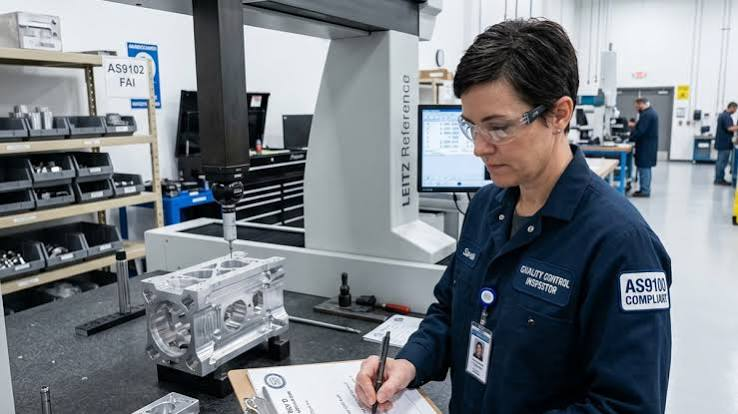
ISO 9001 and AS9100 certifications signal that a shop has documented quality management processes and has been audited against them. These are meaningful credentials, particularly for regulated industries. However, the certificate alone does not tell you how rigorously those processes are applied on the shop floor or whether they extend to incoming material inspection, first article review, and in-process measurement.
A more useful evaluation involves asking how a shop handles non-conformance. Every production environment produces parts that fall outside specification at some point. The question is whether the shop has a formal process for identifying those parts before they ship, documenting the root cause, and implementing corrective action. Shops with mature quality systems can answer this question in specific terms. Shops without them tend to give general reassurances.
In-Process Inspection Versus Final Inspection
There is a meaningful operational difference between a shop that inspects parts at the end of a run and one that inspects at defined intervals during production. In-process inspection allows for adjustments before a full batch is compromised. End-of-line inspection catches problems, but only after they have already occurred at scale.
For high-precision or high-volume work, the timing of quality checks directly affects both yield and cost. When evaluating a potential partner, ask where in the process measurement occurs and what equipment is used. Coordinate measuring machines, optical comparators, and calibrated hand gauges each serve different purposes, and a well-equipped shop will be able to describe which tools they use for which types of features.
Capacity, Scheduling, and the Reality of Lead Times
A shop’s stated lead time is often an optimistic number. It reflects ideal conditions — adequate staffing, available machine time, and no upstream material delays. Real lead times depend on where your job sits in the production queue, how complex the setup is relative to their current workflow, and whether they have reserve capacity to absorb schedule pressure.
Engineers who have worked with multiple shops over time understand that lead time commitments are only as reliable as the shop’s capacity management practices. A shop running at full utilization with no buffer is structurally unable to absorb a rush job or recover quickly from an equipment issue. When evaluating a partner, it is worth asking about their current workload, how they handle priority conflicts between customers, and what happens to your order if a machine goes down.
Single-Source Dependency and Risk Exposure
Relying on one shop for a critical component creates exposure that becomes visible only when something goes wrong. Equipment failure, labor turnover, a key operator’s departure, or a sudden increase in another customer’s volume can all compress your supplier’s available capacity without warning. The more critical the component, the more this risk matters.
This does not mean every part needs a backup supplier. But for long-running programs or components with long qualification cycles, it is worth understanding whether a potential partner has the scale and redundancy to protect your continuity. Shops with multiple machines capable of running the same setup offer more resilience than those where a single machine is the only option for a given operation.
Communication Infrastructure and Engineering Responsiveness
The practical working relationship with a machining partner involves a significant amount of technical communication — design questions, drawing clarifications, engineering change orders, first article documentation, and shipping coordination. The quality of that communication directly affects how smoothly jobs run and how quickly problems get resolved.
Some shops are structured to handle this well. They have dedicated project contacts, use standard documentation formats, respond to technical questions within a predictable window, and flag potential issues early in the quoting or setup phase. Others route all communication through a single point of contact who is also managing the shop floor, which creates delays and information gaps.
DFM Feedback as an Indicator of Technical Depth
Design for manufacturability feedback — the ability of a shop to review a drawing and identify features that will be difficult or costly to machine — is one of the clearest indicators of genuine technical depth. A shop that can look at your design and say “this radius creates a tool access problem at this depth” is operating with real process knowledge. A shop that quotes whatever is on the drawing without comment may be setting up for a problem that surfaces mid-production.
Requesting DFM feedback early in the engagement, even on straightforward parts, gives you a reliable signal about the shop’s technical fluency and willingness to engage as a working partner rather than just a vendor.
Traceability and Documentation for Regulated Industries
For engineers working in aerospace, defense, or medical manufacturing, documentation is not optional. Traceability requirements typically include material certifications, heat lot records, in-process inspection data, and final dimensional reports. These documents are part of the deliverable, not an afterthought.
A shop unfamiliar with documentation-intensive industries will often struggle to produce compliant packages consistently. Ask for sample documentation from previous jobs in similar industries. Review the format, the completeness, and whether the data actually connects the finished part to the original material source. Gaps in that chain create compliance risk that can affect your own customer relationships and audit outcomes.
How Document Control Reflects Broader Process Discipline
The ability to maintain accurate, organized job documentation across a production run reflects the same discipline that produces consistent parts. Shops that track revisions carefully, store records systematically, and can retrieve historical data without difficulty tend to operate with the same attention on the floor. Documentation quality is often a reliable proxy for overall process maturity.
Closing Thoughts: Building a Supplier Relationship That Holds Up Under Pressure
The checklist above is not a scoring system. There is no threshold number of criteria that guarantees a successful supplier relationship. What it reflects, taken together, is a picture of operational maturity — the difference between a shop that performs well under favorable conditions and one that performs consistently under real-world constraints.
Engineers who invest time in evaluating these factors before committing to a partner tend to spend significantly less time managing problems once production is underway. The early work of asking detailed questions, reviewing documentation, and understanding a shop’s capacity realities pays off in reduced friction across the full program lifecycle.
The right machining partner is not necessarily the one with the lowest quote or the fastest stated turnaround. It is the one whose processes, communication habits, and technical depth align with what your project actually requires — and who can sustain that alignment over time, not just on the first job.
