

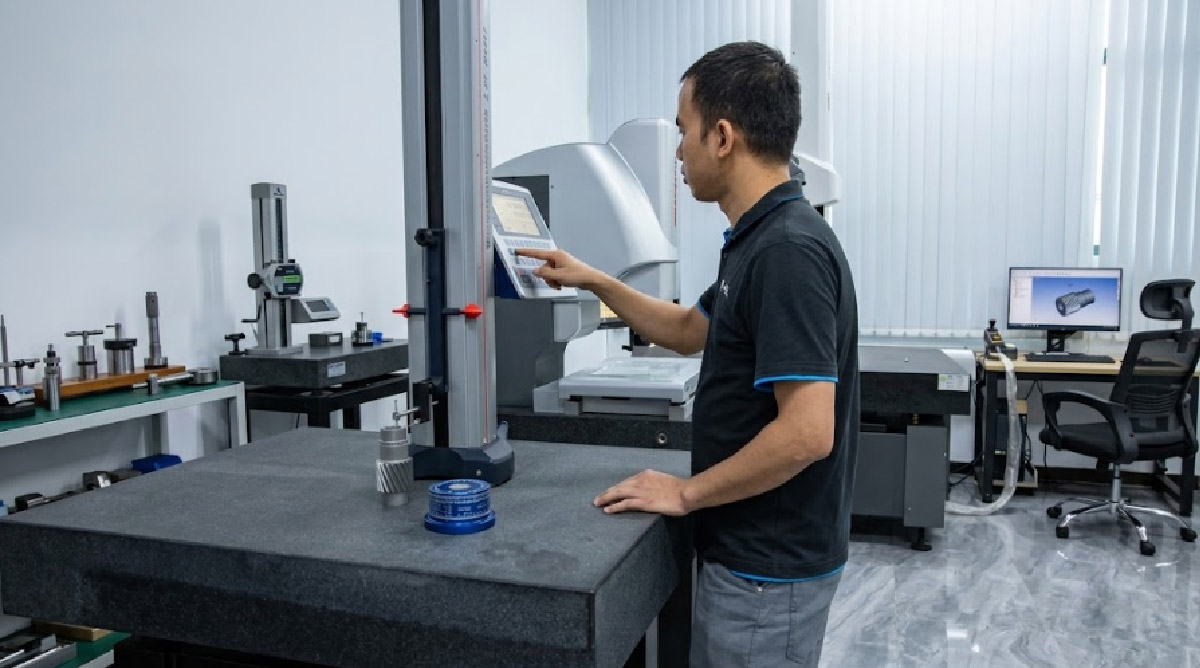
Rapid prototyping is the process of turning a digital design into a physical part, enabling engineers to test out concepts of a product before moving on to full-scale production. But a prototype that appears to be correct can still have problems in actual operation. Functional testing fills this gap as it looks at the way components fit, function, and resist expected loads. If it is used early in the development process, it can reveal flaws in the design, provide insight into design modifications that can be implemented at the production stage, and reduce the need for making costly modifications at the production stage.
-
Understanding Functional Testing in Rapid Prototyping
Functional testing is used to determine whether the prototype will perform as desired and expected, within certain conditions. It is not visual inspection (appearance); it is about mechanical movement, structural integrity, assembly compatibility, and other performance requirements.
For example, a housing prototype could have the same size, but not the same durability to resist vibrations or multiple setups. Testing helps to detect such vulnerabilities before the problems begin to get costly in manufacturing. It also assists engineers in deciding if the design fits the technical requirements and needs to be improved.
-
Identifying Design Flaws Before Production
It is important to identify design issues early on in the process, as they will be more complex to correct once production tooling and manufacturing processes are in place. Functional testing enables engineers to research possible failure points without the modifications becoming too complicated.
Testing can identify interference between the moving parts, loose connections, over-deformation, inadequate sealing, or unexpected friction. From this, the engineer can make the necessary adjustments in the thickness of the wall, clearance, type of material, and fastening.
This is an ongoing process of substituting assumptions with actual data. Each iteration of testing provides feedback to inform decisions and avoid wasting time in later phases of development.
-
Selecting Suitable Prototypes and Manufacturing Methods
To make a meaningful functional test to evaluate the characteristics, a prototype is required. Manufacturing process, material, surface roughness, and dimensional accuracy may influence the test results. Therefore, it is essential to select the proper rapid prototyping services in the preparation of reliable test parts.
CNC can produce high-precision components from engineering-grade metals and plastics, and 3D printing is great for initial tests and complicated designs. Rapid injection molding provides plastic sample parts for re-testing, and sheet metal fabrication provides brackets, enclosures, and structural assemblies. These manufacturing capabilities help 3ERP’s engineers make realistic decisions on the test goals, materials, and development timeline.
-
Establishing the Right Functional Testing Criteria
It is more effective to test when engineers set the criteria they wish to be measured before they look at a prototype. These criteria should be related to the intended use of the product, rather than to an overall assumption of acceptable performance.
Important considerations include:
- Dimensional accuracy: Verify critical measurements, tolerances, clearances, and alignment against CAD specifications.
- Mechanical performance: Examine load capacity, stiffness, fatigue behavior, and resistance to deformation where relevant.
- Assembly compatibility: Check whether parts connect correctly and remain properly aligned during operation.
- Environmental resistance: Evaluate temperature, moisture, chemicals, or vibration when these conditions affect intended use.
- Operational reliability: Repeat relevant movements or operating cycles to identify inconsistent performance or premature wear.
Not every prototype needs every test. Engineers should prioritize criteria according to the product’s risks, operating environment, and development stage.
-
Improving Material Selection Through Practical Testing
The behavior of a prototype when it is subject to forces, heat, moisture, friction, and chemicals depends on the properties of the materials used. A material that is good for visual presentation may not have the stresses needed for functional validation.
Testing can be used to compare the options of aluminum, stainless steel, titanium, polycarbonate, POM, and PEEK to specific engineering requirements. For instance, a light plastic can be used in an enclosure, while a tougher metal can be used for a heavily loaded mechanical part.
But the prototype results are to be considered with a pinch of salt. The characteristics of printed materials may differ from those of molded/machine-made structures. Evidence of product performance is more likely to be relevant when representative materials and processes are used.
-
Accelerating Iterations Without Compromising Validation
Rapid prototyping helps to achieve short development cycles, and speed alone does not determine product readiness. Functional testing provides purpose to each iteration; it is related to the design changes and failures.
Engineers can make changes to the CAD models, create new parts, and test only specific parts of the product without redesigning the whole product. Furthermore, prototype manufacture can be performed concurrently to enable a comparison of different geometries or different materials, in similar development lead times.
The 3ERP process of in-house manufacturing and coordinated inspection allows for an iterative development process, which uses a variety of manufacturing techniques including CNC machining, 3D printing, and injection molding. Depending on geometry, material, finishing, and project requirements, standard simple parts can have a lead time as short as 3 days.
-
Connecting Test Results With Manufacturing Quality
Functional testing is more useful if the results of it are used to make decisions in the design for manufacture process. A component can be good as one prototype, but have problems when assembled or repeatedly produced.
Therefore, dimensional measurements, tolerances, manufacturing constraints, and test results should be reviewed by the engineer. Coordinate measuring machines can be used to check critical dimensions, and documented inspection results can be used to identify deviations from critical dimensions.
ISO 9001:2015 certified quality management is a structured way of process control and record keeping, and is perfect for production-based validation. 3ERP is a certified developer and offers quality-driven development from prototype testing to manufacturing. But certification does not ensure that each individual component will meet all of the functional requirements, and therefore testing and inspection are necessary.
-
Turning Functional Testing Into a Reliable Development Strategy
Functional testing should be done during the entire product development process, with the testing becoming deeper as the designs become mature. The prototypes can be used to determine the initial feasibility, engineering prototypes can be used to test the performance, and pre-production prototypes can be used to determine manufacturing consistency and assembly requirements.
The staged process allows teams to differentiate between a concept with promise and a design with adequate technical evidence. The documentation of test conditions, test failures, corrective action taken, and retest results also improves the communication between the design and manufacturing teams.
Conclusion
Rapid prototyping becomes engineering valuable with functional testing, which shows if a physical design is functioning as designed or not, rather than simply appearing accurate. Material, measurable criteria, controlled iterations, and manufacturing-aware validation are ways for teams to tackle weaknesses before they become manufacturing issues that are too costly. Testing throughout the development process helps make decisions with knowledge of the design’s performance, provides greater confidence in the design, and helps smooth the path from concept to a manufacturable product.
Read next: How to Choose the Right Size Pop Art Print for Your Wall
