

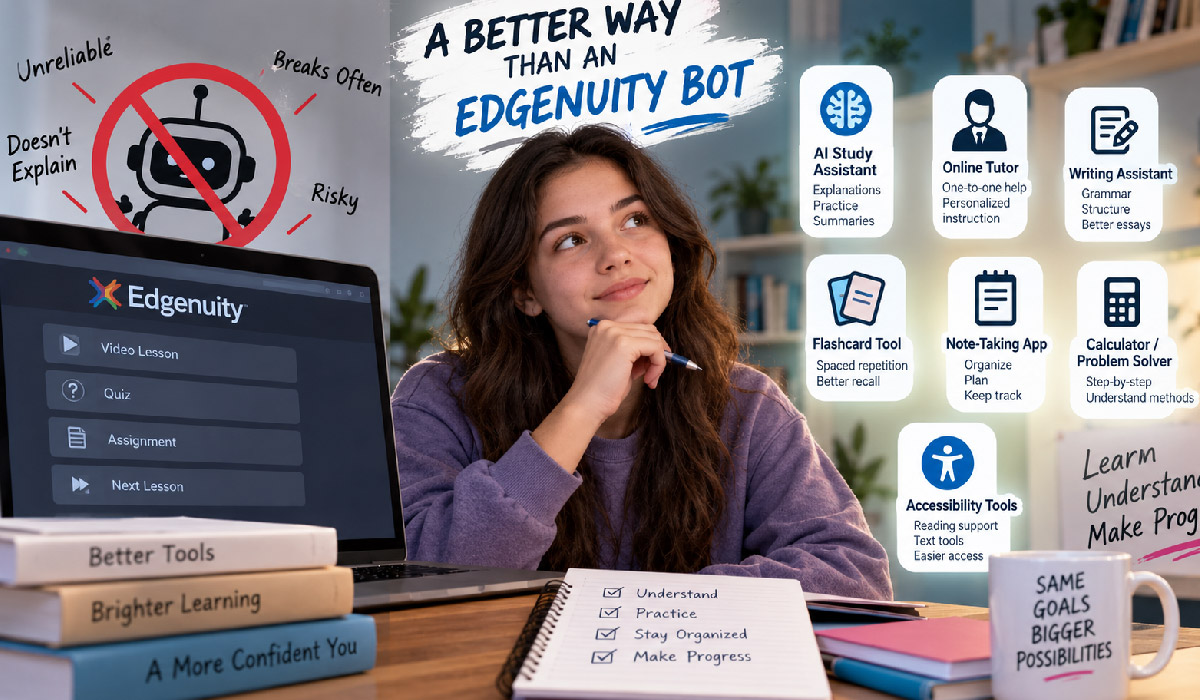
Why Students Look for an Exodus Edgenuity Bot Alternative
Anyone who’s spent a few weeks inside Edgenuity knows the drill: long video lessons, repetitive quiz formats, and assignments that pile up faster than you can get through them. It’s not surprising that students start searching around for something faster, something that cuts through the busywork. That’s usually how someone ends up typing Exodus Edgenuity Bot Alternative into a search bar in the first place.
But the reason behind the search matters more than the search term itself. Most students aren’t actually looking to skip learning — they’re stuck on a concept, running low on time, or just tired of re-reading the same paragraph without it sinking in. What they need isn’t automation. It’s an Edgenuity study tool that actually explains things, or a bit of tutoring, or a smarter way to organize what’s due and when.
This article walks through the realistic alternatives — the ones built around explanation, practice, and understanding rather than simply pushing through a course on autopilot.
What Is an Exodus Edgenuity Bot, Really?
How Students Typically Use This Kind of Tool
Search around and you’ll find that an “Edgenuity bot” generally refers to some kind of automation script or browser add-on meant to speed through lesson videos, click through quiz screens, or otherwise reduce the manual clicking involved in an online course. The appeal is obvious — nobody enjoys sitting through a ten-minute video just to answer three questions about it. Students turn to this sort of thing hoping to save time or get past a section they’re already frustrated with.
Why Students Often Look Elsewhere
The trouble is, tools like this tend to be unreliable. They break when Edgenuity updates its interface, they only work on certain browsers, and they don’t explain a single thing — you finish the lesson no smarter than when you started. There’s also a more serious issue lurking underneath: leaning on automation to get through graded work can cross into territory that conflicts with a school’s academic rules, and it leaves you unprepared for the test or the next unit that builds on what you skipped. That combination — unreliable, unhelpful, and risky — is exactly why so many students end up hunting for a genuine Exodus Edgenuity Bot Alternative instead.
Best Exodus Edgenuity Bot Alternatives at a Glance
Rather than one single replacement, think of it as a toolbox. Different problems call for different tools — a student stuck on chemistry needs something different from a student who just can’t keep track of due dates.
| Alternative Type | Best For | Useful Features | Main Advantage |
| AI Study Assistant | Explanations and revision | Questions, summaries, examples | Fast learning support |
| Online Tutor | Difficult subjects | One-to-one instruction | Personalized help |
| Writing Assistant | Essays and assignments | Grammar, structure, editing | Better writing quality |
| Flashcard Tool | Memorization | Spaced repetition | Better recall |
| Note-Taking App | Course organization | Notes, search, planning | Keeps materials organized |
| Calculator/Problem Solver | Math practice | Step-by-step calculations | Helps understand methods |
| Accessibility Tools | Different learning needs | Reading and text support | Easier course access |
Worth noting: before committing to any specific product, it’s worth checking its current features yourself — apps update constantly, and what worked well a year ago might look completely different today.
1. AI Study Assistants for Edgenuity Coursework
This is probably the closest thing to what most people are actually hoping for when they search for a bot alternative — something quick, but that also teaches you something along the way.
A good AI study assistant can take a dense Edgenuity reading passage and explain it in plainer language, break a confusing multi-part question into smaller steps, or throw together a few practice questions so you can test whether you actually understood the material. It’s especially useful the moment you hit a wall — you’re staring at a lesson, nothing is clicking, and you just need someone (or something) to explain it a different way before you try it yourself.
That said, AI isn’t infallible. It gets things wrong sometimes, especially with very specific or unusual questions, so it’s smart to double-check anything important against your actual course material. And it should go without saying — turning in AI-written answers as your own work isn’t the point here, especially where your school’s rules say otherwise.
2. Online Tutoring Services
If you find yourself hitting the same wall in the same subject over and over, a tutor is often a better fit than any app. There’s something a well-trained human does that software still struggles with — noticing exactly where your understanding breaks down and adjusting on the spot.
Tutoring works well for math, science, English, history, pretty much anything where the material builds on itself. A tutor can slow down, speed up, or approach a topic from a completely different angle depending on what clicks for you. It also adds a layer of accountability that’s easy to lose when you’re studying alone through a screen.
This option tends to suit students who already grasp the basics but get tripped up once questions get harder or more layered — less “I don’t understand any of this” and more “I get it until it gets complicated.”
3. Writing and Grammar Tools
Edgenuity courses often include essays or short written responses, and this is one area where a decent writing tool genuinely earns its keep. Grammar checkers and editing assistants are great for catching awkward phrasing, weak sentence structure, or the kind of small errors that are easy to miss when you’ve read your own paragraph five times in a row.
The right way to use these tools follows a pretty simple order: write your own draft first, run it through a grammar or clarity check, look over what it suggests, and then make the final edits yourself. That last step matters — the tool should sharpen your writing, not replace it.
4. Flashcards and Spaced-Repetition Tools
Some parts of a course just come down to memorization — vocabulary, formulas, historical dates, scientific terms, foreign language material. This is where flashcard apps with spaced repetition genuinely outperform any bot. They’re built to bring information back to you right before you’d otherwise forget it, which is a very different thing from just recognizing an answer on a multiple-choice quiz.
There’s a real gap between recognizing something and actually remembering it later, and that gap is usually what trips students up on cumulative tests.
5. Note-Taking and Study Organization Apps
Edgenuity can feel like a moving target once you’re juggling several courses at once — different lessons, different deadlines, different half-finished assignments scattered across tabs. A decent note-taking app solves a problem that has nothing to do with understanding the material and everything to do with keeping track of it.
A simple system works better than a complicated one. Try sorting everything into three buckets: Learn, Practice, Review. Notes and new concepts go in “Learn,” problem sets and drills go in “Practice,” and anything you need to revisit before a test goes in “Review.” It’s not fancy, but it keeps things from slipping through the cracks.
6. Step-by-Step Math and Problem-Solving Tools
For math-heavy sections — algebra, geometry, equations, graphing — the tool that shows its work matters more than the one that just spits out a final number. A solver that walks through each step gives you something to actually learn from, and lets you compare your own process against it to see exactly where things went sideways.
Look for tools that show working steps, offer some kind of visual or graph when relevant, and let you check your own solution rather than just handing you the answer outright. And as always, use these for practice and understanding — not as a shortcut around whatever your course’s rules on outside help actually say.
How to Choose the Right Exodus Edgenuity Bot Alternative
It helps to think in terms of the actual problem you’re facing, rather than browsing tools at random.
| Your Main Problem | Better Alternative |
| “I don’t understand the lesson.” | AI tutor or human tutor |
| “I forget what I studied.” | Flashcards/spaced repetition |
| “My essays need editing.” | Writing assistant |
| “I lose track of assignments.” | Study planner/note app |
| “Math steps confuse me.” | Step-by-step problem solver |
| “Reading is difficult.” | Accessibility/read-aloud tools |
Before settling on anything, it’s worth asking a few quick questions: Does it actually explain the answer, or just give it to you? Will it work on your device? Does it handle your data reasonably? Is it free, or worth what it costs? Does it fit the subject you’re struggling with? And, maybe most importantly — does it help you learn, or does it just get the task off your plate?
Features That Matter More Than “Bot” Automation
The appeal of automation usually comes down to one word: speed. But speed on its own doesn’t actually solve the underlying problem. What tends to matter more, long-term, is whether a tool explains things accurately, adapts to how you personally learn, gives you useful feedback, and lets you track whether you’re actually improving.
A tool that shaves five minutes off a lesson but leaves you just as confused isn’t saving you anything — you’ll just end up re-learning the material later, usually under more pressure, right before a test.
Is Using an Edgenuity Bot Allowed?
Honestly, it depends — on your school, your teacher, and the specific assignment. Automatically completing graded work through a bot can run straight into conflict with academic-integrity policies, and different schools enforce this differently. Study aids, tutoring, and proofreading tools often fall under a more relaxed set of rules than anything that completes graded work on your behalf.
If you’re not sure where the line is, just ask your teacher directly what kind of outside help is and isn’t allowed. It’s a much safer bet than assuming.
How to Use Study Tools Without Becoming Dependent on Them
A few habits go a long way here. Try the question yourself before reaching for any tool. Pin down exactly where you got stuck. Ask the tool to explain just that piece — not the whole assignment. Work through a similar example on your own. Then go back to the original question and check your work. Finally, jot down what you actually learned from the process.
Done this way, a study tool makes you sharper over time instead of quietly making you more dependent on it.
Exodus Edgenuity Bot Alternative: Which Option Is Best?
There’s no single winner here — it really comes down to what’s actually giving you trouble.
Best for explanations: an AI study assistant. Best for personalized support: a human tutor. Best for writing: a grammar or writing assistant. Best for memorization: spaced-repetition flashcards. Best for organization: a note-taking or planning app. Best for math: a step-by-step problem solver. Best for accessibility needs: reading and assistive-learning tools.
Practical Tips for Getting Better Results From Any Study Tool
Be specific about the subject and topic you’re working on, and mention what you already understand so the explanation isn’t starting from zero. Ask for the reasoning behind an answer, not just the answer. If something still doesn’t click, ask for it in simpler terms, then request a similar practice question to test yourself. Double-check anything that seems important, keep your own notes as you go, and stick to whatever rules your school and teacher have set. And one more thing — there’s rarely a good reason to hand over school login details or personal information to a random third-party tool.
Final Thought: Choose Learning Support, Not Just Automation
At the end of the day, the right alternative depends entirely on what’s actually slowing you down. No single tool is the universal best pick — it’s about understanding, practice, feedback, and slowly needing less help over time, not more.
Before choosing an Exodus Edgenuity Bot Alternative, figure out what’s actually getting in your way. Need an explanation? Try a tutor or study assistant. Struggling to stay organized? A planner will do more for you than any bot. Need repetition to make things stick? Flashcards or a problem-solving tool will get you there. The goal isn’t just to finish the course faster — it’s to come out the other side actually understanding the material.
Frequently Asked Questions
What is the best Exodus Edgenuity Bot Alternative?
There isn’t one universal answer. It depends on whether you need tutoring, plain explanations, writing help, memorization support, math practice, or just better organization.
Can AI help me understand Edgenuity lessons?
Yes — it can explain concepts, summarize readings, generate practice questions, and clarify terms you’re stuck on. Just double-check anything critical and stick to your course’s rules.
Is an Edgenuity bot the same as an AI tutor?
Not really. A bot is generally built around automating clicks and screens, while an AI tutor is built around explaining, practicing, and giving feedback.
What’s the safest way to use an Edgenuity study tool?
Use it to understand the material, practice on your own, stay organized, and check your work — not to automatically finish graded assignments for you.
Can I use tutoring for Edgenuity coursework?
Yes, tutoring can genuinely help with tough subjects. Just make sure it lines up with whatever your school allows in terms of outside assistance.
How do I pick the right alternative?
Start with the actual problem — confusion, forgetting material, writing trouble, math trouble, disorganization, or accessibility — and pick the tool built for that specific issue.
You May Also Read: Marta Fitzgerald: The Private Life of Rush Limbaugh’s Third Wife
