

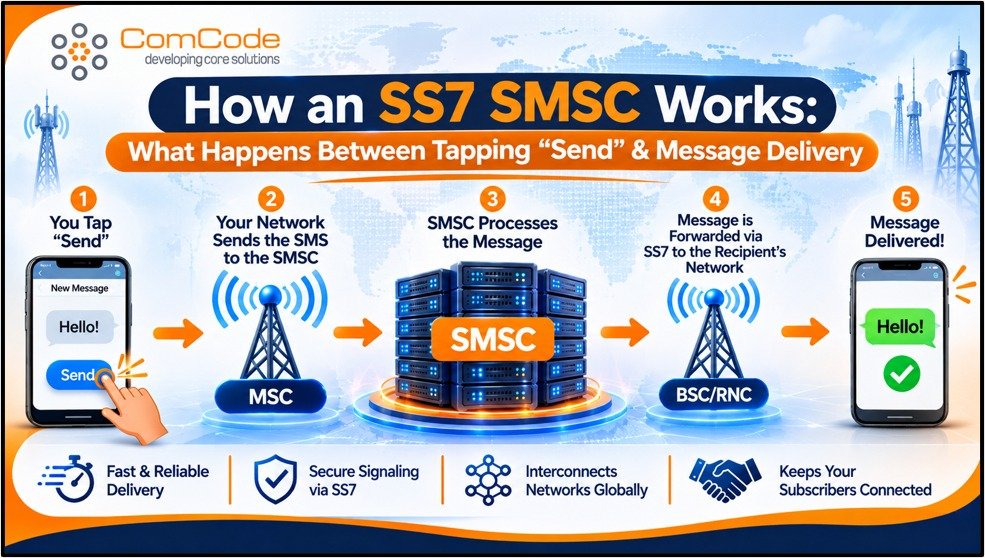
You type a message, tap “Send,” & a moment later your friend’s phone buzzes. It feels instant, but behind that simple action sits a chain of systems in the core network in telecom that validates, stores, routes & delivers your text. At the center of it all is the Short Message Service Center (SMSC) & the way it talks to handsets, operators & applications relies on SS7 signaling and, for external senders, the SMPP protocol.
This article walks through exactly what happens between “Send” & delivery, from the first radio hop to the final delivery report.
What Is an SMSC?
The Short Message Service Center is the network element responsible for receiving, storing, forwarding & delivering SMS messages. It works on a store-and-forward principle: instead of pushing a message straight to the recipient, the SMSC first accepts & stores it, then attempts delivery. If the recipient’s phone is off or out of coverage, the message is not lost. The SMSC holds it & tries again later.
In the core network in telecom, the SMSC sits alongside other key elements:
- MSC/VLR: the switch & visitor register that serve subscribers in a given area
- HLR/HSS: the subscriber database that knows where each user is currently registered
- SMS gateways & routers: the entry & exit points to other networks & applications
Every SMS, whether it is a chat between friends or a one-time password from your bank, passes through an SMSC at least once.
A Quick Primer on SS7 & SIGTRAN
Signaling System No. 7 (SS7) is the signaling framework operators use to set up calls, exchange subscriber data & carry SMS between network nodes. Even in the age of messaging apps, traditional SMS still depends on it.
For SMS, the relevant layer is the Mobile Application Part (MAP). The key MAP operations are:
- MO-ForwardSM: carries a message from the sender’s MSC to the SMSC
- SendRoutingInfoForSM: asks the HLR where the recipient is currently served
- MT-ForwardSM: carries the message from the SMSC to the recipient’s serving MSC
- ReportSMDeliveryStatus & AlertServiceCentre: let the SMSC know when a previously unreachable subscriber becomes available
Where SIGTRAN Fits In
Traditional SS7 ran over dedicated TDM links. Today, most operators carry the same signaling over IP using SIGTRAN, a family of protocols that includes M3UA for transporting SS7 messages & SCTP for reliable, multi-homed transport. SIGTRAN lets an SMSC exchange MAP messages with the HLR & MSCs over standard IP networks, which reduces cost, simplifies scaling & replaces aging TDM hardware.
Step-by-Step: The Life of a Text Message
Step 1: The Handset Sends the Message (MO-SMS)
When you tap “Send,” your phone packages the text into a short message & transmits it over the signaling channel of the radio network. The serving MSC receives it, checks that you are allowed to send SMS & forwards it toward your operator’s SMSC using MO-ForwardSM.
Step 2: The SMSC Accept’s & Stores the Message
The SMSC validate’s the message: it check’s the sender, the destination address, the message format & any applicable limits. Once accepted, the message is stored & the SMSC confirms receipt back to the MSC, which tell’s your phone the message has been sent. This is the moment you see the “Sent” status.
The SMSC also record’s details such as the validity period (how long to keep trying) & whether a delivery report was requested.
Step 3: Routing Lookup
Now the SMSC needs to find the recipient. It send’s a Send Routing Info For SM request to the recipient’s HLR or the Home Subscriber Server in LTE network’s. The reply contains the identity of the MSC or VLR currently serving the subscriber, along with the subscriber’s IMSI. If the recipient is on another operator’s network, the request is routed across operator interconnect’s to that network’s HLR.
Step 4: Delivery Attempt (MT-SMS)
Armed with the routing information, the SMSC sends the message to the serving MSC using MT-ForwardSM. The MSC pages the handset, delivers the text over the radio interface & returns an acknowledgment. The SMSC marks the message as delivered and, if requested, generates a delivery report for the original sender.
Step 5: Failure & Retry
Not every attempt succeeds. The recipient may be switched off, in a tunnel or in an area without coverage. In that case:
- The SMSC keeps the message in its queue & notifies the HLR that a message is waiting
- When the subscriber reappears on the network, the HLR alerts the SMSC, which retries immediately
- Otherwise, the SMSC retries on a schedule, often with increasing intervals
- When the validity period expires, the message is discarded & a failure report may be returned
This store-and-retry behavior is what makes SMS so dependable compared with many real-time messaging channels.
How Messages Enter the SMSC: SMPP
Handsets are only one source of messages. Banks, retailers, delivery companies & apps all need to send texts at scale & they do it through the SMPP protocol (Short Message Peer-to-Peer). SMPP is a TCP-based protocol designed for high-volume, reliable exchange of messages between an external system & an SMSC.
Binding Types
An application opens a session with the SMSC by “binding” in one of three modes:
- Transmitter: can only submit messages
- Receiver: can only receive messages & delivery reports
- Transceiver: can do both over a single connection
Key PDUs
- submit_sm: the application sends a message to the SMSC
- submit_sm_resp: the SMSC acknowledges & returns a message ID
- deliver_sm: the SMSC passes an incoming message or a delivery receipt back to the application
- enquire_link: a keep-alive that confirms the session is healthy
The Role of an SMPP Gateway
An smpp gateway sits between external senders & the SMSC. It handles authentication, throttling, routing, protocol conversion & billing, so the SMSC itself is shielded from direct exposure to every customer connection. Many operators & messaging providers use an SMPP gateway to manage thousands of simultaneous binds from enterprise clients & aggregators.
A Simple SMPP SMS Flow
A typical smpp sms submission looks like this:
- The application binds to the SMSC as a transceiver with its system ID & password
- It sends a submit_sm containing the sender ID, destination number & text
- The SMSC replies with submit_sm_resp & a message ID
- The SMSC routes & delivers the message using the same HLR lookup & MT-ForwardSM steps described above
- A delivery receipt returns to the application as a deliver_sm
A2P Messaging & the SMSC
SMS began as person-to-person (P2P) traffic, but today a large share of volume is A2P messaging, where an application sends the message to a person. Typical examples include:
- One-time passwords & two-factor authentication codes
- Banking alerts & transaction notifications
- Appointment reminders & delivery updates
- Marketing & promotional campaigns
A2P traffic behaves differently from P2P. It arrives in bursts, often in the thousands per second, demands fast delivery for time-sensitive codes & needs precise delivery reporting. This pushes SMSCs to support higher throughput, smarter queuing, priority handling & sophisticated routing rules. It also makes the SMSC a revenue-critical platform for operators, since A2P messaging is a major income stream.
Security & Abuse: Why SMS Firewalls Matter
SS7 was designed in an era of trusted networks & that trust is now a weakness. Attacker’s who gain access to the signaling network can abuse MAP operation’s to:
- Locate subscriber’s by querying routing information
- Intercept message’s, including one-time password’s
- Spoof sender addresse’s to send fraudulent text’s
- Flood network’s with spam or run SMS fraud scheme’s
An SMS Firewall protects against these threats by inspecting signaling & messaging traffic at the network edge. It can block unauthorized MAP requests, validate that incoming messages come from legitimate sources, filter spam & spoofed senders & detect A2P traffic that is being disguised as P2P to avoid termination fees. This last practice, often called grey routing or A2P bypass, costs operators significant revenue, so a firewall protects both subscribers & the business.
Common Challenges & Best Practices
Running an SMSC well takes more than just keeping it online. Operator’s & messaging provider’s should consider the following:
- Scalability: size the platform for peak A2P bursts, not average load & scale horizontally where possible
- Delivery optimization: tune retry schedules, use smart routing & keep HLR data accurate to raise delivery rates
- Monitoring: track delivery receipts, latency, queue depth & error codes in real time to catch problems early
- Redundancy & failover: deploy geo-redundant SMSC nodes & multi-homed SIGTRAN links so a single failure does not interrupt service
- Compliance: enforce sender ID registration, opt-in rules & local regulations to avoid blocked traffic & penalties
Conclusion
The next time you tap “Send,” remember the journey your message takes. Your handset hands it to the MSC, which forwards it to the SMSC over SS7 & SIGTRAN. The SMSC stores it, asks the HLR or Home Subscriber Server where the recipient is, delivers it through the serving MSC & reports back, retrying if necessary. Meanwhile, applications feed the same SMSC through the SMPP protocol, powering the huge A2P messaging ecosystem, while an SMS Firewall guards the whole path against abuse.
Understanding how these pieces fit together is essential for anyone building, operating or optimizing a messaging platform. If you are planning an SMSC, an SMPP gateway or an SMS Firewall deployment, a specialist telecom partner can help you design a solution that delivers reliably, scales smoothly & stays secure.
FAQ
- What is the difference between an SMSC & an SMS gateway?
Ans. An SMSC is the core network element that store’s, route’s & delivers message’s across the mobile network. An SMS gateway, such as an SMPP gateway, is the interface that connect’s external application’s & partners to the SMSC & manages access, routing & protocol conversion.
- Is SMS still routed over SS7?
Ans. Yes. Most traditional SMS still relies on SS7 MAP signaling, usually carried over IP using SIGTRAN. Newer LTE & 5G network’s can also use Diameter-based interface’s for SMS, but SS7 remains widely deployed, especially for interconnect.
- What does SMPP stand for?
Ans. SMPP stands for Short Message Peer-to-Peer. It is the standard protocol applications use to send & receive SMS through an SMSC.
- What is A2P messaging?
Ans. A2P messaging means application-to-person messaging, where software such as a banking app or e-commerce system sends texts to users, as opposed to one person texting anoth
