

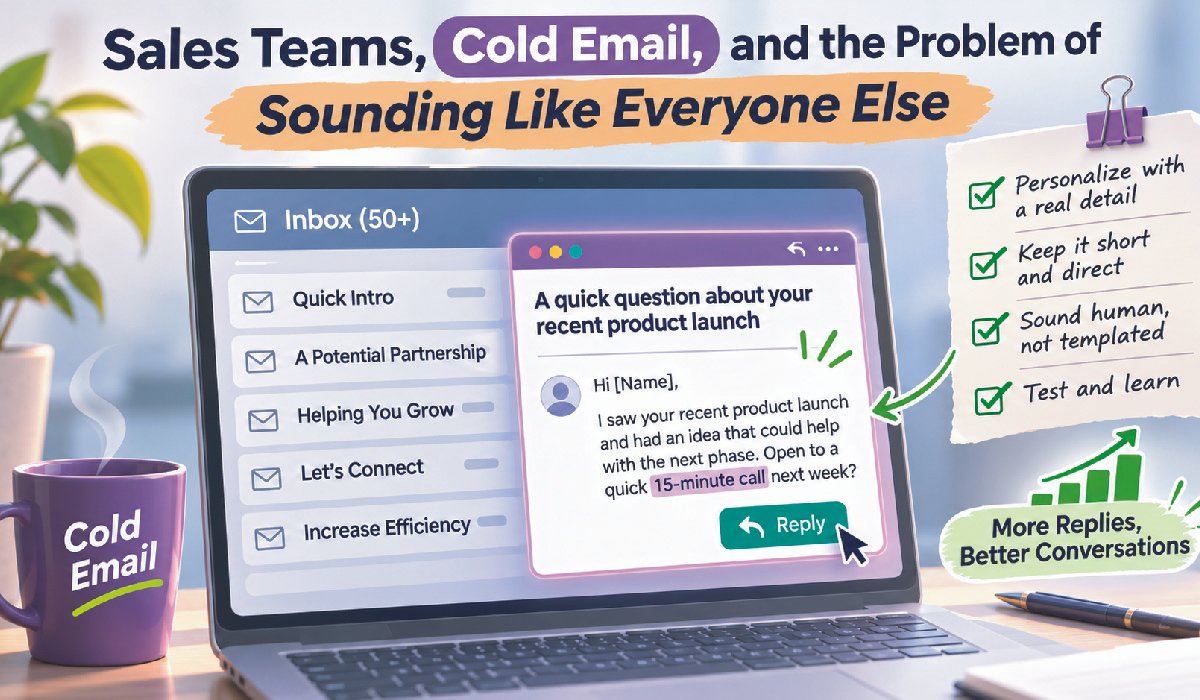
A prospect opens an email, reads one sentence, and knows it came from a template. Nothing in it is wrong. It is just indistinguishable from the five others that arrived that morning.
AI drafting has made it trivially easy to produce outreach at scale and just as easy for every competitor to do the same. The messages that still get replies are the ones that sound like they were written by someone who had a reason to write to this particular person.
The Inbox Is Already Crowded
The M+R Benchmarks report found that nonprofits sent roughly 50 emails per subscriber in 2025, about 31 of them fundraising-related. Commercial senders face a similar volume. In an inbox that full, readers decide in a line or two whether a message deserves attention.
Generic phrasing is the fastest way to lose that decision. Openers like a warm greeting followed by a broad compliment and a vague value statement are so common that readers skim past them almost automatically.
Where AI-Drafted Outreach Goes Wrong
The failure is rarely factual. It is tonal. Drafts tend to be evenly polite, evenly enthusiastic, and evenly structured, which reads as detached. A real salesperson varies their confidence, gets to the point faster with some prospects than others, and occasionally says something slightly unexpected.
- Every message opens with the same kind of compliment.
- Sentences are nearly the same length from start to finish.
- The call to action is a stock phrase that could end any email.
- Nothing in the message could only have been written to this recipient.
What Replies Tend to Have in Common
Messages that earn answers usually contain one concrete detail about the recipient, a short and direct ask, and a rhythm that sounds spoken. They are often shorter than the templates around them and less polished in a way that reads as human.
A Workflow That Keeps Scale and Voice
Sales teams cannot hand-write every message, and they should not give up the speed that drafting tools provide. The workable middle is to automate the structure and personalize the opening line, then run a quick rhythm adjustment before sending.
That adjustment is easy to make with a step to humanize AI text in a way that varies sentence length and phrasing so a templated message reads more like a note from a person, while the personalized detail and the offer stay exactly as the rep wrote them.
Reps should always read the final version before sending. A rewriting step should never be allowed to change a price, a date, or a commitment, and a ten-second read catches the rare case where it does.
Testing Instead of Guessing
The advantage of outreach is that it is measurable. Teams can send two versions of an opener to similar segments and compare reply rates. A few weeks of testing usually reveals which phrasing styles resonate and which are ignored, and the results are often surprising.
It helps to track one metric at a time. Changing the subject line, the opener, and the call to action at once makes it impossible to tell which change mattered.
Respecting the Recipient
There is also an ethical dimension. Messages should be honest about who is sending them and why. Natural-sounding does not mean misleading, and the best outreach pairs a human tone with transparent intent.
Writing a First Line That Earns the Second
The opening sentence carries most of the weight in outreach. It should signal that the message is about the recipient, not the sender. A reference to a recent post, a hiring announcement, or a product launch shows that the writer did homework. A generic compliment shows the opposite.
Specificity is more persuasive than flattery. One precise, accurate observation about the prospect’s business outperforms three sentences of praise, and it is something no template can fake.
Following Up Without Repeating Yourself
Follow-ups are where sameness hurts most, because the recipient has already seen the first message. A follow-up that restates the original in different words reads as automated. One that adds new information, a relevant example, or a short question reads as attentive.
- Add one new piece of information in every follow-up.
- Shorten each message relative to the last.
- Change the format, such as a question after a statement.
- Know when to stop. Three thoughtful messages outperform seven identical ones.
Keeping Records of What Works
Teams that save their highest-reply messages and review them monthly tend to improve steadily. The patterns are usually simple: shorter openings, one specific detail, a direct and low-pressure ask. Writing those patterns down turns individual instinct into a shared playbook.
Segmenting Before Writing
The most effective way to avoid generic outreach is to write for a narrow group. A message to chief financial officers at mid-sized logistics companies can use language and examples that a broad template cannot. Narrower segments make personalization easier and make the message feel considered.
Segmentation also clarifies what to test. A change that lifts replies in one segment may do nothing in another, and learning that is more useful than a single blended average.
Subject Lines That Sound Like People
Subject lines carry a large share of the open decision. The best ones are short, specific, and slightly informal, such as a question about a recent announcement. Over-polished subject lines with promotional phrasing look like marketing and are ignored by many recipients.
- Keep subject lines under about six words where possible.
- Reference something real, such as a recent event or role.
- Avoid stacked punctuation and promotional phrasing.
- Test two versions against similar segments before settling.
Reviewing Replies as Feedback
Replies, including negative ones, are the best source of information about messaging. A recipient who says this is not relevant to me is telling the sender something about targeting. A recipient who says this sounds like a template is telling the sender something about tone. Reading replies weekly as a team turns outreach into a learning loop.
Respecting the Reader’s Time
Short messages are not only more effective but also more respectful. A busy prospect appreciates a note that can be read in fifteen seconds and answered in one line. Cutting every sentence that does not serve the ask is the simplest edit a sales writer can make, and it usually improves rhythm at the same time.
It also helps to make the next step easy. A single clear question, such as whether a short call next week makes sense, gets more replies than an open-ended invitation to connect at some point.
Finally, remember that outreach is a conversation, not a broadcast. Writing each message as though a single, specific person will read it, because one will, tends to produce better rhythm and better results than any template.
Teams that keep these habits tend to find that reply rates improve gradually and that the quality of conversations improves too, because the people who respond are those who felt addressed as individuals.
Outreach at scale is here to stay, and so is the sameness that comes with it. Sales teams that keep a human rhythm, add a real detail, and test their phrasing will keep earning replies in a market where most messages sound alike.
Read More: 8 Essential Partners for Tree Care and Yard Recovery in Ambler, PA
