

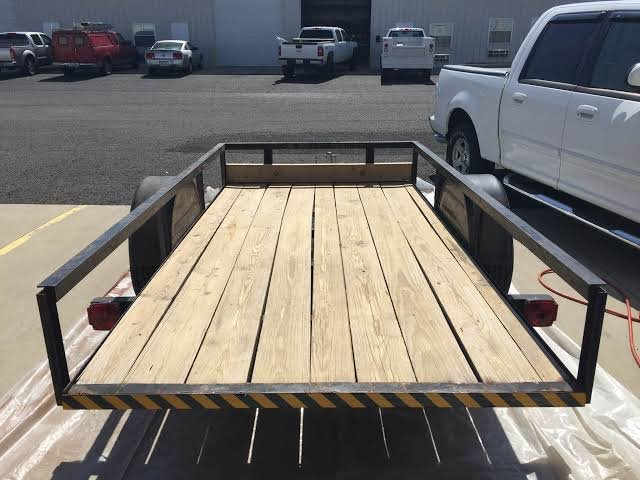
Most folks who haul equipment around Schuylkill County know how easy it is to put off replacing a couple of weathered planks on a utility or flatbed trailer. The wood still looks fine from ten feet away, and you have a job to get to before noon. Mechanics who work on local hauling gear at Jonestown AG Supply LLC regularly see what happens when those tired boards get pushed one season too far. Swapping them early is almost always the cheaper call.
What Pennsylvania Weather Does to Wood Trailer Floors
Open-deck trailers along eastern Pennsylvania’s highways take a beating year-round. Wood plank decks weather the elements and accelerate decay. Springs bring wet leaves, dirt, and mulch that rest against side rails and the front bulkhead. Water has nowhere to go to evaporate, and damp conditions promote the growth of wood-decay fungi which break down the fibers and leave the wood spongy and weak. Even heavy, pressure-treated wood begins to decay in the same way. As the wooden planks lose strength, the crossmembers hold up the deck, and when the wood becomes spongy and decays, the steel crossmembers eventually weaken and break.
Early Warning Signs You Should Catch Before Loading Up
You don’t need slick shop gauges to detect trailer floor. Just grab a flathead screwdriver and drive it into the nastiest wood you can find, especially near screw holes and back dovetail, and around the wheel wells. If the tip goes in easily or the wood just crumbles off in dry pieces, that piece has lost all its strength. Tap your tool out on the floor. Listen carefully. A firm-sounding rap will tell you it is solid wood, whereas a thud will tell you it is soft or rotted within. Watch out, also, for screws that are too deeply sunk in. That’s a sign the wood is giving way. Catching soft timber during a routine walkaround lets you schedule simple trailer repair on your own calendar instead of scrambling mid-week.
What Actually Happens When a Board Snaps Under Weight
One crossmember bears the weight of the trailer, and if it bugs one of those crossmembers down until it breaks through, then it could tip a trailer on its side, when it only takes. Set an empty trailer on the driveway to snap a board. It usually happens when a skid steer goes over a trailer axle. Load it over a bump in Route 61 on a loaded pallet. It can tear hoses or break the tie-down rings and the fender supports. Out on public roads, keeping heavy freight supported by a sound deck structure is also a basic safety rule, because shifting cargo puts your tow vehicle and nearby drivers in real danger.
Comparing Planned Deck Work Against Emergency Breakdown Costs
Add the numbers up, and you can see the choice easily. New 2×8 boards, a handful of deck screws, and a few hours of some basic shop work add up to a bill you can budget for in a quiet week. Now consider the other side. You call a wrecker to haul a stuck tractor from a busted bed. You pay for pulling a tire or a bent axle. You lose a couple days’ worth of paid work with the rig just sitting there. Owners who take their trailers to Jonestown AG Supply LLC before the spring or harvest rush tend to spend a small share of what a single breakdown in the middle of the season ends up costing.
Conclusion
Decayed and weak trailer boards eventually break, but most of the time it is while transporting a load. A board is lost when the load shifts, or the trailer takes a bad bump. Catching the board in time can save a company a lot of hassle and lost time along the Schuylkill County highway. Treat wood as it breaks down to a soft, splintering condition, as a warning. Have it removed before it becomes truly decayed and weak. Swapping out boards is quick, easy, and safe.
