

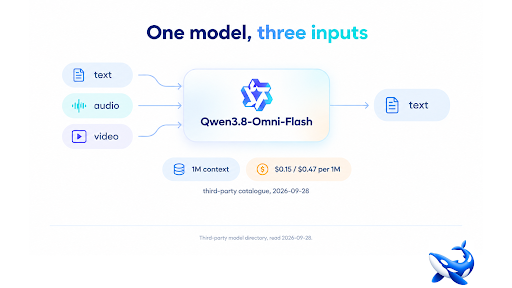
Multimodal models have been shipping for years, and most of them lie about it in a specific way: they accept an image because something upstream converted it into text first. Native audio and video input is a different claim, and it is the one worth checking. This month’s new AI models include an entry in the Qwen line that takes audio and video directly, carries a one-million-token context window, and is listed in a third-party public directory on 28 September 2026 at $0.15 per million input tokens and $0.47 per million output tokens — the lowest price in this batch for a model with that combination. On OrcaRouter the catalogue of new ai models shows what each entry costs to call, and on a multimodal workload that cost is multiplied by a tokenisation problem most comparisons never mention.
What “native” changes about the bill
The difference between native and pipelined multimodal input is not architectural elegance. It is the token count.
A pipelined system transcribes audio to text and samples video into frames, then describes the frames, and sends the resulting text to the model. Each stage is lossy, each stage has a cost, and the text that arrives is a summary of what the model was supposed to perceive. A native model consumes the media directly, which preserves detail the pipeline destroys — and changes how the input is billed.
That second half is the part buyers underestimate. Audio and video tokenise at very different rates depending on the model’s encoder and on the sampling policy applied. A minute of audio might be a few hundred tokens or a few thousand. A minute of video might be thousands or tens of thousands, and the number moves with resolution, frame rate and how the encoder handles motion. Two models with the same headline input rate can therefore differ by an order of magnitude on the same media file.
Which means the headline rate is close to meaningless for a media workload until you know the tokenisation. The way to find out is to send one representative file of each type — one real recording, one real screen capture, one real document scan — through the API and read the token usage from the response. That is a twenty-minute test and it is the only one that produces a usable number.
Why a low rate on a multimodal model is plausible
The instinct to distrust a low rate on a model that handles video is reasonable, because video encoding is expensive. The resolution is the same as everywhere else in this batch: sparsity and specialisation.
A flash-tier model is designed for throughput rather than for peak reasoning. It gives up depth on hard problems in exchange for a low cost per token, and it pairs that with an encoder that turns media into a manageable number of tokens. Whether the trade is acceptable depends entirely on the task. Transcribing and summarising a meeting, tagging a media library, extracting structure from a screen recording — these are tasks where breadth of input matters and deep reasoning does not. They are also tasks where the volume is large, which is exactly where a low rate compounds.
The wrong place to use it is a task that needs careful reasoning over the media: a compliance review of a recorded call, a judgement about whether a scene contains something specific. A flash tier will produce a fluent answer and the answer may be confidently wrong, and the reason is that the model was priced for the other job.
What the score tells you, and what it hides
We looked for an independent capability figure for this model on 28 September 2026 and found none, so this article quotes no score for it. That is not a judgement on the model and not a gap we intend to fill with a vendor number; a comparable figure that does not exist is worth less than an empty space that says so.
The absence is informative in itself. Public capability indexes are built around a general bundle — reasoning, knowledge, code, mathematics — with a strong bias toward text. A model whose selling point is that it consumes audio and video directly sits outside that bundle, and this one has no page on the index we checked.
The index has a second gap that matters more. Even where such a model is measured, no part of that measurement covers media handling: there is no audio track and no video track. So a score in this category is by construction an answer about the part of the job that matters least.
The consequence for a reader is a specific kind of error: treating the lack of a number as a verdict, in either direction. The number to look for is one your own workload produces. If you extract structure from recorded calls, the metric that matters is field-level accuracy on a sample of your own calls, and no public index publishes it.
Where the context window matters more than the price
A one-million-token context is the other half of this entry’s story, and on media workloads it is the more consequential half.
Long media inputs are the case where context limits bite first. An hour of recorded audio, a long screen recording, a batch of scanned documents — these arrive as tens of thousands of tokens each, and a model with a modest window forces you to chunk, and chunking forces you to invent a merge step, and the merge step is where accuracy quietly dies. Being able to send the whole thing removes an entire class of engineering work.
It also changes what the price comparison means. A model with a small window and a lower rate can be more expensive per task than one with a large window at a higher rate, because the chunking pipeline costs you tokens for overlap and costs you accuracy for the seams. That is the same cost-per-completed-task argument that applies everywhere else in this batch, and it applies with unusual force when the input is media.
How to decide whether it belongs in your stack
Build the test around tokens, not around the model.
Pick three files that represent your real media — not a clean demo recording, the messy one with background noise and crosstalk. Send each through and record the token count, the wall-clock latency and whether the output field you need is correct. Do the same for whatever pipeline you use today.
Then compare on cost per correct extraction and on latency to a usable result. Both will surprise you, usually in the direction of the pipeline being more expensive than it looked: transcription, frame sampling and the merge step are each billed somewhere even when they are not billed by the model. If the native model clears your accuracy bar, the saving is real and it scales with volume. If it does not clear the bar, you have learned something more useful than a price list can tell you — where your accuracy bar actually sits, and what it costs to reach it.
Sourcing note: Qwen3.8-Omni-Flash’s first appearance in a third-party public model directory on 21 September 2026, its one-million-token context window, its native audio and video input, and its listed rates of $0.15 per million input tokens and $0.47 per million output tokens were read from that directory on 28 September 2026 and are that directory’s figures. No independent capability score is quoted, because the index we checked has no page for this model; the observation that the index carries no audio or video track is a statement about the index’s scope. The discussion of tokenisation variance across encoders, the accuracy cost of chunking, and the test design are editorial framing rather than measured results. The statement that this model is not in OrcaRouter’s catalogue is a statement about our own catalogue on 28 September 2026; no rate of ours is quoted for it. This article names no competing platform and describes none.
