


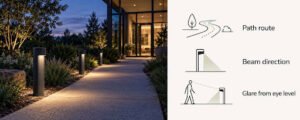
A row of bollards can help people recognize a walkway after dark, but the fixtures need to do more than mark the route. Poor placement can leave dark gaps, put bright light in a pedestrian’s line of sight, or make an entrance difficult to identify. Good planning starts with the path itself: where people enter, where they turn, and what they need to see.
Bollards are relatively short outdoor fixtures often used beside walkways, driveways, and landscape edges. Their low mounting height can suit pedestrian-scale spaces, but the actual effect depends on each fixture’s optics and installation. Treat them as part of a complete site plan, and compare the light they put on the walking surface—not just the fixture’s appearance.
Map the route before selecting fixtures
Walk the path in daylight and note its full route. Include entrances, turns, changes in level, crossings, gates, and places where the path meets a parking area or building. These transition points often need more attention than the straight sections because visitors need to understand where to go next.
Sketch the route and mark the points where people are likely to pause or change direction. Then consider the approach view: can someone see the next section of the walkway from where they are standing? A layout that looks evenly spaced on a drawing may feel confusing if the fixtures fail to reinforce the path’s direction.
Also identify what sits beside the route. Planting beds, low walls, seating, and signs may benefit from some spill light, but they should not distract from the walking surface. Decide whether the bollards will mainly guide movement, define an edge, or help identify an entrance. A clear primary purpose makes product comparisons easier.
For larger properties or public-facing routes, share the site plan with a lighting professional. Their review can account for the path width, pedestrian activity, surrounding light, and any applicable project criteria.
Choose a light pattern that suits the path
Bollards can distribute light in different directions. Some spread light around the fixture, while others direct more light toward a selected side or area. The right pattern depends on the route. A narrow path beside planting may need a different distribution from a wider walkway with pedestrians approaching from several directions.
Look at fixture-specific photometric information when it is available. It can help show how the light spreads across the ground and where brighter or darker areas may appear. Do not assume that two bollards with similar shapes or wattages will create the same result. Optics, mounting height, output, and orientation all affect the pattern.
Instead of choosing a spacing distance from a generic rule, evaluate the specific fixture on the specific path. Put proposed locations on the plan and check the manufacturer’s information. A mockup or temporary placement can reveal whether the path appears continuous from a pedestrian’s point of view.

Check fixture height and sightlines
Height affects both the visual presence of a bollard and where its light lands. A compact fixture may blend into a residential garden path, while a taller model can be more noticeable along a larger site route. The right size depends on the surroundings and the product’s distribution, not a universal height recommendation.
View the planned fixtures from several positions: walking toward them, approaching from the side, and looking out from nearby windows or seating. If the light source is visible and uncomfortable from those viewpoints, compare a more shielded or directional design. A fixture that looks attractive in a catalog photo may feel too bright when seen at eye level along a dark path.
The U.S. National Park Service advises directing light only where needed, using shielded fixtures, and choosing the lowest light level that suits the task. Its guidance notes that more output does not automatically create a safer environment and may reduce visibility.
Reduce glare and unwanted spill
A pedestrian should be able to see the walking surface without staring into a bright source. Check bollards from a person’s normal eye height, especially where a path slopes or where people approach from below the fixture. A light source that is hidden from one direction may become visible from another.
Pay attention to nearby windows and property lines, too. Light that spills into a residence, neighboring site, or planted area may create a nuisance without improving the route. Shielding, directional optics, careful orientation, and modest output can help keep the light focused.
Night testing is valuable because the same fixture can feel different against a bright building facade than against a dark garden. Review the effect after the surrounding lights are on and again with them off. If the path feels harsh, first check aiming and fixture distribution before adding more lights.
Compare product details and installation needs
Once the layout is clear, compare product specifications that affect the installation:
- Distribution: Confirm whether the fixture sends light around itself or in a more controlled direction.
- Height and dimensions: Check the full fixture size against path width, planting, and nearby structures.
- Voltage and power: Confirm the electrical configuration and required components for the exact model.
- Materials and finish: Match the product to the site conditions and the visual character of the property.
- Mounting method: Determine whether the fixture is designed for surface mounting or another installation approach.
- Maintenance access: Plan for cleaning and service without damaging surrounding paving or planting.
AQLightingGroup’s bollard collection includes different fixture sizes, styles, and electrical configurations. Their listings provide model-specific information, so compare the details for each fixture rather than assuming one specification applies across the category. AQLightingGroup can be part of the product comparison process for residential and commercial pathway projects.
For hardwired work, confirm local requirements and have a qualified electrician handle installation as needed. The fixture, wiring, foundation, and any controls should follow the manufacturer’s instructions and project requirements.
Review the route after dark
After installation, walk the path from each direction it will be used. Check for dark sections, unexpected glare, and points where the route becomes hard to follow. Look at turns and crossings in particular, since visitors may need more visual information there than along a straight stretch.
If the light pattern feels uneven, revisit spacing, aiming, and product distribution. Avoid solving every dark spot by increasing output. A different orientation or a fixture with a more suitable beam pattern may improve the route while keeping surrounding areas darker.
The goal is a path that reads clearly, feels comfortable to walk, and fits its setting. AQLightingGroup offers bollard options for different outdoor applications. Review the product details, map fixture positions, and check the nighttime effect before finalizing a larger installation.
FAQs:
- What are bollard lights commonly used for?
They are often used beside walkways, driveways, and landscape edges to help define outdoor routes or areas. Their suitability depends on the fixture’s light distribution and the needs of the site. - How far apart should pathway bollards be installed?
There is no single spacing distance for every fixture and path. Check the product’s photometric information and evaluate the layout for the path width, beam pattern, and desired coverage. - Can bollards create glare on a walkway?
Yes, if the source is visible from a pedestrian’s normal line of sight or the output is too bright for the setting. Check the route from multiple approach angles and consider shielded or directional fixtures. - Are bollards suitable for commercial properties?
They can be used along commercial walkways and entrances when the fixture and layout suit the site. Larger projects should be checked against applicable design criteria and reviewed by a lighting professional. - What should I compare when choosing bollards?
Compare fixture height, light distribution, voltage, materials, mounting method, and maintenance access. Verify each detail on the product page for the exact model.
