

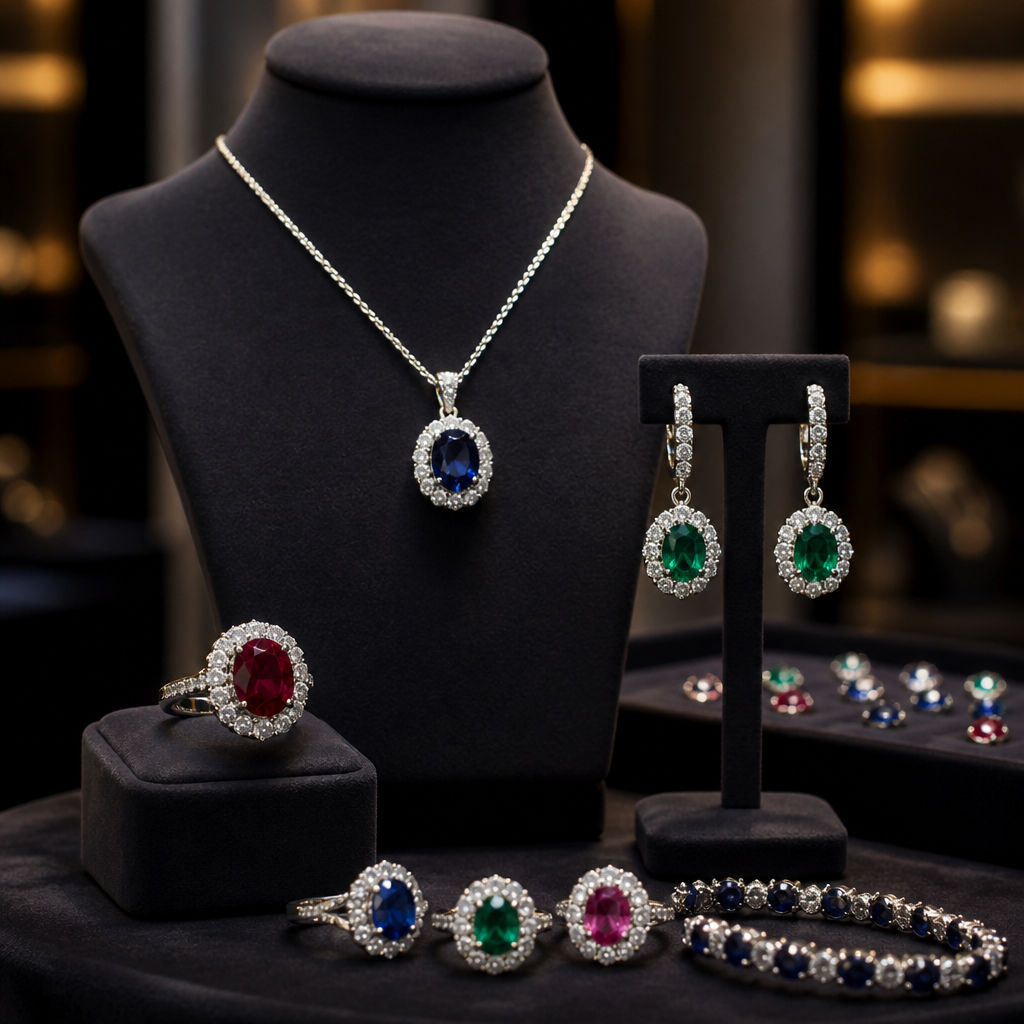
Most people buy diamonds one piece at a time, usually to mark something — a birthday, an anniversary, a promotion, a graduation. The result, a decade later, is a drawer of individually lovely things that refuse to work together: a pair of studs too small for the pendant, a bracelet that fights the yellow gold of a gemstone ring, a cross necklace that sits at exactly the wrong length under every collar you own. Building a small, deliberate diamond wardrobe is a different exercise, and it is mostly about proportion, metal consistency and knowing which pieces earn their keep daily versus which belong to evenings and photographs.
What follows is a practical framework for assembling that wardrobe — including how colored stones such as sapphire, ruby and emerald fit alongside white diamonds without turning the whole collection into a costume.
Start With the Pieces You Will Actually Wear Every Day
There are three categories that do the heavy lifting in almost every collection: diamond stud earrings, a simple pendant on a fine chain, and a tennis bracelet. They are the jewelry equivalent of a white shirt. They go with everything, they survive changing taste, and they photograph well in any light.
Studs: size before everything else
Buyers obsess over cut grade and color before they have decided on scale, which is backwards. A stud that is too large for the wearer’s lobe reads as heavy no matter how well it is cut; one that is too small disappears entirely under hair. If you can, try three sizes on the actual ear. A smaller total weight in a brilliant round, well cut, will often look livelier than a larger stone that leaks light out of the bottom.
Cluster settings and motif studs — hearts, clover shapes, squares framed with smaller stones — are a sensible way to get visual presence from a group of modest stones. They read as design rather than as a statement about carat weight, which is often exactly the effect people want for daytime. Check the back fittings too: screw backs or locking posts are worth the mild inconvenience if the earrings will be worn through gym sessions and airport security lines.
Pendants and cross necklaces: length is the design decision
A solitaire pendant at 16 inches sits at the base of the throat and works with open collars; at 18 inches it falls just below and layers more easily with a second chain. Cross pendants tend to look best slightly lower, where the vertical line of the piece has room to read. If you intend to layer, buy chains in deliberately different lengths — two inches apart is usually enough to stop them tangling — and keep the metals matched.
Tennis bracelets: construction over stone count
A tennis bracelet lives on a moving wrist and takes more abuse than anything else in the box. Look at how the links articulate, whether the clasp has a secondary safety catch, and how the stones are held — four-prong settings show more of each stone, while channel or bezel-adjacent styles protect girdles better. Ask about sizing: a bracelet that slides two inches up the forearm will spin and wear unevenly at the clasp.
Where Fancy Color Diamonds Change the Calculation
White diamonds are graded, in simple terms, on the absence of color. Fancy color diamonds invert that logic entirely — here, saturation and hue are the value, and the vocabulary shifts to terms like intensity and overtone. That inversion catches new buyers off guard, because a stone that would be penalized in one system is prized in the other. Anyone considering a colored diamond should read up on how the trade actually discusses these stones; industry coverage of fancy color diamond market trends and grading nuances is a far better primer than retail marketing copy.
Practically speaking, fancy color stones work beautifully in earrings, where the pair sits away from the face’s own color and the two stones can be matched to each other. They are harder to place in a necklace that will be worn against a dozen different fabric colors. If you want one colored element in an otherwise white-diamond wardrobe, earrings are the lower-risk place to put it.
Mixing in Sapphire, Ruby and Emerald
Colored gemstone accents — a square stud framed in sapphire, a pendant with a ruby center — give a collection personality without the cost curve of a saturated colored diamond. Three rules keep the mixing from going wrong. First, limit yourself to one dominant color story at a time; a sapphire necklace and emerald earrings worn together rarely flatter either. Second, match metal across the pieces you wear simultaneously, because white gold against yellow reads as accidental rather than intentional. Third, respect hardness differences in storage: emerald in particular is more fragile than its hardness number suggests, and should never be jumbled loose with diamonds.
Colored stones also carry cultural and symbolic weight that diamonds largely do not, which is part of their appeal. Yellow sapphire, for example, has a long tradition behind it in South Asian jewelry — the background on pukhraj yellow sapphire and its place in tradition is a useful illustration of how a single stone can function as heirloom, ornament and meaning at once. That symbolic layer is worth considering when a piece is intended as a gift.
Buying: Online Browsing, In-Person Decisions
Screens are excellent for narrowing options and terrible for judging scale and brilliance. A sensible process is to shortlist online, then see the two or three finalists under normal light. For shoppers in or near New York, the diamond district remains the most efficient place to do that comparison work, and retailers like Leon Diamond — which keeps an online store alongside a showroom on West 47th Street and offers appointments — are built for exactly this split between browsing and deciding. Their collections concentrate on the core categories worth building around: diamond studs in solitaire, cluster and motif styles, solitaire and cross pendants, tennis bracelets, fancy color diamond earrings and gemstone-accented pieces in 14K and 18K white gold, which makes them a reasonable starting point for anyone assembling fine diamond jewelry with consistent metal and proportion across the set. Their blog guides also cover the buying questions most people arrive with.
A Short Checklist Before You Commit
- Confirm the piece is a certified diamond and that you understand what the documentation covers.
- View the stone in at least two lighting conditions — showroom spotlights flatter almost everything.
- Check metal karat and finish against the pieces you already own.
- Test clasps, backs and safety catches with your own hands, not the salesperson’s.
- Ask about sizing, shipping and the return or exchange policy before you pay.
- For gifts, decide whether the recipient wears white or yellow metal before anything else.
The Long View
A good diamond wardrobe is small. Four or five pieces that share a metal, a scale and a sensibility will be worn more than fifteen that do not speak to each other — and they will travel better, store better and pass down better. Buy the studs first, get the size right, then add the pendant and the bracelet as occasions supply the excuse. Save the colored diamond or the gemstone piece for when you know precisely what gap it fills. That sequence costs nothing extra and spares you the drawer full of near-misses.
