

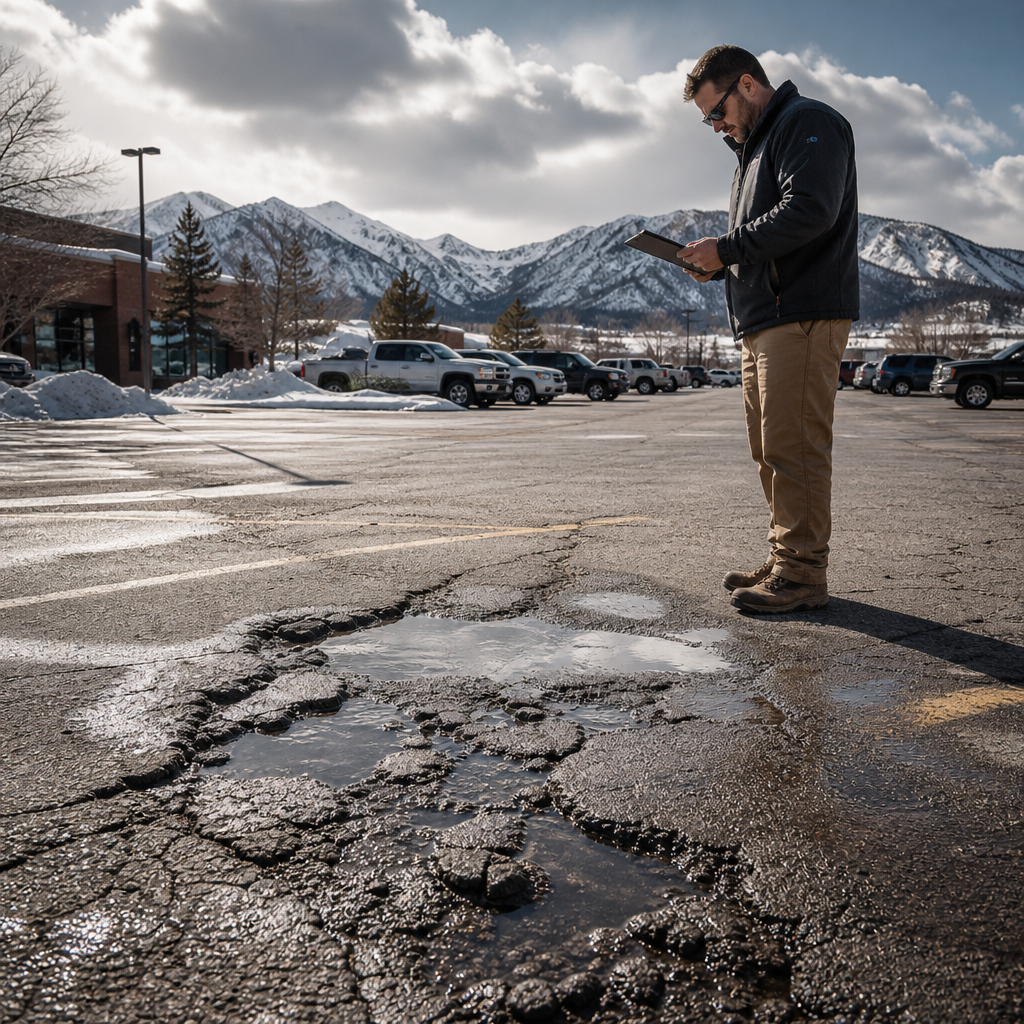
A parking lot is usually the largest single surface a commercial property owns, and it is almost always the first thing a tenant, customer or prospective buyer sees. Yet it tends to be the last line item anyone plans for. In Colorado, that delay is expensive. Freeze-thaw cycling, intense UV at altitude, winter de-icing chemicals and sudden summer downpours all attack asphalt from different directions, and a lot that could have lasted two decades can begin unraveling in eight or nine years without routine attention.
The good news: pavement deterioration is predictable. It follows a curve, and the cost of intervention climbs steeply as you move down that curve. Understanding where your lot sits on it is the difference between a maintenance budget and a capital replacement project.
What Colorado’s Climate Actually Does to Asphalt
Asphalt pavement is a flexible system: aggregate held together by a bituminous binder, resting on a compacted base. Everything that goes wrong traces back to one of three failures — the binder oxidizing, water reaching the base, or the base losing support.
Along the Front Range, properties can see dozens of freeze-thaw transitions in a single season. Water that seeps into a hairline crack expands roughly nine percent as it freezes, levering the crack wider each cycle. Repeat that fifty times over a winter and a two-millimeter crack becomes a half-inch channel feeding moisture straight into the subgrade. Once the base is saturated and traffic flexes the surface above it, you get alligator cracking, then potholes, then full-depth failure.
Altitude adds a second problem. Stronger UV exposure accelerates oxidation of the binder, which is why older lots look gray and feel chalky underfoot. Oxidized asphalt is brittle, so it cracks more readily and ravels at the edges. De-icing salts and magnesium chloride compound the damage by holding moisture at the surface and attacking the binder chemically.
Reading the warning signs
- Color shift to light gray — binder oxidation; the surface is losing flexibility.
- Loose aggregate at edges and along drive aisles — raveling has started.
- Longitudinal cracks following construction joints — normal, but they are open doors for water.
- Interconnected block or “alligator” cracking — structural fatigue; surface treatments alone will not fix it.
- Standing water 24 hours after rain — a drainage problem that will eventually become a base problem.
- Depressions around catch basins or manholes — settlement, often from an undermined base.
The Hierarchy of Repairs — and When Each One Is the Right Call
Property managers often ask for a single quote on “fixing the lot.” A better question is which treatment matches which defect, because applying the wrong one wastes money twice — once on the work and again when the defect reappears.
Crack sealing
This is the highest-return maintenance task in pavement management, full stop. Hot-pour rubberized sealant is routed or cleaned into prepared cracks, where it bonds to the walls and stays flexible through temperature swings. Done on a two-to-three-year cycle, crack sealing keeps water out of the base and can add years to a lot’s service life for a fraction of what resurfacing costs. Cold-pour products from a bucket are fine for a homeowner’s driveway; on commercial traffic they tend to shrink and pull away. For a clear walkthrough of how the prep work and materials differ by defect type, this practical guide to asphalt patching and crack repair techniques explains the fundamentals well.
Sealcoating
Sealcoat is a sacrificial wear layer. It does not add structural strength — a common misunderstanding — but it shields the binder from UV, oxygen, fuel drips and de-icing chemicals, and it restores the dark, uniform look that makes a property read as well kept. Typical commercial cycles run every three to five years depending on traffic volume, sun exposure and whether the lot sees heavy delivery vehicles. Sealcoating a lot with active structural cracking, however, is cosmetic only; the failures will telegraph through within a season.
Patching and full-depth repair
Potholes and alligatored areas mean the base has failed. A surface skim patch buys a few months. Full-depth patching — saw-cutting a clean rectangle, removing the compromised asphalt and base, recompacting and replacing — addresses the cause. It costs more per square foot but does not come back on next year’s work order.
Mill-and-overlay versus full reconstruction
When surface distress is widespread but the base is still sound, milling off the top layer and placing new asphalt resets the surface without the cost and disruption of reconstruction. Mill-and-overlay also preserves existing grades and curb heights, which matters for drainage and ADA transitions. If the base itself is unstable, though, overlaying only hides the problem — reflective cracking usually appears in two to three years.
Striping, ADA Compliance and Liability
Markings are not decoration. Faded stall lines reduce usable parking count because drivers space themselves conservatively. Worn fire lane markings can draw a fire marshal citation. And accessible parking — stall widths, access aisles, signage height, the slope of the route from stall to entrance — is a genuine liability exposure where the standards are specific and enforceable. Re-striping is typically paired with sealcoating because the fresh surface gives the paint a clean bond, and because it is the natural moment to correct a layout that has drifted out of compliance or no longer fits how the site is actually used.
Building a Multi-Year Plan Instead of Reacting
Pavement management uses a condition index — commonly a PCI score derived from a walked survey of distress type, severity and extent — to put a number on where each section of a lot sits. Scoring sections separately matters, because a loading dock and a far corner of overflow parking age at completely different rates. Once you have scores, you can sequence work: seal the sections that are still in good shape, patch and overlay the ones in the middle, and schedule the worst sections for reconstruction in a future budget year. That sequencing is what flattens spending into predictable annual amounts rather than one painful surprise.
It is the same logic property teams already apply to building envelope work, where a staged approach to roof replacement and long-term property protection prevents emergency spending. Pavement deserves the same treatment — and the two are related, since roof drainage that discharges onto asphalt without a splash block or proper slope will undermine the base beneath it.
Choosing a Contractor Who Plans, Not Just Quotes
The distinction worth looking for is whether a contractor sells treatments or sells a plan. Ask whether they will walk and score the site before recommending anything, whether crews are in-house or subcontracted, what sealant materials they use, and how they handle phasing so tenants keep access during work. A contractor who leads with a condition assessment and a three-to-five-year sequence is giving you a budgeting tool, not just a price. Firms that specialize in commercial work understand the operational side too — nighttime phasing for retail centers, dock access for industrial sites, ADA routes for healthcare campuses. One example of that approach in Colorado is Asphalt Coatings Company, which has worked across the state since 1986 using in-house crews and PCI-based assessments to build condition-based, multi-year maintenance plans for commercial properties from Fort Collins and Denver to Colorado Springs, Grand Junction and Pueblo.
A Practical Starting Point
If your lot has not been formally assessed, start there rather than with a repair order. Walk the site after a rain and photograph where water stands. Note every crack wider than a pencil and every area where aggregate is coming loose. Check whether fire lanes and accessible stalls are legible from a driver’s seat, not from a clipboard. Then get a written condition summary that breaks the lot into sections with recommended treatments and a suggested year for each.
From there, the calendar does most of the work: crack seal on a short cycle, sealcoat and re-stripe on a medium cycle, patch structural failures as they appear, and reserve for resurfacing well before the surface forces your hand. Spend a little, often, in the right places — and Colorado’s weather becomes something your pavement survives rather than something that decides your budget for you.
