

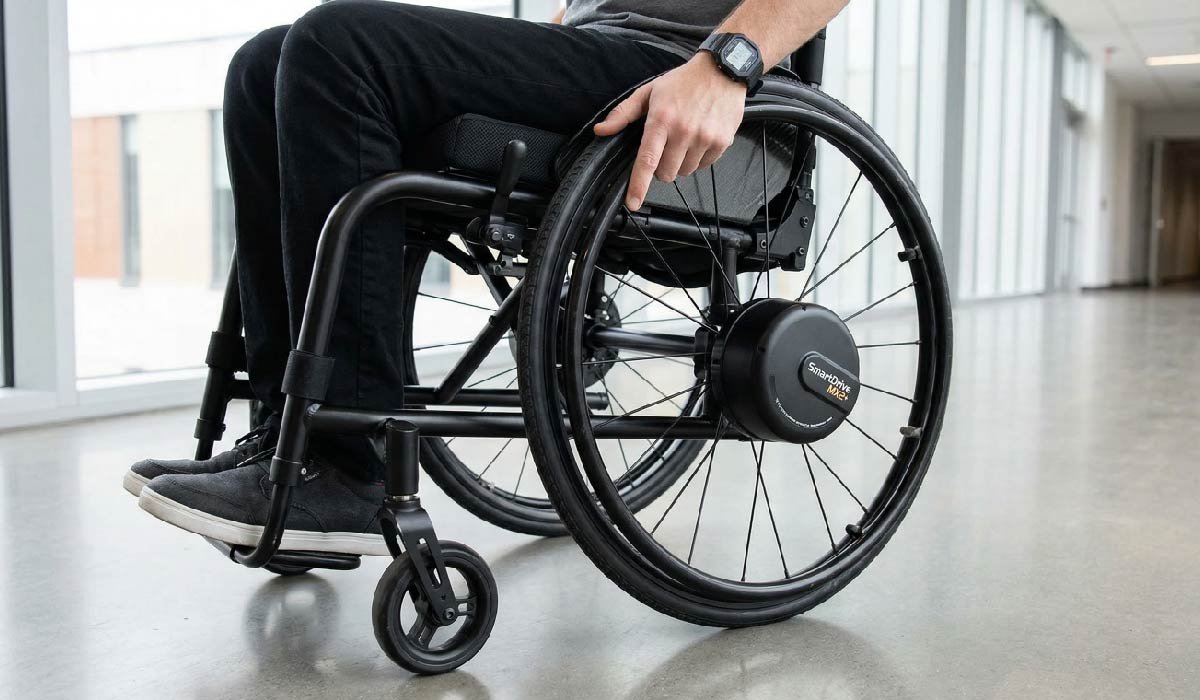
Somewhere between a fully manual wheelchair and a powered chair sits a category that trips up even experienced clinicians: power assist. It’s neither one thing nor the other, and that’s exactly the point. Choosing between manual, power assist, and full power isn’t really about which wheelchair looks more capable on a spec sheet. It’s about matching the mechanics of the chair to what a person actually needs to do with their body, day after day, for years.
So let’s pull this apart properly, because the wrong pick here has real consequences: shoulder injuries from years of over-propelling a manual chair, or lost upper body function from switching to full power too early.
What manual actually asks of the body
A manual wheelchair demands repeated, high-load shoulder and wrist movement, thousands of times a day for a full time user. That’s a huge ask on joints that weren’t built for that kind of repetitive strain. Research into wheelchair users has flagged shoulder pain and rotator cuff injury as depressingly common outcomes for long term manual users, especially those propelling heavier or poorly fitted chairs.
That doesn’t mean manual is the wrong answer. For plenty of people, especially those with strong upper body function and an active lifestyle, a well fitted ultralight manual chair supports independence, transfers, and general fitness better than any powered alternative. The trick is fit, not just chair type. Seat height, axle position, and wheel camber all change how much force a shoulder has to generate per push.
Where power assist earns its spot
Power assist wheelchairs bolt a modest motor onto what is otherwise a manual chair, amplifying each push rather than replacing the push entirely. Think of it less like an electric car and more like an electric bike, you still pedal, the motor just takes the edge off the hills.
This makes power assist a genuinely useful middle ground for people whose manual propulsion is becoming harder, due to fatigue conditions, progressive shoulder wear, or reduced cardiovascular capacity, but who still want to stay active in the chair rather than switch to full power. It also matters for transport and storage, since many power assist systems can be broken down into parts a carer can actually lift, unlike a full power base.
When full power is the honest answer
Sometimes the kindest, most functional recommendation is full power, and clinicians shouldn’t hesitate to say so just because it feels like a bigger leap. For clients with limited or no functional propulsion capacity, progressive neurological conditions, or significant fatigue, a power wheelchair with proper seat functions such as tilt, recline, and elevating legrests protects skin, supports respiratory function, and honestly just gives back energy for the parts of the day that matter more than pushing wheels.
Drive wheel position matters more than people expect here too. Front wheel drive chairs tend to climb obstacles and turn tightly in confined indoor spaces, while rear wheel drive chairs often feel more stable at higher outdoor speeds. Mid wheel drive splits the difference with the tightest turning circle of the three, handy for tight apartment hallways or crowded classrooms.
The questions that actually decide it
Instead of starting with what a client wants stylistically, start with function. How far do they need to travel in a typical day, and across what surfaces? Is fatigue building across the day, or is strength stable? What does their home, school, or workplace physically allow in terms of doorway widths and turning space? Is there a carer available for manual handling, and what’s realistic for them long term? And critically, what does this person want their energy spent on, because pushing a manual chair all day uses up energy that could go toward work, study, or just being present with family.
Truth is, none of these answers stay fixed forever. A chair that’s right this year might not be right in three, particularly for progressive conditions, so building in a review point matters as much as the initial prescription.
So what’s the actual takeaway?
There’s no universally superior wheelchair type, only a better or worse match for a specific body, a specific home, and a specific life. Manual protects independence and fitness when the body can sustain it. Power assist extends that independence a little longer once shoulders start complaining. Full power hands back energy and function when propulsion itself becomes the barrier. Get the assessment right, and the equipment quietly disappears into the background of someone’s life, which, honestly, is the whole goal.
Weight, transport, and the parts nobody asks about first
Chair weight rarely makes the first page of anyone’s decision making, yet it quietly shapes daily life more than most features on a spec sheet. A heavier power base might handle rough ground beautifully, but if it needs to fold into a small hatchback every school morning, that strength becomes a genuine problem for a tired parent or a support worker with a bad back. Manual chairs and power assist systems generally win here, since many can be broken into carryable sections, while full power bases usually need a hoist, a ramp, or a modified vehicle.
So it’s worth asking early in the process, not as an afterthought once a chair has already been ordered, exactly how this equipment will get from the front door to the car, the school gate, or the workplace lift. A brilliant chair that can’t leave the house on a Tuesday morning isn’t actually solving the problem it was bought to solve.
Battery life and the reality of a full day out
For power assist and full power users, battery range deserves more attention than it usually gets during a showroom demo. A chair that comfortably handles a short trip to the letterbox can behave very differently across a full school day, a work shift, or a weekend outing that involves hills, carpet, and gravel, all of which drain a battery faster than smooth flat flooring. Ask about realistic range under normal use, not just the manufacturer’s best case figure, and factor in charging opportunities across a typical day.
Cold weather and older batteries both shrink range too, so a chair that’s been perfectly reliable for two years might start needing a midday top up as components age. Building a rough battery check into annual reviews saves someone getting caught out halfway through an outing with no power left and no charger nearby.
