

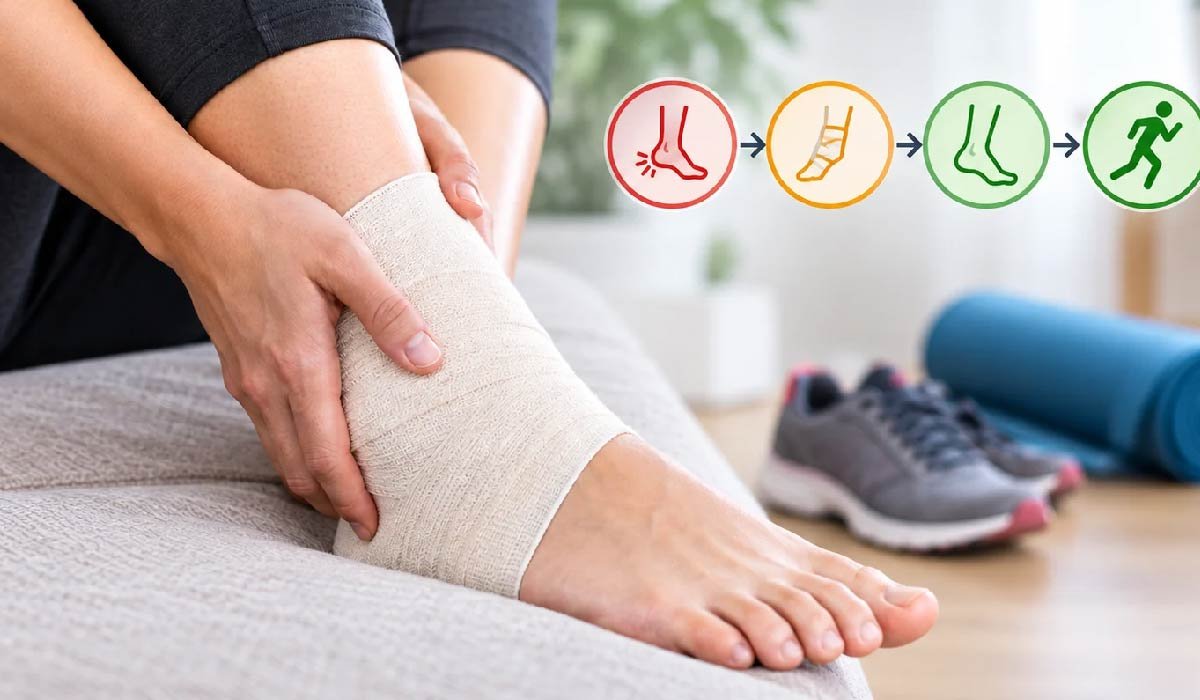
You feel it before you see it. A roll of the ankle on a kerb, a sharp pull, then that sickening second where you test your weight and decide not to.
By evening the joint looks angry. By the next morning it looks worse. So out comes the tube of gel. The assumption underneath it: rub this in and the ankle will sort itself out.
It won’t. Not because the gel is useless, but because a sprain is an injury to ligaments, and ligaments work to a timetable that no cream can shorten. Pain relief is one small part of a much longer job.
What Actually Happens Inside a Sprained Ankle
The ligaments on the outside of the ankle stretch past their limit. In a mild sprain the fibres are stretched but intact. In a severe one they tear, partly or all the way through.
Blood vessels around the joint leak fluid into the surrounding tissue. That leak explains the timing. Swelling often peaks a day or two after the injury, not at the moment it happened.
The second morning is usually worse. That is when most people start to worry, and when the wrong decisions get made.
Three grades are used in clinics. Grade one is a stretch with little damage, grade two is a partial tear with pain and swelling, and grade three is a complete tear that makes the joint feel unstable when you stand on it.
Grade decides the timeline. A grade one sprain can settle in a fortnight. A grade three can take three months, and sometimes longer.
The First 72 Hours Are About Protection, Not Pain
For years the advice was rest, ice, compression, elevate. The updated version is PEACE and LOVE, published in the British Journal of Sports Medicine. It keeps protection and elevation, and adds a warning that matters here. Avoid anti-inflammatory medication for the first 48 to 72 hours.
The reasoning is that inflammation is part of the repair signal. Damp it down too hard and you may slow the process. The guidance covers pills and rub-on products alike.
This is where most people misread the point. A gel that reduces pain is not the same as a gel that speeds healing. It can make the next few days bearable. It cannot reattach a ligament.
Why the swelling peaks on day two
Fluid keeps collecting for 24 to 48 hours after the fibres are damaged. Gravity makes it worse. An ankle that looked manageable at bedtime can look alarming by lunchtime if you have been on your feet.
Elevation above heart level, a compression bandage and gentle movement within a comfortable range do more for that swelling than any topical product.
Where a Pain-Relieving Gel Earns Its Place
If you want to keep moving, and you should, you need the pain low enough to try. This is the honest role of a pain-relieving gel. It buys you a window in which the joint can be used gently, instead of being guarded all day.
Topical NSAIDs work where they are applied, and less of the drug reaches the stomach than with a tablet, which is why they are often suggested for people who cannot tolerate oral anti-inflammatories.
The trial evidence is decent. A Cochrane review of 61 trials and 8,386 people with acute musculoskeletal pain found ketoprofen gel, the active ingredient in Fastum, gave good pain relief to roughly seven or eight people in ten. Placebo gel managed two or three in ten. The number needed to treat came out around 2.5.
That is a real effect. It is also a modest one. And it says nothing about repair.
What the trials do not show
No trial has demonstrated that rubbing a gel onto a torn ligament makes it heal faster. The outcome measures are pain, function and how quickly people return to normal activity. Those are worth having. They are not the same as tissue healing.
There is also a practical limit. Ketoprofen gels carry a photosensitivity warning. Keep the treated skin out of direct sun. Same for sunbeds, during use and for a couple of weeks afterwards.
Weeks Two to Six: The Part Nobody Does
The swelling drops. The pain becomes manageable. So the exercises stop, and the ankle is declared fine.
That is the mistake. This is the stage that decides whether you sprain it again in three months. The ligament has scarred, but the muscles around it are weaker and the balance reflexes are slower. Neither comes back on its own.
Calf raises, done slowly and through a full range, rebuild the strength that protects the joint. Single-leg stands, first with eyes open and then closed, retrain the balance system. A wobble board helps later, once walking is comfortable.
Two or three short sessions a week beats one long one. Frequency wins.
Why So Many Sprains Never Really Heal
A 2019 review of the epidemiology is blunt. Up to 70 per cent of people who sprain an ankle report some lasting physical limitation, and many develop chronic ankle instability. The review by Herzog and colleagues makes uncomfortable reading.
The cause is rarely the original tear. It is the strength and the balance that never came back, plus the habit of ignoring a joint that still feels loose.
People who sprain once are more likely to sprain again, and each repeat injury loosens the joint a little further until a minor accident becomes a long-term weakness.
When to Stop Self-Treating and Get It Looked At
Some ankles need an X-ray. The Ottawa rules are the standard test, and they are simpler than the name suggests. Two questions do most of the work.
- You cannot take four steps on it, even limping, right after the injury and again in the clinic.
- There is tenderness along the back edge of the outer ankle bone, or over the bone at the base of the fifth toe.
- Deformity, numbness, or a crack you heard at the time are reasons to go in regardless.
Any of those, and you need imaging before you start rehab. A fracture treated as a sprain is how people end up with a joint that never settles.
See a physiotherapist anyway if the swelling has not clearly improved after a week, if you cannot walk normally after two, or if the ankle gives way without warning.
Frequently Asked Questions
Should I use a gel or take a tablet?
A gel puts the drug where the pain is and sends less of it through the stomach. A tablet may suit widespread pain or a joint you cannot easily reach. Ask a pharmacist if you take blood thinners, have kidney problems or a history of stomach ulcers. Both routes carry risk.
How long can I keep using a pain-relieving gel?
Short courses are the norm. If you still need it after seven to ten days for the same injury, that is a signal to get the ankle assessed rather than to keep buying tubes.
Can I walk on a sprained ankle?
Yes, within comfort. Gentle loading helps the fibres line up and keeps the joint from stiffening. Crutches for a couple of days are fine if walking is unbearable, but complete rest for weeks works against you.
Does the gel help a torn ligament heal?
No. It helps with pain, which lets you move. Healing depends on the grade of the tear, your age, and how consistently you do the strength and balance work afterwards.
