

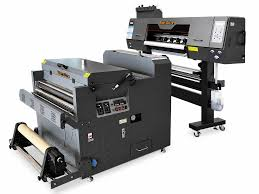
Any printing company’s key question is which is the best DTF printer to select. These aspects of production speed, print quality, and operating cost, are influenced by the machine. These are the factors that need to be taken into account by businesses before making an investment.
There are 2 popular options: 2-head DTF printers and 4-head DTF printers. Either of the two is fit for different production needs. Their performance and cost can be considerably different, though.
A more basic solution might be better for a smaller business. If your business requires more production, then it would require a commercial printing facility. Having an idea about these variations can aid shoppers make informed choices.
Understanding 2-Head DTF Printers.
2-head DTF printing has 2 sets of print heads for creating designs. This installation can be employed for small- and medium-scale businesses. It provides a feasible production level with cost-effective investment.
Colour and/or detail transfers can be produced on these machines. Their real performance will be determined by the printhead technology and guidelines.
Main advantages include:
- It requires less up-front investment than many larger configurations.
- Appropriate machinery for small firms.
- May have a more convenient maintenance design.
- Customised printing orders – practicable operation.
- More flexible workstation needs.
Production time might be an issue, though. It’s a decision that needs to be explored when dealing with large orders.
Understanding of the 4-Head DTF Printers.
A 4-head DTF printer is provided to have 4 printheads. It is possible to have higher production with this configuration.
Depending on its design, a further increase in the printing speed can be provided by additional print heads. They can offer more options for ink-channel arrangements, too.
Important advantages include:
- Greater likelihood of producing at maximum capacity.
- Greater suitability for working under load.
- More arrangement of Printheads.
- Greater possibilities for commercial scale-up.
- May eliminate print jams.
These include: pass settings, models of printheads, printing resolution, and software setup.
4-Head vs. 2-Head DTF printers:
The resulting decrease in options comes from understanding the primary distinctions.
| Feature | 2-Head DTF Printer | 4-Head DTF Printer |
| Printheads | Two | Four |
| Production capacity | Suitable for smaller workloads | Better suited to larger workloads |
| Initial investment | Generally lower | Generally higher |
| Maintenance | Depends on configuration | More components may require attention |
| Workspace | Often more compact | May require more space |
| Business suitability | Small and medium businesses | Growing and commercial operations |
| Production speed | Depends on specifications | Higher potential in suitable configurations |
The differences represent a general comparison. Specifications as to actual size may differ according to manufacturers and models. It’s always best to compare specs prior to making a buy.
Understand how to compare the speed and production of printing.
One of the main factors to consider when purchasing a lathe is the speed at which it can make the products. Businesses should get a good idea of how many documents they will need each day.
Smaller orders may be more economically serviced by a 2-head printer. But when it comes to big orders, there is more pressure on production.
For greater output capacity, a 4-head printer may be the way to go. This can aid in the business administration’s hectic agendas.
Seek suppliers’ real-life production examples. This is to gain insight into true running performance.
Consider print quality and accuracy
It doesn’t matter how many printheads you have; print quality is important. Consistent colours and clear design are expected of the customers.
Either of the two configurations can deliver superb print quality. But performance is achieved based on the particulars of the printhead and the machine calibration.
Pull sample prints from the suppliers before buying so you can get a feel for the material. Review and check the details, color consistency, and general aesthetics.
Work out the Total Investment and Running Costs
These may include:
Inks and PET films used in DTF.
- Adhesives (powder & curing supplies).
- Electricity and equipment maintenance.
- Printhead cleaning materials.
- Replacement parts and services.
- Income costs, including wages and benefits paid to workers; labor and production costs.
There will be a greater start-up cost for purchasing a 4-head printer. But if there is greater production capacity, then the expense will be justified.
A 2-head machine might be more convenient for getting started. It may have the capacity to aid companies in managing their preliminary investments.
Which configuration is better for small business?
There is a low production capacity in the small business. You could also have limited budgets.
The 2-head printer may be a wise choice to begin with. It could be able to offer some capacity for made-to-order orders. It is essential for businesses to select the best cheap DTF printer for sale.
What is the proper time to opt for a 4-Head DTF Printer?
In some businesses, where there is a requirement for customers, it can be advantageous to use a 4-head printer.
Take into account this configuration if:
- Your order size never dips below a certain level.- Your order count continues to grow over time.
- Shorter deliveries are expected.
- You frequently make large clothing requests.
- You have printing delays due to your current printer.
- There is adequate space and operating funds.
For smaller volumes, a dual-head DTF printer might be adequate. But those who are anticipating a quick growth in business should take into account the higher capacity alternatives.
Maintenance and after-sales support
Therefore, maintaining the printhead is crucial in DTF printing. Failure to maintain can impact production quality.
Additionally, verify the manufacturer’s warranties and troubleshooting. What is just as important is whether the after-sales service is reliable; it will help you protect your investment.
Conclusion
2-head and 4-head DTF printers can bring various benefits to use. Depending upon your production needs and budget, it is best to select the right choice.
For small businesses, a 2-head system is likely to be appropriate. It’s a feasible choice for normal custom orders.
For larger operations, a 4-head configuration might be warranted. With the proper configuration, it can be used to deliver increased production.
It helps to have a good quality printer to optimize workflow. It may also help maintain, generate,e and extend organizational success over the long haul and keep manufacturing at a stable level.
