

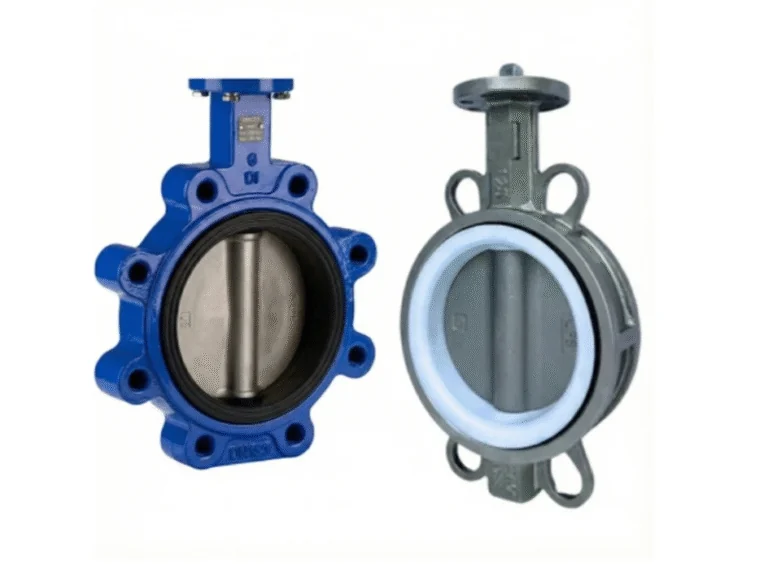
Butterfly valves are widely used in industrial piping systems because of their compact structure, simple operation, and relatively low installation costs. Among the available connection types, wafer-style and lug-style butterfly valves are two common choices.
Although these two valves look similar and serve similar flow-control purposes, their body designs and installation methods are different. These differences can affect pipeline maintenance, installation requirements, and overall project costs.
Understanding how wafer and lug-style butterfly valves work can help engineers, contractors, and purchasing teams select the right option for their piping systems.
1. What Is a Wafer-Style Butterfly Valve?
A wafer-style butterfly valve has a compact, thin body that fits between two pipe flanges. Long bolts or threaded studs pass through the flanges and secure the valve in position. The valve itself does not have separate threaded mounting holes for each flange.
This design makes wafer butterfly valves relatively lightweight and easy to install. They also require less space than some other valve connection types, making them suitable for piping systems with limited installation room.
Wafer-style butterfly valves are commonly used in:
- Water supply and distribution systems
- HVAC and cooling water pipelines
- Irrigation systems
- General industrial fluid handling
One important limitation is that a standard wafer valve relies on both pipe flanges to hold it in place. Therefore, it is generally not suitable for dead-end service where one side of the pipeline needs to be disconnected while the other side remains pressurized.
2. What Is a Lug-Style Butterfly Valve?
A lug-style butterfly valve has threaded holes or lugs around its body. Each pipe flange can be bolted directly to the valve using separate fasteners.
Unlike the wafer design, the two flange connections are independent. This allows maintenance teams to remove piping from one side without necessarily removing the entire valve from the pipeline.
For this reason, lug-style butterfly valves are often selected for systems that require more flexible maintenance arrangements.
Common applications include:
- Water and wastewater treatment plants
- Chemical processing systems
- Industrial water circulation
- Marine piping systems
- General process pipelines
Some lug-style designs also support dead-end service. However, this depends on the valve’s construction, pressure rating, seat design, and manufacturer’s specifications. Buyers should confirm these requirements before installation.
3. Wafer vs. Lug Butterfly Valves: Key Differences
Both designs use a rotating disc to control fluid flow. However, their connection structures create several practical differences.
| Comparison Factor | Wafer-Style | Lug-Style |
| Body design | Slim body with alignment holes | Body with threaded lugs |
| Installation | Clamped between two flanges | Bolted independently to each flange |
| Weight | Generally lighter | Generally heavier |
| Initial cost | Usually lower | Usually higher |
| Maintenance | Less flexible for one-sided removal | More convenient for one-sided maintenance |
| Dead-end service | Generally unsuitable | Possible with an approved design |
| Space requirements | Compact | Requires clearance for individual bolts |
The main difference is not how the valve controls flow, but how it connects to the pipeline.
For standard pipeline installations, a wafer valve may be sufficient. For systems that require independent flange connections or more flexible maintenance, a lug valve may be a better option.
4. Installation and Maintenance Considerations
Installation requirements should be considered before selecting either valve type.
For a wafer butterfly valve, installers need to position the valve between two aligned pipe flanges. The bolts must be tightened evenly to provide proper support and avoid damaging the valve body or seat.
The pipe flanges should also have enough clearance for the valve disc to rotate freely. Incorrect alignment or insufficient clearance can affect valve operation and sealing performance.
Lug-style butterfly valves offer a different installation arrangement. Each flange connects to the valve body independently, so installers can use separate fasteners on both sides.
This structure can simplify certain maintenance tasks. For example, when downstream equipment needs inspection or replacement, a properly rated lug valve may remain installed while the downstream pipe section is removed.
However, the pipeline must be safely isolated and depressurized before maintenance. A lug connection alone does not guarantee safe isolation under every operating condition.
5. Which Butterfly Valve Should You Choose?
There is no universal answer. The right choice depends on the pipeline layout, operating conditions, and maintenance requirements.
Choose a wafer-style butterfly valve when:
- The pipeline uses two standard flanges.
- Installation space is limited.
- Lower initial equipment costs are important.
- The valve does not need to support dead-end service.
- The pipeline layout allows both sides to be disconnected during maintenance.
Choose a lug-style butterfly valve when:
- Independent flange connections are required.
- Downstream equipment needs regular removal or inspection.
- The pipeline design requires greater maintenance flexibility.
- Approved dead-end service is part of the system requirements.
Before placing an order, buyers should also check the nominal valve size, pressure class, operating temperature, fluid characteristics, and applicable flange standards.
6. Other Factors to Consider When Purchasing Butterfly Valves
The body connection is only one part of valve selection. Material compatibility and sealing performance are equally important.
For example, ductile iron bodies are commonly used in general water applications because of their strength and cost efficiency. Stainless steel may be more suitable for corrosive environments. Seat materials such as EPDM, NBR, and PTFE also have different chemical and temperature resistance properties.
The disc material, stem design, and operating method should match the actual working conditions. Manual lever handles may be sufficient for smaller valves, while larger valves or automated systems may require gear operators, pneumatic actuators, or electric actuators.
Conclusion
Wafer and lug-style butterfly valves share the same basic flow-control principle, but their connection designs serve different installation and maintenance needs.
Wafer valves are generally more economical and compact, making them suitable for standard pipeline applications. Lug valves offer independent flange connections and greater maintenance flexibility, especially when one-sided pipeline removal is required.
The best choice depends on the actual operating environment rather than price alone. Buyers should review the technical specifications and confirm service requirements before selecting a valve.
For a closer look at their structural differences and installation features, view more about wafer and lug-style butterfly valves.
