

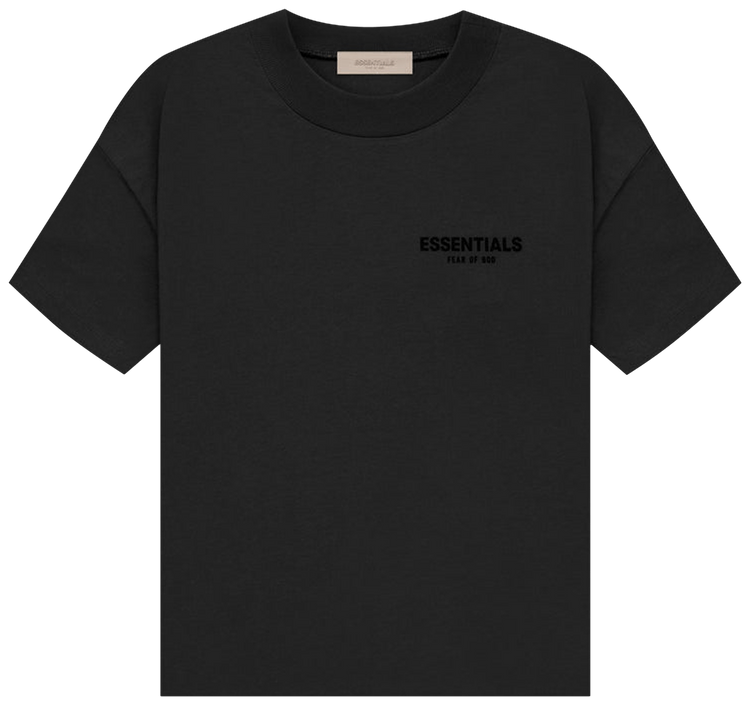
The fiftieth wash is roughly where a cotton tee stops being a guess. By then you know about the neckline, which is either still lying flat on your collarbone or has gone wavy, sort of like a rubber band left in a hot car, and that’s honestly what people clock long before a faded color. Tees at Essentials Clothing USA sit in the $75 to $89 range right now, down from $280, which is enough money to care how one ages without being enough to baby it.
And the part that wears out isn’t the fabric, which surprises people. Cotton jersey takes a beating. It’s edges and attachments that tire early: collar, hem, chest print.
Why the collar quits before the fabric does
A ribbed collar is knit a lot tighter than the body, which is the only reason it keeps shape, and also, unfortunately, the exact part you stretch every time you haul the shirt over your head. Do that a few hundred times, add an afternoon of it hanging wet off a hook, and the stitching holding that rib on gives up gradually. It doesn’t tear. It waves, and once it’s waving it waves forever.
Which you can slow right down for nothing, if you can break the habit of pulling a shirt off by the collar. Hem first, up over the head, like a sweater. Wet ones I’d hang by the shoulders, since soaked cotton is heavier than it looks and gravity hunts for the weakest seam.
Those little fuzzy balls under the arms
They come from friction, basically, which is a boring answer but there it is. Short cotton fibers rub against themselves, usually with help from a bag strap, and they ball up. Blends do it a bit differently, though. The FAQ on the site mentions a little polyester mixed into the cotton on some pieces for stretch and shrink resistance, and because polyester fiber is stronger it grips those pills instead of shedding them the way plain cotton will.
So wash it inside out. That’s the whole reason the line exists on a care label, and I’d bet it’s the one people ignore most, when all it does is shift the rubbing to the side nobody looks at.
What your machine actually means by cold
Cold on most American washers is just whatever’s coming out of the tap, somewhere in the 60s or low 70s°F depending on the month, and that’s fine. Heat is the problem. Warm fibers relax, the drum agitates them while they’re relaxed, and they come back shorter more or less permanently, because yes, you can tug a damp shirt into some of its length, but never all of it. Which is why I’d treat cold as a rule, not a preference.
| Step | What to do | What it protects |
| Sorting | Wash with like colors | Stops a dark brown tee clouding a white one |
| Water | Cold, off the tap | Length and width, since heat shrinks cotton |
| Loading | Inside out | Pushes pilling to the hidden face |
| Bleach | Skip it | Dye on the darks, fiber strength everywhere |
| Drying | Hang, weight on the shoulders | The collar rib, and shrink again |
| Pressing | Low iron, inside out | Printed or raised chest logos |
Pretty much all of that is on the product pages already. What isn’t is how much slack cotton gives you for ignoring it, and honestly, not a lot. One hot wash, fine. A habit of them, no.
About the dryer, which I’d mostly skip
Heat and tumbling age a tee faster than anything else you’re likely to do to it, and shrinking is almost the lesser issue. What it really does is drag short fibers out of the knit — that fluff in the lint trap is your shirt, in powder form — so after forty-odd cycles on high, a real piece of it has gone down the vent.
Line drying is slower and leaves cotton stiffer than most people like. I’d still do it. Want it soft? Take it down a little damp and wear it for an hour, since it finishes drying on you. One cheat I’ll own up to: a short spin on air fluff, no heat, which loosens it without cooking anything.
Hems, prints, and the year-two surprises
Hems are sneakier. Nobody’s ever watching when the bottom of a boxy tee gets chewed up, but it happens, on belt buckles mostly, or the desk drawer corner you brush past all day. A thread pulls, then it runs, and a run on a cover-stitched hem won’t quit on its own, so, small scissors, flush, same day you notice. Don’t tug it. That’s how a snag becomes a hole.
Prints are a heat thing, really, not a washing thing. One pass with an iron that’s too hot and the print’s hazed over, and nobody can fix that. Low iron, inside out, done. The Essentials T-Shirts lineup goes plain unisex blacks, the dark brown, the classic gray, and the bigger the graphic on the chest, the more I’d keep an iron off that panel altogether. Embroidery doesn’t crack, by the way. It loosens, threads creeping free at the edges, and no, there’s no tidy repair for that one.
Fifty washes, and how fast you get there
Run the math backwards. Wear a shirt once a week, launder it every time, and you’re at fifty cycles inside a year, which isn’t much of a lifespan for a $75 tee. Keep three going and those fifty washes stretch over three years, so collar stretch and fiber loss get split three ways.
There’s a second argument for a spare, nothing to do with laundry: colors here don’t reliably come back once a run sells through. So the dark brown you were eyeing in October? Might not be listed come April.
Worth settling the fit before the first wash, though, since that exchange window of theirs only covers a piece that’s still unworn, unwashed and tagged, inside thirty days, and even then you’re getting credit or a swap rather than cash. So try it on over dry carpet first, arms up, and look at where that shoulder seam lands.
Key Takeaways
|
Fifty washes isn’t a warranty, obviously. It’s a handy number to keep in your head while you’re at the machine wondering whether cold is worth the extra thought. It is. A tee handled gently for a year reads as lived in. One that’s been cooked just reads as done.
