

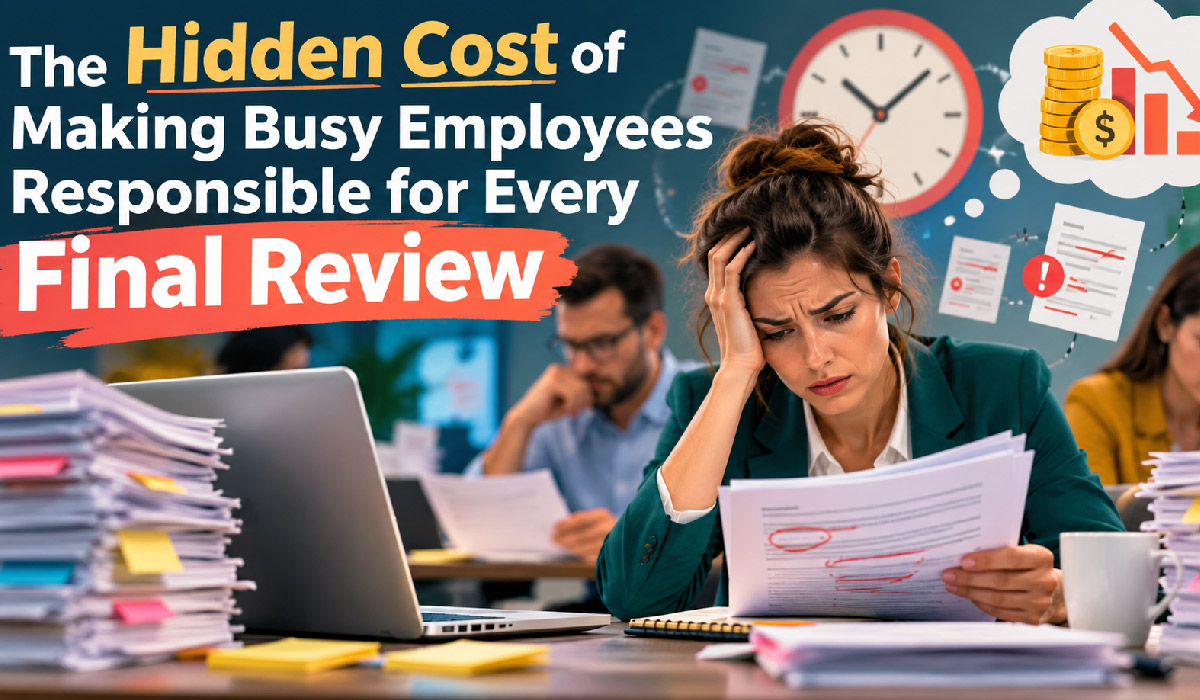
Making busy employees responsible for every final document review drains company profits by pulling skilled staff away from high-value work while failing to catch critical errors. When organizations assign proofreading to whoever happens to have free time before a deadline, they treat quality assurance as an informal chore rather than an essential operational discipline. Account managers, software engineers, and senior directors end up spending their afternoons hunting typos and formatting bullet points instead of closing deals or developing products. Shifting away from ad-hoc internal reviews protects team capacity, ensures consistent document quality, and preserves your company’s professional reputation.
Every commercial organization depends on clear written communication to win bids, retain clients, and coordinate operations. Yet, when project timelines compress, the final review is often rushed through tired eyes right before a file ships. Employees skim pages with divided attention, hoping their intuition catches every mistake. This informal process creates an expensive cycle of missed errors, late-stage corrections, and employee burnout that quietly erodes operating margins.
Why Informal Quality Control Drains Billable Capacity
Assigning document reviews to internal team members reduces billable capacity because it forces your highest-compensated professionals to spend non-billable hours on basic mechanical tasks. When a company lacks a dedicated editorial review process, proofreading tasks inevitably fall on project leads, creative directors, or department heads who should be focusing on revenue generation.
Consider what happens during a standard proposal cycle. A senior strategist billed out at two hundred dollars an hour spends three hours proofreading a fifty-page response document. Those three hours produce zero strategic value for the client and generate zero billable revenue for the firm. Multiplying those lost hours across an entire year reveals tens of thousands of dollars in wasted labor per employee, capital that could fund business development or strategic hiring.
Furthermore, context switching damages overall workday velocity. Proofreading requires quiet, sustained concentration that conflicts directly with the fast-paced coordination work expected of modern managers. When an account director stops answering client emails to review an internal deck, their core responsibilities stall. Re-establishing deep focus after an hour of proofreading takes considerable mental effort, leaving workers feeling frazzled and behind schedule.
The friction deepens when documents require cross-departmental reviews. Routing a draft through three separate managers without centralized oversight creates conflicting comments, duplicated effort, and endless email chains. Projects sit idle in internal review queues for days, delaying campaign launches and frustrating clients who expect prompt turnaround times.
How Cognitive Blindness Traps Internal Reviewers
Internal teams struggle to catch mistakes in their own work because the human brain experiences a well-documented cognitive bias known as mind-reading anticipation. When an author or close collaborator spends days drafting a document, their mind becomes overly familiar with the subject matter.
During a self-review or peer review, the brain perceives internal intent rather than the literal characters displayed on the page. The mind automatically bridges broken syntax, skips missing words, and ignores repeated syllables because it processes the concept rather than the text. Even the most meticulous professionals routinely miss glaring errors in documents they helped create simply because their brains anticipate the narrative before their eyes read the words.
Expecting coworkers to act as objective safety nets fails for the same reason. When team members sit in the same planning meetings, share the same corporate shorthand, and understand project context, their brains share the author’s familiarity bias. They understand what the document is trying to say, which blinds them to confusing phrasing that an external reader would stumble over immediately.
Additionally, internal staff members rarely possess specialized training in mechanical proofreading or style sheet enforcement. They might catch an obvious spelling error, but they consistently overlook inconsistent capitalization, misaligned decimal tabs, and broken cross-references. Relying on casual coworker skims provides a false sense of security while leaving serious structural defects in place.
The Operational Risk of Inconsistent Brand Messaging
Allowing multiple employees to review public-facing assets produces inconsistent brand messaging because each contributor applies their own personal writing habits and grammatical preferences. Without a centralized editorial standard, external deliverables project an uncoordinated and disjointed corporate voice.
One manager might prefer the Oxford comma, while another deletes it. A technical director might capitalize departmental terms that marketing leaves lowercase. When these conflicting styles appear across different pages of a single proposal or annual report, the deliverable looks messy and disorganized. Prospective clients evaluate that inconsistency as a warning sign of deeper operational negligence.
Partnering with dependable providers of business proofreading services or collaborating with specialized editorial quality assurance teams eliminates internal review bottlenecks, enforces strict house style guidelines, and protects company reputation. Bringing dedicated external reviewers into your document workflow ensures that every outward-facing asset reflects seamless professionalism without pulling internal talent away from core commercial goals.
Furthermore, execution errors carry high financial stakes in formal procurement environments. Enterprise evaluation panels routinely disqualify bids that contain formatting blunders, mathematical discrepancies, or missing compliance sections. Losing a multi-million-dollar contract because an overworked team member missed a typo in a pricing schedule is an expensive operational failure that no business can afford.
Why Automated Grammar Checkers Cannot Solve the Problem
Many business leaders assume that installing automated grammar extensions and AI tools eliminates the need for manual proofreading. While software tools excel at catching basic misspellings and obvious subject-verb disagreements, they remain remarkably blind to context, tone, and factual consistency.
Algorithmic tools evaluate sentences against rigid statistical rules rather than human communicative intent. A software tool will not flag using “statute” instead of “statue” or “pubic” instead of “public” because both words exist in the dictionary. It cannot confirm whether an event date mentioned on page three matches the schedule on page twelve, nor can it identify that an email address on the contact page is missing a domain extension.
Worse, automated grammar tools frequently degrade persuasive business writing. Algorithms tend to standardize sentence structures into generic, bland corporate prose, stripping away the distinct energy that makes marketing copy and executive thought leadership compelling. Relying exclusively on automated checkers produces flat, monotonous writing that fails to connect with clients.
Software also fails to verify layout alignment and functional elements. An algorithm cannot tell you if a table border is clipped, if an image caption contradicts the graphic, or if a hyperlinked tracking URL routes to a broken page. Catching these critical errors requires perceptive human eyes that evaluate design, messaging, and functionality simultaneously.
Protecting Employee Morale and Workday Balance
Eliminating informal proofreading duties protects employee morale by removing a chronic source of frustration, late-night anxiety, and burnout. High-performing professionals take pride in their work and want to contribute at their highest skill level, not spend evenings hunting misplaced commas.
When organizations force staff to juggle proofreading on top of full workloads, the review pass usually happens after hours. Team members stay late at the office or work from home late into the night, straining to catch errors while mentally exhausted. This constant overtime erodes employee satisfaction and contributes to high staff turnover among top performers.
Establishing a clear division of labor communicates institutional respect for your team’s time. When writers, designers, and project managers know that a dedicated editorial partner will handle final polish and quality assurance, they work with greater confidence and speed. They can focus entirely on creative strategy and customer engagement, knowing an objective safety net catches execution errors before work goes live.
Removing this administrative burden also accelerates project velocity. Instead of files sitting in multiple review inboxes waiting for busy colleagues to clear their schedules, assets move through a structured, predictable editorial pipeline. Projects launch on time, client deliverables ship with complete accuracy, and internal teams maintain their momentum.
Conclusions
Treating document proofreading as an informal side duty leaves your business vulnerable to lost billable hours, embarrassing public blunders, and employee burnout. When organizations ask busy professionals to catch their own errors under tight deadlines, cognitive bias and mental fatigue ensure that costly mistakes slip straight through to prospective buyers.
Adopting an intentional, structured quality assurance process restores operational efficiency to your company. By removing proofreading duties from core revenue generators, standardizing brand voice rules, and relying on dedicated editorial review, you protect your gross profit margins and elevate your corporate standing.
Investing in specialized review support ensures your outgoing communications match the quality of your services. When your proposals, reports, and marketing assets communicate with total clarity and mechanical accuracy, your audience can focus entirely on your core value proposition, driving sustainable business growth for years to come.
