

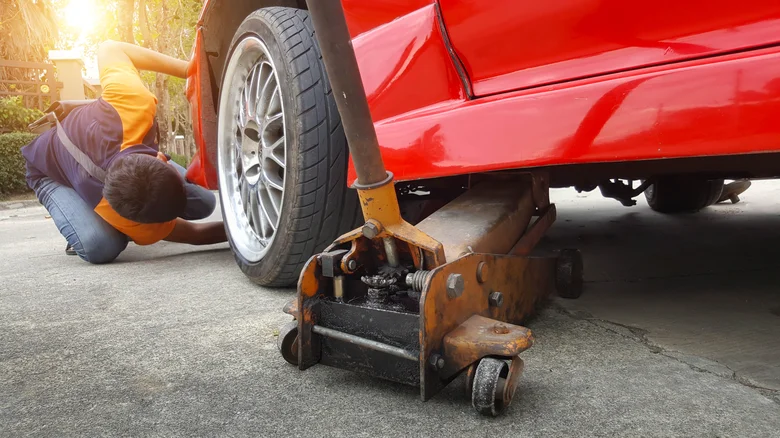
Every year, vehicles fall from improperly used jack stands in garages across the country. Some result in damaged trucks. Others result in injuries that sideline mechanics for months. The incidents that make it into safety reports share a common thread: they were almost always preventable, and they almost always happened because someone skipped a step they had done dozens of times before without consequence.
Pickup trucks present specific challenges that passenger cars do not. Their weight distribution is different. Their frames are designed for payload and towing, not necessarily for predictable lift points during service. The gap between a stand that holds and one that fails is often no more than a few inches of placement error or a surface that looked level but was not.
This is not a guide for beginners stumbling through their first oil change. It is written for people who already work on trucks regularly — whether that means weekend maintenance in a home garage or daily service in a professional shop — and who understand that the mistakes most likely to cause serious damage are the ones made out of habit, not ignorance.
Why Jack Stand Errors on Trucks Are Different From Passenger Vehicles
A truck jack stand is not interchangeable with the equipment used for sedans and compact SUVs. Pickup trucks carry significantly more dead weight at the frame, often have lifted suspensions that shift the center of gravity, and present longer wheelbases that affect how load distributes across support points. When a stand shifts or tips under a light passenger car, the drop is manageable. When the same thing happens under a three-quarter-ton pickup, the results are structurally devastating — and dangerous to anyone nearby.
Professionals who work on trucks regularly understand this distinction, and many of them reference product categories specifically designed for truck capacity and geometry when sourcing equipment. Selecting the right truck jack stand is the baseline requirement, and everything after that depends on using it correctly.
Load Ratings Are Not Interchangeable Across Vehicle Classes
One of the most common errors professionals see is the use of jack stands with insufficient load ratings for the actual vehicle being lifted. Mechanics who primarily work on passenger vehicles often have stands in their shop that perform perfectly for that class of work. When a half-ton or heavy-duty pickup comes in, those same stands may be used without any consideration of whether the rating is appropriate.
The result is not always immediate. A stand may hold under a truck through multiple service appointments before the stress accumulates enough to cause failure. This gradual fatigue is harder to detect than sudden collapse, and it creates a false sense of security that actually increases risk over time.
Mistake One: Placing the Stand on an Unprepared Surface
Surface preparation is treated as an afterthought in most garage environments. The floor gets used as-is, regardless of whether it is level, whether there is debris underneath the stand base, or whether the concrete has settled unevenly over time. Mechanics who have been working in the same space for years often stop noticing these conditions entirely.
A stand placed on a floor with even a slight slope will migrate under load. Not dramatically, not immediately, but enough that by the time the truck has been accessed from underneath and repositioned, the stand is no longer exactly where it was placed. On a heavy pickup, that migration can mean the stand has moved from a stable support point to a compromised one.
Concrete Is Not Always Flat, Even When It Looks That Way
Older garages and shop floors settle over years of use, vehicle traffic, and temperature changes. What appears visually flat may have a gradual grade that is only detectable with a level. Many professionals who have been caught off-guard by stand movement on familiar floors describe the same thing: they had worked in that spot for years without incident, and then one day the stand walked.
Using a level before positioning stands — particularly when working on heavy trucks — is a habit that takes seconds and consistently prevents this category of error.
Mistake Two: Using the Wrong Contact Point on the Frame
Pickup truck frames are not uniform in their strength. There are sections designed to bear vertical load and sections that are not. When a stand is placed under a structural cross-member, the load distributes correctly. When it is placed under a body panel, a rusted section of the frame rail, or a component not rated for that kind of stress, the truck can shift, the stand can punch through thin metal, or both.
Owner’s manuals and service documentation identify correct lift points for a reason. Those points were determined through engineering, not convention. In professional shops, referencing OEM documentation for each truck model before lifting is standard practice — particularly for newer trucks where frame geometry has changed from previous generations.
Rust Changes Everything About Frame Integrity
Trucks operated in regions where roads are salted during winter months carry a specific risk that mechanics in other parts of the country may not account for. Frame rust is not always visible from above. It may look manageable from a distance but be compromised structurally in ways that only become apparent under load.
Experienced mechanics working in northern states and rust-belt regions have developed the habit of inspecting contact points before placing any equipment. They use lights, mirrors, and physical testing before committing a stand to a position. This adds time to a job, but it also prevents the kind of catastrophic frame failure that totals a truck during a routine service.
Mistake Three: Relying Solely on the Floor Jack While Working
A hydraulic floor jack is a lifting tool. It is not a support tool. This distinction is clearly stated in every floor jack manufacturer’s documentation and reinforced by organizations like OSHA, which addresses jack safety in its general industry standards. Despite this, trucks are regularly worked on while supported only by the floor jack, with stands either not deployed or placed in a secondary role.
Hydraulic systems can fail, seals can degrade, and internal bypasses can cause slow drops that are imperceptible until the vehicle has descended far enough to cause a problem. A truck supported entirely by a floor jack during extended work represents an active risk that no amount of experience or familiarity with the equipment changes.
The Stand Is the Primary Safety System, Not the Secondary One
This framing matters because it affects behavior. Mechanics who think of the stand as a backup tend to position it carelessly, trusting the jack to do the real work. Mechanics who treat the stand as the primary support — and the jack as the tool used only to reach that support position — behave differently. They check stand placement before releasing the jack. They verify stability before going underneath. They do not reposition components while the truck is at height without re-confirming stand contact.
Mistake Four: Using Mismatched Stand Heights on Uneven Work
When a truck needs to be raised higher on one side than another — during differential work, for example, or when a suspension component requires angle access — some mechanics stack stands or use mismatched equipment to achieve different heights. This is a practice that professional shops treat as a serious procedural violation.
A truck jack stand is engineered to operate within its designed height range. Stacking a stand on blocks, cribbing, or other improvised bases changes its stability geometry entirely. The base-to-height ratio that makes a stand safe at its rated extension becomes inadequate when additional height is added through improvised means.
Mistake Five: Skipping the Stability Test Before Going Under
Once a truck is on stands, the correct procedure is to physically test stability before any person or equipment goes underneath. This means applying lateral and longitudinal pressure to the vehicle to confirm that the stands are holding without movement. It takes roughly ten seconds and is skipped with enough regularity that it appears in almost every post-incident review as a contributing factor.
What a Stability Test Actually Evaluates
The test is not just about whether the truck falls. It confirms that each stand has made full, correct contact with the vehicle and that the truck is not balanced in a way that allows it to rock toward any corner. Trucks with heavy toolboxes, snowplows, or aftermarket equipment have asymmetrical weight distributions that standard placement assumptions do not always account for. A stability test catches these conditions before they become dangerous.
Mistake Six: Ignoring Stand Condition and Service Life
Jack stands are tools that wear. The ratchet mechanisms that hold height can wear down. Welds can develop micro-fractures. Bases can develop hairline cracks. None of these conditions are visible during casual inspection, and most shops do not have a formal replacement schedule for stands the way they might for other safety-critical tools.
Professionals who avoid this mistake treat stands as consumables with a realistic service life and inspect them on a regular basis — not just before each use, but as part of a periodic equipment audit. Stands that have been dropped, overloaded, or used near their maximum rated capacity are retired rather than returned to service.
Mistake Seven: Working Alone Without Communication Protocol
Working under a vehicle without another person knowing the work is happening is an operational risk that extends beyond jack stand safety. If a stand shifts and the truck drops while a mechanic is underneath alone, the outcome depends entirely on whether someone checks on them within an appropriate timeframe. In professional shops, this is addressed through communication protocols. In home garages, it is rarely considered at all.
The mechanics who are most consistent about this are those who have either witnessed or heard direct accounts of what happens when it goes wrong. Experience — even secondhand — changes the habit.
Mistake Eight: Positioning Stands Under Aftermarket Components
Aftermarket lift kits, running boards, skid plates, and frame reinforcements change the contact geometry of a truck. A stand position that would be correct for a factory-spec truck may rest against an aftermarket component rather than the factory frame point it appears to be contacting. The aftermarket component may not be welded or bolted with the same load-bearing intention as the frame itself.
Shops that work frequently with modified trucks develop specific inspection steps for each common aftermarket configuration they encounter. They do not assume that the contact point visible from underneath is the same structural point it would be on a stock vehicle.
Mistake Nine: Assuming All Pavement Is Acceptable
Driveway work is common, and asphalt and paver surfaces create stand stability problems that concrete does not. Asphalt softens in warm weather and can allow stand feet to sink slowly under sustained load. Paver surfaces have joints that can cause stands to shift when pressure is applied from an angle. Neither surface provides the same support as a level concrete shop floor.
Mechanics who regularly work outdoors on trucks use load-spreading base plates or work boards under their stands, and they avoid outdoor lifting during peak heat when asphalt surfaces are most compromised.
Mistake Ten: Dismissing Near-Misses as Non-Events
A near-miss — a stand that shifted but caught before anyone was hurt, a truck that rocked but settled back — is treated in professional safety culture as a reportable event that demands a procedural review. In informal settings, the same incident is often treated as a lucky outcome and forgotten. This difference in response is one of the clearest distinctions between shops with strong safety records and those without.
Every time a truck shifted on a stand without consequence, there was a reason it shifted. Identifying that reason and correcting it before the next lift is the habit that professional mechanics describe when explaining why they have long careers without serious incidents.
Closing Thoughts
The mistakes covered in this article are not theoretical. They are the patterns that appear repeatedly in shop incident reports, safety training programs, and conversations among mechanics who have been doing this work long enough to have seen what can go wrong. Most of them share a common origin: the assumption that familiarity is the same as safety.
Trucks are heavy, uneven in their weight distribution, and often modified in ways that change how they respond to being lifted. The equipment and methods used to support them during service need to account for those realities every single time, not just when the job feels unfamiliar. The mechanics who consistently avoid serious incidents are not the ones with the most experience. They are the ones who apply careful, deliberate process regardless of how many times they have done the same job before.
Slowing down before going underneath a truck costs seconds. Getting it wrong costs much more than that.
