

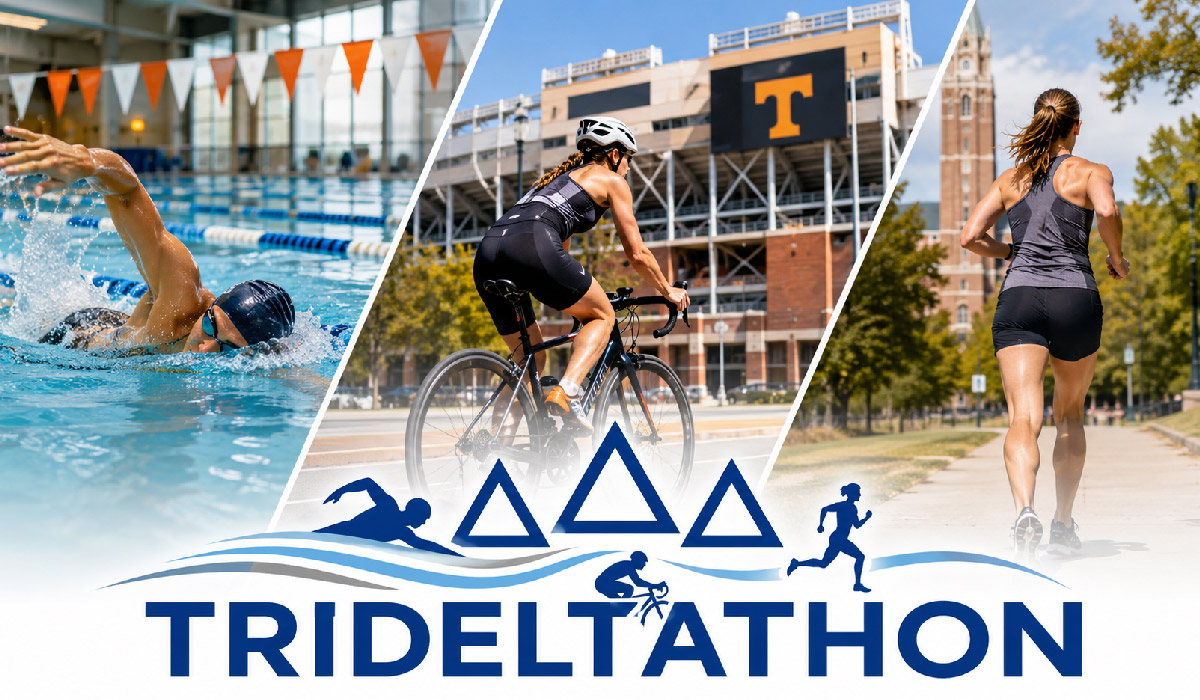
TriDeltathon has been an important name in the Knoxville racing community for many years. The event became known for combining swimming, cycling, and running around the University of Tennessee campus. Unlike many outdoor triathlons, its swimming stage took place in a pool, which gave the race a distinctive format and made it more approachable for many local athletes.
The event also had a purpose beyond competition. Delta Delta Delta sorority used the race to bring students, athletes, volunteers, and community supporters together while raising money for children’s causes in East Tennessee. This charitable connection became an important part of the event’s identity.
The traditional TriDeltathon no longer operates in the same swim-bike-run format. Its spirit, however, continues through TriDeltaRUN, a 5K associated with Delta Delta Delta and Race Day Events. This guide covers the history, original course, charity work, transition, and modern race.
What Is TriDeltathon?
TriDeltathon was a short-distance triathlon held in Knoxville, Tennessee, with strong ties to the University of Tennessee. It followed the familiar triathlon order of swimming, cycling, and running. The shorter distances made the race suitable for people who wanted a multisport challenge without entering a much longer Olympic-distance or endurance event.
One feature that made TriDeltathon unusual was its indoor swimming stage. Competitors started with a 400-meter swim at the University of Tennessee Student Aquatic Center. They then completed a six-mile bicycle ride before finishing with a three-mile run through the university area.
TriDeltathon was also closely connected with Delta Delta Delta, commonly known as Tri Delta. The event mixed fitness with fundraising and community service. Over the years, it became familiar to students, local athletes, relay teams, volunteers, and supporters of children’s causes in East Tennessee.
When and How Did TriDeltathon Begin?
TriDeltathon is reported to have started in 1984, when triathlon was still developing into a more familiar sport across the United States. Bringing swimming, cycling, and running into one short event offered something different from the traditional road races that were already popular with recreational athletes.
Delta Delta Delta members at the University of Tennessee became central to the race and its fundraising mission. A university environment was well suited to the idea because students could participate as competitors and volunteers, while local athletes and businesses could also become involved. The event gradually developed into an annual Knoxville tradition.
Its longevity became one of its strongest features. The planned 2020 race was promoted as the 36th year of TriDeltathon. Organizers also described it as the country’s oldest running pool triathlon. Its long history helped the event develop an identity that extended beyond a single race day.
Why TriDeltathon Became a Knoxville Race Tradition
Several features helped TriDeltathon become recognizable in Knoxville. The first was its close connection with the University of Tennessee. Rather than taking place on an isolated course, the race used university facilities, campus roads, and nearby areas that were familiar to students and residents.
Its short format was another important advantage. Full-distance triathlons can require months of training and specialized preparation. TriDeltathon still challenged athletes in three disciplines, but the distances were manageable enough to attract beginners, students, relay teams, and experienced competitors looking for a faster event.
The charitable purpose gave people another reason to participate. Athletes were not simply competing for finishing times or awards. Their involvement also helped support local children’s causes. The combination of sport, university life, volunteering, and fundraising gave TriDeltathon a community character that helped it remain relevant for decades.
The Traditional TriDeltathon Race Format
The traditional TriDeltathon followed a compact sprint-style course. Athletes began with a 400-meter pool swim before moving into the cycling stage. The bicycle course covered about six miles around the University of Tennessee campus and nearby roads, including the Neyland Drive area. Competitors then finished with a three-mile run through the campus area.
Although these distances were shorter than many larger triathlons, completing them consecutively created a real physical challenge. Competitors had to adjust quickly from swimming to cycling and then from cycling to running. These changes are known as transitions and can strongly affect how an athlete feels during a race.
The short distances also encouraged faster racing. Experienced athletes could push their pace, while newcomers could focus on completing all three stages successfully. This balance helped TriDeltathon work as both a competitive event and an introduction to multisport racing.
What Made TriDeltathon’s Pool Swim Different?
The 400-meter pool swim was one of TriDeltathon’s most recognizable features. Instead of entering a lake, river, or other open-water environment, competitors swam at the University of Tennessee Student Aquatic Center. This removed concerns such as waves, unclear water, changing currents, and large open-water group starts.
The traditional course used eight 50-meter lanes. Swimmers entered individually at short intervals and moved through the pool by changing lanes at the end of each length. Participants were seeded according to their estimated 400-meter swim times, allowing quicker swimmers to start ahead of people expecting a slower time.
A controlled pool did not make the swimming stage effortless. Athletes still needed good pacing and enough energy for cycling and running afterward. However, the predictable environment made the race attractive to people who were comfortable swimming in pools but less confident about open-water competition.
Individual Racers and Relay Teams
TriDeltathon allowed athletes to experience the event in more than one way. Individual competitors completed the entire course themselves. They had to swim 400 meters, cycle six miles, and run three miles, making preparation across all three disciplines important before race day.
Relay participation provided another option. Team members could divide the different parts of the course instead of requiring one athlete to complete everything. A strong swimmer, for example, could handle the pool section while teammates completed the cycling and running portions. This format helped friends and groups participate together.
The broad participation rules reflected the community nature of the event. The 2020 race information listed individual participation for ages 10 through 99 and relay participation for ages 7 through 99. This wide range showed that TriDeltathon was intended to welcome more than highly trained adult triathletes.
TriDeltathon’s Connection With the University of Tennessee
The University of Tennessee was an important part of the TriDeltathon experience. The Student Aquatic Center provided the setting for the opening swim, while the bicycle and running portions used the campus and surrounding Knoxville roads. As a result, the university was not simply a background location but a major part of the course itself.
Students also had opportunities to become involved beyond racing. A community event requires people to help with registration, course directions, transitions, athlete support, setup, and other race-day responsibilities. This gave university volunteers a practical way to support the fundraiser and interact with the wider Knoxville community.
The campus setting also gave TriDeltathon a clear local identity. Participants could associate the race with familiar university landmarks and roads. The modern TriDeltaRUN remains close to this setting, helping preserve the relationship between the event, the university community, and Knoxville.
The Role of Delta Delta Delta in TriDeltathon
Delta Delta Delta, usually called Tri Delta, played an important role in the development and charitable identity of TriDeltathon. The sorority’s involvement connected the race with student service and fundraising rather than allowing it to function only as an athletic competition.
Organizing an event of this kind involves many responsibilities. Registration, volunteers, promotion, fundraising, course preparation, communication, and participant support all need coordination. Working with professional race organizers and community partners helped turn the idea into an event that athletes could return to year after year.
The race also provided students with an opportunity to connect with people outside their immediate university groups. Local athletes, families, businesses, charities, and volunteers could all become involved. Tri Delta’s continuing connection with the newer TriDeltaRUN shows that community fundraising remains an important part of the tradition even though the race format has changed.
The Charity Purpose Behind TriDeltathon
Charitable giving has always been central to the meaning of TriDeltathon. Race proceeds have been associated with helping children’s causes in East Tennessee, particularly through East Tennessee Children’s Hospital and Camp Eagle’s Nest. This gave participation a purpose beyond completing a personal athletic challenge.
The importance of the fundraising mission became especially clear when the planned 2020 TriDeltathon was canceled. Registered participants were given options concerning their entry fees, including allowing the money to remain as a donation supporting East Tennessee Children’s Hospital. Refund and transfer choices were also available.
This arrangement showed that the event’s charitable work was not dependent entirely on athletes crossing a finish line. Even when circumstances prevented the race from taking place, participants could still contribute to the cause. That long-term combination of physical activity and community support became one of TriDeltathon’s defining characteristics.
TriDeltathon and Camp Eagle’s Nest
Camp Eagle’s Nest is closely connected with the charitable story surrounding the TriDeltathon tradition. The summer camp serves children dealing with cancer and certain serious blood disorders. It aims to provide a supportive environment where young people can experience enjoyable camp activities while receiving appropriate care and supervision.
For children who regularly deal with medical appointments and treatment, a camp experience can provide an important change in daily routine. Activities can give campers opportunities to socialize, have fun, build confidence, and spend time with other young people who may understand some of the challenges they face.
Fundraising events can help make programs of this type possible and also increase community awareness. Through TriDeltathon and the modern TriDeltaRUN, athletes are connected with a cause beyond their own performance. Each registration or contribution becomes part of a wider effort supporting children and their families.
What Happened to the Original TriDeltathon?
The traditional TriDeltathon reached a major turning point in 2020. That year’s race was scheduled for April 19, but the event was canceled after the University of Tennessee moved classes online during the COVID-19 disruption. This meant competitors could not take part in the planned swim-bike-run event.
The original pool triathlon did not later return in the same established form. This is important for people who discover older race information online because historic pages may still describe the 400-meter swim, six-mile bicycle ride, and three-mile run even though those details do not describe the current event.
The end of the traditional format did not mean that the community and charity tradition disappeared. Instead, the event eventually moved toward a simpler running format. Understanding this distinction helps explain why searches for TriDeltathon can produce information about both a historic triathlon and a newer Knoxville 5K.
How TriDeltathon Evolved Into TriDeltaRUN
In more recent years, the TriDeltathon tradition has continued through TriDeltaRUN. Rather than requiring participants to complete swimming, cycling, and running stages, the newer event uses a 5K running format. Delta Delta Delta and Race Day Events remain connected with organizing the race.
The change makes participation simpler. A triathlon requires access to a swimming pool for training, a suitable bicycle, a helmet, running equipment, and enough preparation to move between three sports. A 5K requires much less specialized equipment and can be approached by people with a wider range of athletic experience.
Importantly, changing the race format did not remove its charitable focus. TriDeltaRUN continues the relationship with children’s causes while keeping the event near the University of Tennessee. In this way, the newer race preserves important parts of TriDeltathon’s identity while offering a more accessible form of participation.
What Is TriDeltaRUN?
TriDeltaRUN is the modern 5K connected with the history of TriDeltathon. Recent editions have taken place near UT Gardens and the University of Tennessee Agriculture Campus. Much of the route uses Third Creek Greenway, keeping runners close to the university environment that has long been associated with the event.
A 5K covers five kilometers, or approximately 3.1 miles. This distance is popular because experienced runners can race it quickly while newer participants can prepare for it without the training demands associated with a triathlon. The greenway setting also provides a different experience from running entirely on busy city streets.
The current event continues to include familiar features of community racing, such as race shirts, refreshments, overall recognition, and age-group awards. Student discounts have also been offered, strengthening its university connection. Specific schedules and registration details can change between editions.
TriDeltathon vs. TriDeltaRUN: What Changed?
The largest difference between TriDeltathon and TriDeltaRUN is the number of sports involved. The historic race required competitors to swim 400 meters, cycle approximately six miles, and run three miles. The modern event removes swimming and cycling and instead centers on a single 5K run.
This change also reduces the equipment needed. Traditional participants needed swimming gear, a bicycle, a helmet, running shoes, and preparation for transitions. Modern runners mainly need suitable footwear and clothing. Training can therefore focus on walking and running rather than developing ability in three separate disciplines.
Despite those differences, important parts of the event remain recognizable. Delta Delta Delta continues to be involved, the race remains connected with the University of Tennessee area, and charitable fundraising is still central. TriDeltaRUN can therefore be understood as a continuation of the community tradition rather than simply an unrelated replacement race.
Who Can Enjoy the Modern TriDeltaRUN?
The modern format can appeal to a broad group of participants. University students can run with friends, local athletes can use the race as part of their spring schedule, and newer runners can set a goal of completing their first 5K. Experienced competitors can also challenge themselves by racing for faster times or awards.
The reduced equipment requirement is especially helpful for beginners. Owning and maintaining a suitable bicycle can make triathlon participation expensive, while swimming can be a barrier for people without easy pool access. A running event removes both of these requirements and makes preparation more straightforward.
Participation is not limited to people chasing competitive results. Volunteers and supporters also contribute to the event’s atmosphere and fundraising purpose. This broad involvement allows the race to bring together students, athletes, families, community members, and people who primarily want to support children’s programs in East Tennessee.
How to Prepare for TriDeltaRUN
Preparing for a 5K does not need to be complicated. A beginner can start several weeks before race day with regular walk-run sessions. Running sections can gradually become longer as fitness improves, while walking breaks become shorter. Building up slowly is usually more practical than trying to cover the full distance immediately.
Participants can also practice on routes with gentle elevation changes. Third Creek Greenway and the surrounding area are not necessarily identical to a completely flat track, so some experience with rolling terrain can help runners feel more comfortable. Completing practice sessions approaching three miles can also build confidence before the event.
Race-day comfort is equally important. Participants should use familiar shoes and clothing rather than trying new equipment at the last moment. Arriving early provides time for registration, warming up, and finding the starting area. A controlled early pace can also make the final mile more manageable.
Why TriDeltathon Still Matters in Knoxville
TriDeltathon remains significant because its history represents more than the distances athletes completed. For decades, the event connected the University of Tennessee with Knoxville’s athletic community through swimming, cycling, running, student involvement, volunteering, and fundraising. Its unusual pool format also gave it a recognizable place among local multisport events.
The transition to TriDeltaRUN shows how a long-running event can change without completely losing its purpose. The modern 5K is simpler than the historic triathlon, but it continues to bring people together near the university and maintains a charitable connection with children and families in East Tennessee.
This evolution may also help the tradition reach people who would never enter a triathlon. Students, recreational runners, families, volunteers, and competitive athletes can participate in different ways. The race therefore continues to combine physical activity, community involvement, and charitable support.
Conclusion
TriDeltathon developed into a distinctive part of Knoxville’s race history through its combination of a 400-meter pool swim, six-mile bicycle ride, and three-mile run. Its University of Tennessee setting, accessible distances, relay opportunities, and Delta Delta Delta involvement helped make the event appealing to both students and local athletes.
Its charitable purpose was equally important. The event connected physical activity with support for East Tennessee children’s causes, including East Tennessee Children’s Hospital and Camp Eagle’s Nest. That community mission continued to matter even when the planned 2020 race could not take place.
Today, the traditional triathlon has given way to TriDeltaRUN, a 5K near the University of Tennessee area. Although the competitive format has changed, the central idea remains recognizable. TriDeltathon’s lasting story is one of sport, student service, local participation, and charitable support working together.
Frequently Asked Questions
What is TriDeltathon?
TriDeltathon was a charity pool triathlon connected with the University of Tennessee in Knoxville. It traditionally included a 400-meter swim, six-mile bike ride, and three-mile run while supporting children’s causes.
When did TriDeltathon begin?
TriDeltathon reportedly began in 1984 and developed into a long-running Knoxville race tradition. It became especially known for its pool-based swimming stage, University of Tennessee setting, and charitable purpose.
What were the original TriDeltathon race distances?
The traditional TriDeltathon included a 400-meter indoor pool swim, a six-mile bicycle ride, and a three-mile run. These shorter distances made the event approachable for beginners, students, relay teams, and experienced athletes.
What charity did TriDeltathon support?
TriDeltathon was connected with fundraising for children’s causes in East Tennessee, including East Tennessee Children’s Hospital and Camp Eagle’s Nest, which serves children affected by cancer and certain serious blood disorders.
Is TriDeltathon still a triathlon?
The historic swim-bike-run TriDeltathon is no longer the active race format. Its community tradition continues through TriDeltaRUN, a 5K associated with Delta Delta Delta and held near the University of Tennessee area.
You May Also Read: Fibernl: A Detailed Guide to Fiber Internet, TV, Speed, and Home Services
